
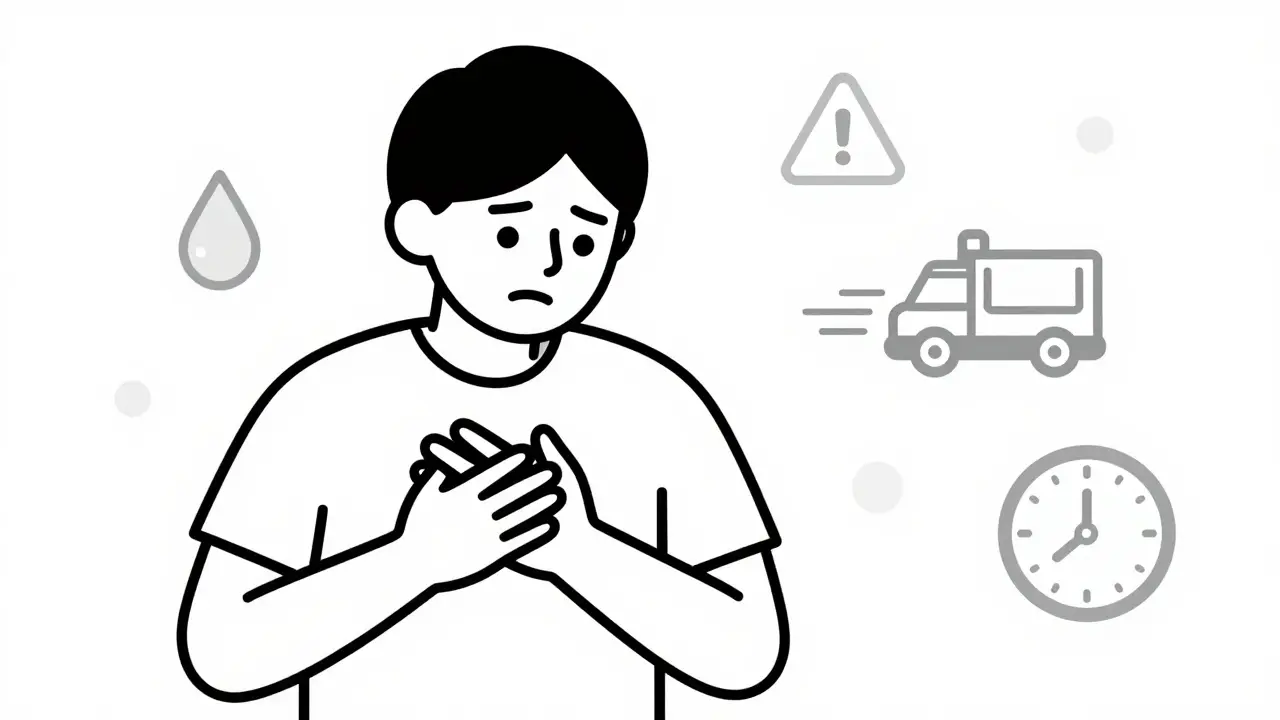
Not all chest pain is a heart attack. But some of it is-and waiting too long can cost your life. If you’re wondering whether your chest discomfort is something you can ignore or if you need to rush to the hospital, here’s what actually matters.
What Counts as Chest Pain?
Chest pain isn’t just a sharp stab or a squeezing feeling in your chest. It can show up as pressure, tightness, burning, or even just a weird heaviness. And it doesn’t even have to be in your chest. You might feel it in your left arm, jaw, neck, back, or upper belly. Some people mistake it for indigestion. Others think it’s just stress.The truth? If you’re having any new, unexplained discomfort in those areas-especially if it lasts more than a few minutes-it’s worth taking seriously. The same goes for symptoms that come with it: shortness of breath, nausea, cold sweat, dizziness, or sudden fatigue. These aren’t just side notes. They’re red flags.
According to the 2021 American Heart Association and American College of Cardiology guidelines, chest pain is defined broadly: any discomfort in the chest, shoulders, arms, neck, jaw, or upper abdomen that’s new, unusual, or persistent. And if you’re over 40, have high blood pressure, diabetes, or a family history of heart disease, your risk goes up-even if you feel fine otherwise.
When You Must Go to the Emergency Department
There’s no room for hesitation here. If you have any of these signs, call 911 right away-don’t drive yourself:- Pressure or tightness in your chest that lasts more than 5 minutes, or comes and goes
- Pain spreading to your arm, jaw, neck, or back
- Breaking out in a cold sweat for no reason
- Shortness of breath with or without chest pain
- Nausea or vomiting that comes with chest discomfort
- Lightheadedness or fainting
- Heart rate over 100 bpm with chest discomfort
- Low blood pressure (systolic under 90)
These aren’t guesses. These are the exact signs that emergency doctors look for when deciding if someone is “sick” or “not sick.” The Society for Academic Emergency Medicine calls this the “Sick vs Not Sick” clinical gestalt. If you’re sweating, pale, breathing fast, or looking unwell-get help now.
Studies show that people who drive themselves to the ER after chest pain have a 25-30% higher risk of complications than those who use EMS. Why? Because ambulances can start treatment on the way. They can give you aspirin, monitor your heart, and send your ECG to the hospital before you even arrive. That saves minutes. And minutes save lives.
What Happens When You Arrive at the ER
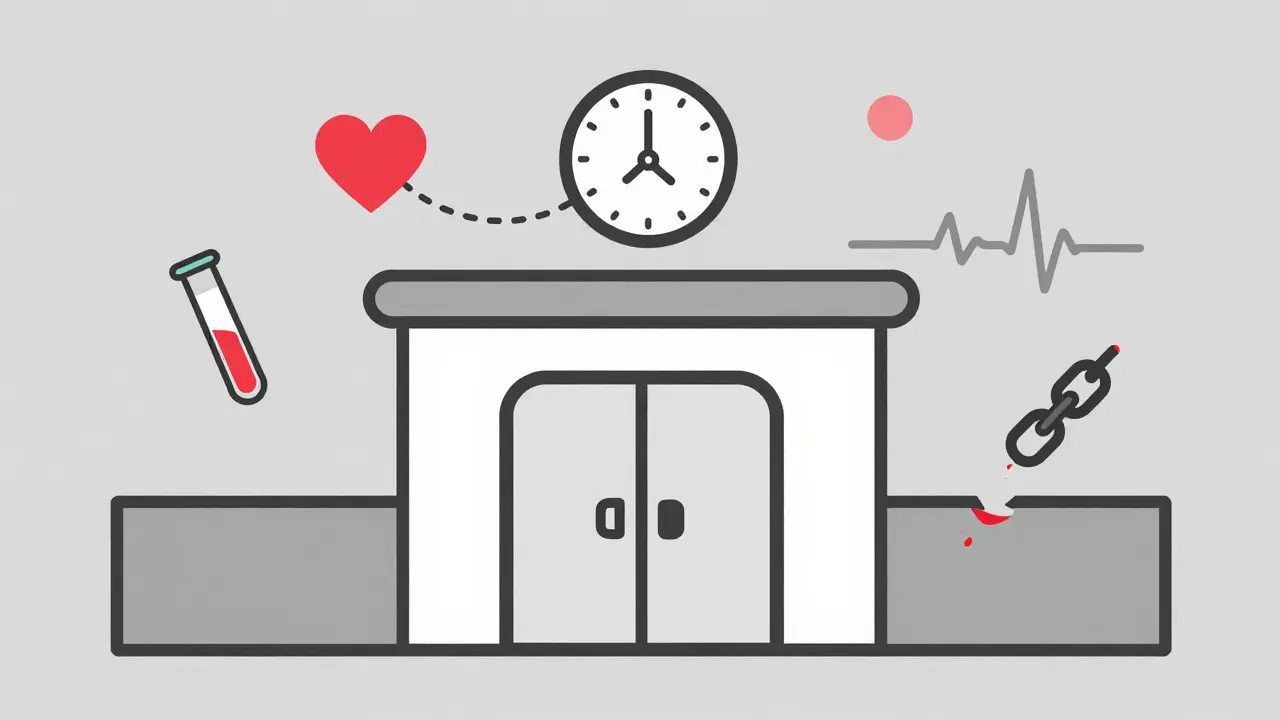
When you walk into the emergency department with chest pain, time is the most important factor. The first thing they do? Get your ECG within 10 minutes. That’s not a suggestion-it’s a mandatory standard under the 2021 AHA/ACC guidelines. A 12-lead electrocardiogram can detect a heart attack in minutes. It’s cheap, fast, and accurate.Then they check your blood. High-sensitivity troponin tests are now standard. Troponin is a protein released when heart muscle is damaged. These tests can rule out a heart attack in as little as one to two hours for most people. If your troponin levels are normal at 0 and 2 hours, and your ECG looks good, you’re likely not having a heart attack.
But here’s the catch: if your troponin is high, or your ECG shows ST-elevation (a clear sign of a heart attack), you’re going straight to the cath lab. The goal? Get your blocked artery opened within 90 minutes of arriving at the hospital. That’s called door-to-balloon time. Every minute counts.
If you’re not having a heart attack but still have symptoms, doctors will use tools like the HEART score to decide what to do next. It looks at your history, ECG, age, risk factors, and troponin. A score of 0-3? You’re low risk and can probably go home with follow-up. A score of 7-10? You’re high risk and need immediate intervention.
What Doesn’t Need the ER
Not every twinge means a heart attack. If your chest pain:- Only lasts a few seconds
- Changes with movement or breathing
- Feels like it’s coming from your ribs or muscles
- Shows up after eating or lying down (like heartburn)
- Is relieved by antacids or changing position
…it’s likely not cardiac. Muscle strain, acid reflux, anxiety, or even a pinched nerve can mimic heart pain. But here’s the thing: if you’re unsure, it’s better to be safe. Don’t try to self-diagnose. Call your doctor or go to urgent care if you’re worried.
One big mistake people make? Waiting to see if it gets worse. Heart attacks don’t always start with a dramatic explosion of pain. Sometimes they creep in slowly. A dull ache that gets worse over hours? That’s still dangerous.
Why You Shouldn’t Wait
About 6 to 8 million people go to U.S. emergency departments every year with chest pain. Only 10-15% turn out to have a heart attack. But if you’re in that 10-15%, delaying care by even 30 minutes can double your risk of death.And it’s not just about the heart. Chest pain can also mean a pulmonary embolism (a blood clot in the lungs), aortic dissection (a tear in the main artery), or even a collapsed lung. These are rare-but deadly. And they all need emergency treatment.
Recent data shows that hospitals using high-sensitivity troponin tests can safely send home 70-80% of chest pain patients within two hours. That means faster care for those who need it, and less stress for those who don’t. But none of that works if you don’t show up.
What to Do Next
If you’ve had chest pain-even if it’s gone now-don’t brush it off. Schedule a follow-up with your doctor. Ask for a stress test, an echocardiogram, or a coronary CT angiogram if needed. Even if your ER visit came back clear, you might still have underlying heart disease.And if you haven’t already: know your numbers. Blood pressure, cholesterol, blood sugar. Know your family history. Quit smoking if you do. Move more. Eat better. These aren’t just good ideas-they’re lifesavers.
And if you ever feel that pressure, that tightness, that weird heaviness in your chest again? Don’t text your friend. Don’t Google it. Don’t wait to see if it passes.
Call 911.
Frequently Asked Questions
Can chest pain be caused by anxiety?
Yes, anxiety can cause chest tightness, rapid heartbeat, and shortness of breath that feel very similar to a heart attack. But you can’t tell the difference on your own. If you’ve never had heart problems and the pain goes away quickly with deep breathing, it might be anxiety. But if you’re unsure, go to the ER. It’s safer to rule out a heart issue than to assume it’s stress.
Is it safe to wait and see if chest pain goes away?
No. If chest pain lasts more than 5 minutes, doesn’t improve with rest, or comes with other symptoms like sweating or nausea, waiting could be deadly. Heart attacks don’t always start with severe pain. Sometimes they begin as mild discomfort that slowly gets worse. Early treatment saves heart muscle-and your life.
Do I need an ECG even if I feel fine?
Yes. Many heart attacks don’t show up on the first ECG. That’s why doctors take serial ECGs-usually every 15 to 30 minutes-if symptoms are ongoing. The ECG is the fastest, cheapest, and most important test in chest pain evaluation. Even if you feel better by the time you get to the hospital, the ECG can still show signs of past damage or ongoing risk.
Can women have heart attacks without chest pain?
Absolutely. Women are more likely than men to have “atypical” symptoms like fatigue, nausea, jaw pain, or back pain without classic chest pressure. In fact, up to 40% of women who have heart attacks don’t report chest pain at all. That’s why it’s critical to take any new, unexplained symptoms seriously-no matter your gender.
What’s the HEART score and why does it matter?
The HEART score is a tool doctors use to predict your risk of having a heart attack. It looks at five things: your History (what the pain feels like), ECG results, Age, Risk factors (like smoking or diabetes), and Troponin levels. A score of 0-3 means low risk-you might be sent home. A score of 7-10 means high risk-you need immediate care. It helps avoid unnecessary hospital stays while catching dangerous cases early.
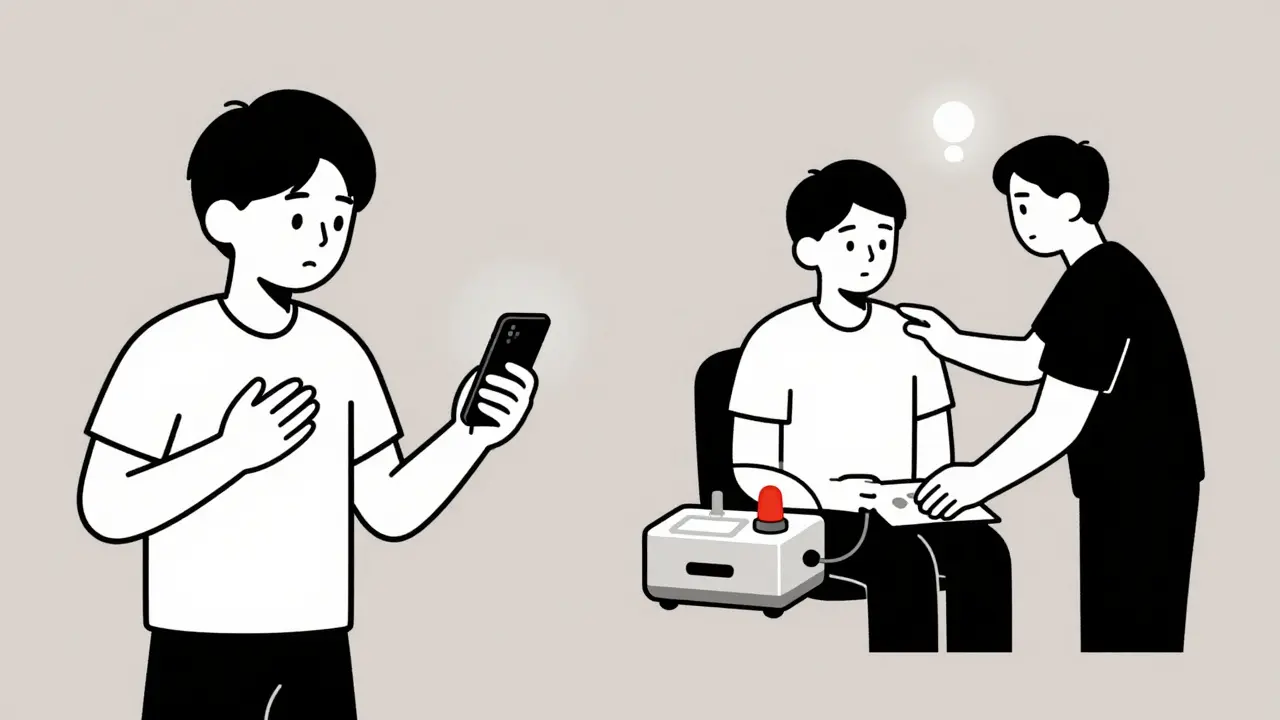
Can I use a home ECG device like Apple Watch to check for a heart attack?
Home ECG devices can detect irregular heart rhythms like atrial fibrillation, but they can’t reliably diagnose a heart attack. They don’t capture the full picture your hospital ECG does. If you’re having chest pain, don’t rely on your smartwatch. Call 911. The hospital has the right tools, the right team, and the right protocols to act fast.
Is it true that most chest pain isn’t heart-related?
Yes. About 85-90% of people who go to the ER with chest pain don’t have a heart attack. But that doesn’t mean you’re safe to ignore it. The goal isn’t to assume you’re fine-it’s to make sure you’re not one of the 10-15% who are. That’s why emergency departments follow strict protocols: to catch the rare but deadly cases while avoiding unnecessary treatment for the rest.
Should I take aspirin before going to the ER?
If you suspect a heart attack and aren’t allergic to aspirin, chewing one regular (325 mg) aspirin can help reduce damage. But only do this if you’re sure it’s heart-related and you’re not at risk for bleeding. Don’t delay calling 911 to find aspirin. The most important step is getting help immediately.


Joanna Ebizie
December 16, 2025 AT 15:20Ugh, another one of these ‘call 911 at the first sneeze’ articles. I’ve had chest twinges for years and still have all my organs. Stop scaring people into ambulance rides.
Souhardya Paul
December 18, 2025 AT 00:56I get where you're coming from, but I lost my uncle because he waited ‘just one more hour’ to see if it was ‘just gas.’ He was 52, fit, no history. The ECG showed a 90% blockage. If he’d called sooner, he’d be here. Not saying panic - but don’t gamble with your heart.
Also, the part about EMS giving aspirin on the way? That’s huge. My mom’s ambulance crew gave her nitro and started an IV before we even got to the hospital. That’s not magic - that’s protocol.
And yeah, most chest pain isn’t cardiac. But the 10% that is? It doesn’t wait for your schedule.
Aditya Kumar
December 18, 2025 AT 06:08lol why even read this. i have better stuff to do.
Tiffany Machelski
December 19, 2025 AT 03:05i just want to say thank you for writting this. i was so scared last month and i didnt know what to do. this helped me call 911 when i felt it again. i think i was having a mini heart thing. they said my troponin was normal but my ecg had somthing off. they kept me overnite. i feel so much better now. thank you for being clear.
p.s. sorry for the typos. my hands are still shaky.
SHAMSHEER SHAIKH
December 20, 2025 AT 08:23Let me be unequivocally clear: the distinction between cardiac and non-cardiac chest discomfort is not a matter of opinion - it is a matter of life and death. The guidelines cited herein are not suggestions; they are the product of decades of rigorous, peer-reviewed clinical research. To dismiss them is to endanger not only oneself, but also one’s family, one’s community, and the emergency personnel who are forced to respond to preventable crises.
Moreover, the HEART score is not a gimmick - it is a validated, evidence-based algorithm that has reduced unnecessary admissions by over 70% in multiple international studies. To ignore it is to ignore science.
And to those who say, ‘I’ve had this before and it was nothing’ - yes, perhaps. But the next time? It might not be. The heart does not apologize for its silence. It does not warn you in advance. It does not care how busy you are.
Call 911. Not because you’re scared. But because you are responsible.
James Rayner
December 21, 2025 AT 18:54It’s funny how we treat our bodies like they’re disposable apps - ‘if it glitches, just restart.’
But the heart? It doesn’t have a reboot button. It doesn’t have a ‘try again later’ option. It just… stops.
I used to think chest pain was dramatic. Now I know it’s the body screaming in a language we’ve forgotten how to listen to.
Maybe we don’t need more info. Maybe we just need more humility.
And yes - I chewed aspirin before the ambulance came. Didn’t wait for the doctor’s permission. Just did it.
Still alive. Grateful.
❤️
Kayleigh Campbell
December 23, 2025 AT 09:01So let me get this straight - if I feel like I swallowed a cactus and my left arm tingles, I gotta call 911? But if I eat a burrito and then feel like I’m being hugged by a bear, I’m fine?
Also, why does every ER doctor look at me like I’m wasting their time? Like I’m the 47th person today who thought ‘my chest is weird’ meant ‘I’m dying’?
Still… I’d rather look dumb than be dead. So yeah. I’ll call. But I’m bringing snacks for the paramedics.
Arun ana
December 24, 2025 AT 17:36Good post. Very clear. I shared this with my dad in India. He’s 68, smokes, doesn’t believe in doctors. Now he says he’ll go if he feels anything. Small win.
Also, I use my Apple Watch to track my heart rate. It’s cool, but I know it’s not a doctor. Thanks for reminding us.
👍 ❤️
Cassandra Collins
December 25, 2025 AT 12:22Did you know the American Heart Association gets funding from pharmaceutical companies? They want you to go to the ER so they can sell you stents and statins. The real cause of chest pain? Glyphosate in your food. And the FDA is covering it up.
Also, why do they always do ECGs? It’s all a scam. I read on Reddit that heart attacks are caused by 5G towers. My cousin’s neighbor’s cousin had chest pain and it was just anxiety. He took CBD oil and now he’s fine.
Don’t trust the system. Trust your gut. And maybe stop eating processed food.
Elizabeth Bauman
December 25, 2025 AT 17:46As an American woman, I’m tired of being told my symptoms are ‘atypical.’ Why do we even have to explain ourselves? If I feel like I’m being crushed, I deserve to be taken seriously - no matter what my gender is.
And while we’re at it - why do we let other countries dictate our medical standards? This ‘HEART score’ sounds like something from a European bureaucracy. We’re Americans. We don’t need algorithms to tell us when to call 911. We just need common sense.
Also, I’ve never seen a single ambulance in my neighborhood. Maybe we should fix that before we lecture people about ‘door-to-balloon time.’
Mike Smith
December 25, 2025 AT 19:40Let me be clear - this isn’t about fear. It’s about responsibility.
When you call 911, you’re not just saving yourself. You’re saving the paramedics from having to explain to your kids why you didn’t listen.
You’re saving the ER staff from triaging someone who could’ve been saved.
You’re saving your family from a lifetime of ‘what if?’
There’s no shame in being cautious. There’s only shame in waiting too long.
So if you’re reading this and you’ve ever brushed off chest discomfort - stop. Now. Call your doctor. Or call 911. Don’t wait for the next episode.
Your future self will thank you.
Ron Williams
December 26, 2025 AT 20:12As someone who grew up in a village where the nearest hospital was 3 hours away, I learned early: if you’re unsure, you move.
My uncle thought his chest pain was ‘just wind.’ He waited two days. By the time they got him to a doctor, his heart was too weak to fix.
So I don’t care if it’s ‘probably nothing.’ I care that it’s ‘maybe everything.’
And yeah - I carry aspirin in my wallet. Not because I think I’m gonna die. But because I don’t want to be the reason someone else does.
Josias Ariel Mahlangu
December 27, 2025 AT 14:57This is the problem with modern medicine - too many tests, too many rules. Back in my day, we knew when to rest. When to pray. When to endure. Now everyone runs to the hospital like it’s a Starbucks.
Weakness is contagious. And this article? It’s just feeding the sickness.
anthony epps
December 29, 2025 AT 13:58so if i feel a little tightness and i’m 35 and healthy, i should still go? what if i’m just stressed? what if i just need to breathe?
just want to make sure i’m not overreacting. thanks.
Andrew Sychev
December 30, 2025 AT 11:30MY CHEST HURTS AND I’M NOT GOING TO THE ER BECAUSE I DON’T TRUST THE SYSTEM.
I’VE BEEN TO THE HOSPITAL BEFORE. THEY TOLD ME IT WAS ‘ANXIETY.’
THREE WEEKS LATER I HAD A HEART ATTACK.
SO NOW I’M NOT TAKING ANY CHANCES.
I’M MOVING TO THE WOODS.
I’M LIVING OFF GRID.
I’M LEARNING TO HEAL WITH HERBS.
AND IF I DIE?
AT LEAST I DIED ON MY TERMS.
NO DOCTORS. NO TESTS. NO HOSPITALS.
JUST ME. AND THE WIND.
Souhardya Paul
December 31, 2025 AT 12:43James, I hear you. I’ve been that guy who thought it was stress. I was wrong.
But here’s what I learned: the heart doesn’t care if you’re ‘on your terms.’ It doesn’t care if you’re ‘anti-system.’ It just beats - or it doesn’t.
And if you’re gonna live off-grid, fine. But take a basic first aid course. Keep aspirin. Know your numbers.
Because dying on your terms doesn’t help anyone else. Living on yours? That’s the goal.
And yeah - I still carry aspirin. And I still call 911 if I’m unsure.
Because I’m not just living for me.
I’m living for the people who’d be left behind.