Imagine taking your morning medication with a heavy breakfast versus on an empty stomach. In one case, the drug might absorb twice as fast; in the other, it could barely register in your bloodstream. This isn't just a theoretical concern-it’s a regulatory requirement. For decades, scientists debated whether Fasted vs Fed State Testing is a type of dual-condition assessment that examines how physiological and pharmaceutical responses change based on nutritional status. Today, it is non-negotiable for most new drug approvals.
The core issue is simple: your body operates differently when you haven’t eaten in 12 hours compared to two hours after a meal. In pharmaceutical research, this difference can alter drug absorption by up to 300% for certain compounds. In exercise science, it changes which fuel source your muscles burn. Understanding both states ensures that medications work safely and that performance recommendations are accurate.
The Physiological Divide: What Happens in Your Body
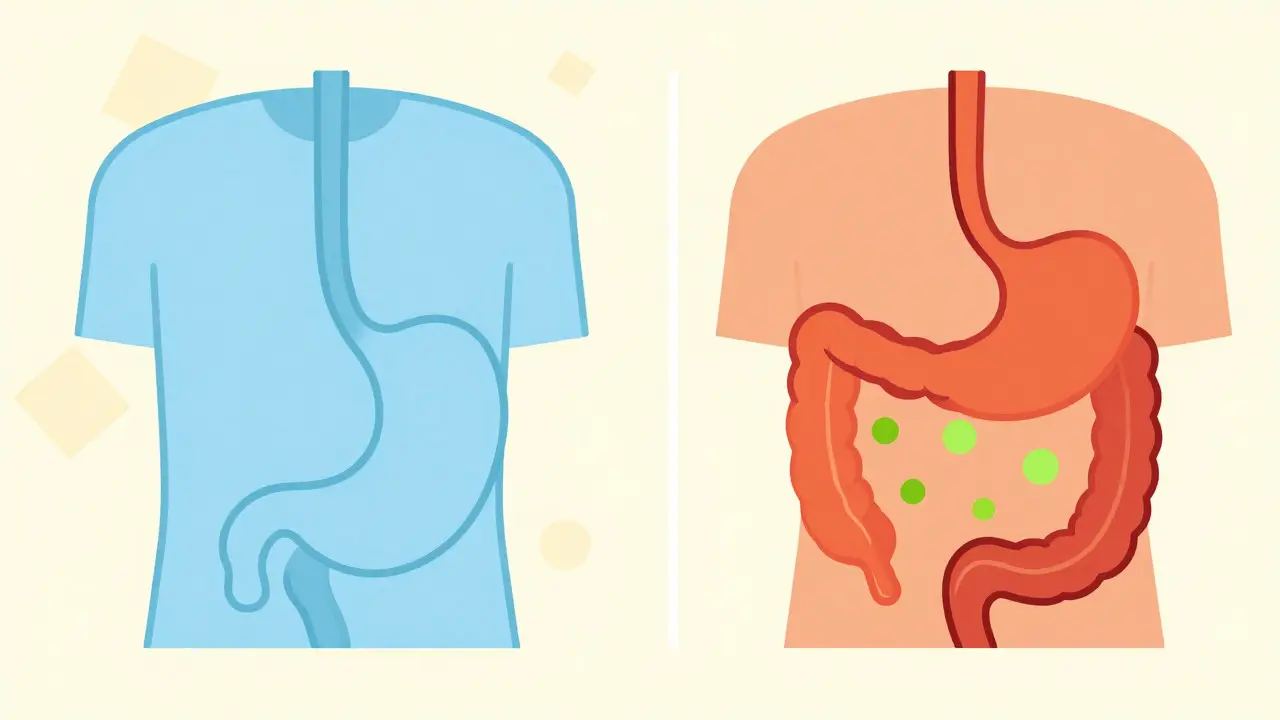
To understand why we test both ways, we have to look at what’s happening inside your gastrointestinal tract and metabolic system. When you are in a Fasted State, defined operationally as 8-12 hours without caloric intake, your body shifts its priority from digestion to maintenance. Blood glucose levels stabilize, and insulin drops. This triggers lipolysis, where stored fat breaks down into free fatty acids (FFAs) for energy. Studies show FFA availability is 30-50% higher in this state.
In contrast, the Fed State occurs within 2-4 hours after eating. Here, digestion takes center stage. Gastric acid production increases, and the physical movement of food slows down gastric emptying. Data from SmartPill capsule studies reveals a stark difference: gastric residence time averages just 13.7 minutes in a fasted state but stretches to 78.3 minutes when fed. Intragastric pH also drops significantly, reaching a median minimum of 1.5 in fed conditions versus 2.5 in fasted conditions. These mechanical and chemical changes directly impact how pills dissolve and how nutrients enter the bloodstream.
| Parameter | Fasted State | Fed State |
|---|---|---|
| Gastric Residence Time | ~13.7 minutes | ~78.3 minutes |
| Intragastric pH (Median Min) | 2.5 | 1.5 |
| Free Fatty Acid Availability | Baseline | Lower (due to insulin) |
| Glycogen Utilization | Lower | 15-25% Higher |
| Primary Fuel Source | Fat Oxidation | Carbohydrate/Glucose |
Pharmaceutical Implications: The Food Effect Problem
In the world of Bioequivalence Standards, the "food effect" is a critical variable. The FDA and EMA require dual-condition testing because food can dramatically alter a drug's bioavailability. Some drugs need food to be absorbed properly, while others are better absorbed on an empty stomach. If a manufacturer only tests in one state, they risk recommending the wrong dosing instructions.
Consider lipophilic compounds like fenofibrate. In fed-state studies, their bioavailability can increase by 200-300% because dietary fats help solubilize the drug. Conversely, drugs like griseofulvin see absorption decrease by 50-70% when taken with food. This variability means that for any oral drug where the food effect is unknown, regulators now mandate testing in both states. A 2019 analysis of 1,200 New Drug Applications found that 35% of drugs show clinically significant food interactions. Without dual testing, patients might take a medication that either fails to work or causes toxicity due to unexpected accumulation.
The standard for these tests is rigorous. The FDA defines a high-fat, high-calorie meal for fed-state studies as containing approximately 800-1,000 calories, with 150% of the caloric content coming from fat (roughly 500-600 calories). Trials must adhere to these macronutrient values within ±10% to ensure consistency across different study sites. This standardization allows researchers to compare data reliably, ensuring that the observed differences are due to the physiological state, not variations in what people ate.
Exercise Physiology: Performance vs Adaptation
While pharmacology focuses on absorption, exercise science uses fasted and fed states to optimize human performance and health. The debate here centers on trade-offs. Fasted training enhances metabolic adaptations, specifically mitochondrial biogenesis. Research indicates that exercising in a fasted state upregulates PGC-1α expression by 40-50% compared to fed exercise. This suggests that if your goal is long-term metabolic health and fat oxidation capacity, training fasted may offer superior physiological benefits.
However, there is a cost. High-intensity work capacity drops by 12-15% in fasted conditions because the body relies less on immediate glycogen stores. For competitive athletes who need peak power output, the fed state is generally preferred. A meta-analysis of 46 peer-reviewed studies showed that fed-state exercise enhances prolonged aerobic performance by 8.3%, but provides no significant benefit for sessions under 60 minutes. This nuance is crucial: if you’re doing a short, intense sprint session, the nutritional state matters less than if you’re running a marathon.
Experts like Dr. John Hawley from Australian Catholic University suggest periodizing these approaches. Instead of always training fasted or always fed, athletes can alternate. This strategy allows them to capture the metabolic benefits of fasted training without consistently compromising high-intensity performance. It’s a practical application of understanding that both states serve different physiological purposes.
Regulatory Landscape and Future Directions
The regulatory environment continues to tighten. The European Medicines Agency’s 2021 guideline revision requires fed-state testing for all oral drugs where the food effect is unknown. Furthermore, the FDA’s 2023 draft guidance expands requirements to include diverse ethnic populations. Research has shown that Asian subjects exhibit 18-22% slower gastric emptying times than Caucasian subjects in fed conditions. This demographic variation means that one-size-fits-all protocols might miss critical safety signals for specific patient groups.
Looking ahead, precision medicine is influencing how we view these tests. Genetic variants, such as those in the PPARGC1A gene, explain 33% of individual response variability to fasted versus fed training. As our ability to genotype patients improves, we may move away from blanket recommendations toward personalized dosing and training schedules. However, until then, dual-condition testing remains the gold standard for ensuring safety and efficacy.
Practical Takeaways for Different Audiences
If you are a patient, pay attention to your prescription label. If it says "take with food," don’t skip the snack. If it says "take on an empty stomach," avoid meals for at least two hours before and one hour after. These instructions aren’t arbitrary; they are based on the bioequivalence data generated through rigorous fasted and fed state testing.
For athletes and fitness enthusiasts, consider your goals. Are you trying to maximize endurance and metabolic health? Incorporating some fasted sessions might help. Are you preparing for a competition requiring explosive power? Prioritize fed-state training to ensure your glycogen stores are fully stocked. There is no single "best" state-only the right state for the specific objective.
For researchers and developers, the key is standardization. Whether you are designing a clinical trial or a sports nutrition study, controlling for sleep duration, hydration status, and pre-test activity is essential. Variability in these factors can mask the true effects of the nutritional state, leading to inconclusive results.
How long does a fasted state last?
In medical and scientific contexts, a fasted state is typically defined as 8 to 12 hours without caloric intake. Only water is usually permitted during this window to maintain hydration without triggering digestive processes.
Why do some drugs need to be taken with food?
Some drugs, particularly lipophilic ones, require dietary fats to help dissolve and absorb into the bloodstream. Taking them with food can increase their bioavailability significantly, sometimes by more than 200%. Conversely, other drugs are degraded by stomach acid or blocked by food particles, so they must be taken on an empty stomach.
Does fasted training burn more fat?
Acutely, yes. Fasted training increases circulating free fatty acids and promotes greater fat oxidation during the workout. However, over the long term, total body composition changes depend more on overall caloric balance than on the timing of your workout. Fasted training offers metabolic adaptations like improved mitochondrial function, but it may reduce the intensity you can sustain.
What is the standard meal used in FDA bioequivalence studies?
The FDA mandates a high-fat, high-calorie meal for fed-state studies. This meal typically contains 800 to 1,000 calories, with about 50% of the calories coming from fat. This standard ensures that the "worst-case" scenario for drug absorption is tested, providing a conservative estimate of how food affects the drug.
Can I switch between fasted and fed training days?
Yes, periodization is a common strategy. Many experts recommend mixing fasted and fed sessions throughout the week. This approach allows you to gain the metabolic benefits of fasted exercise while maintaining the high-intensity performance capabilities supported by fed-state training.