
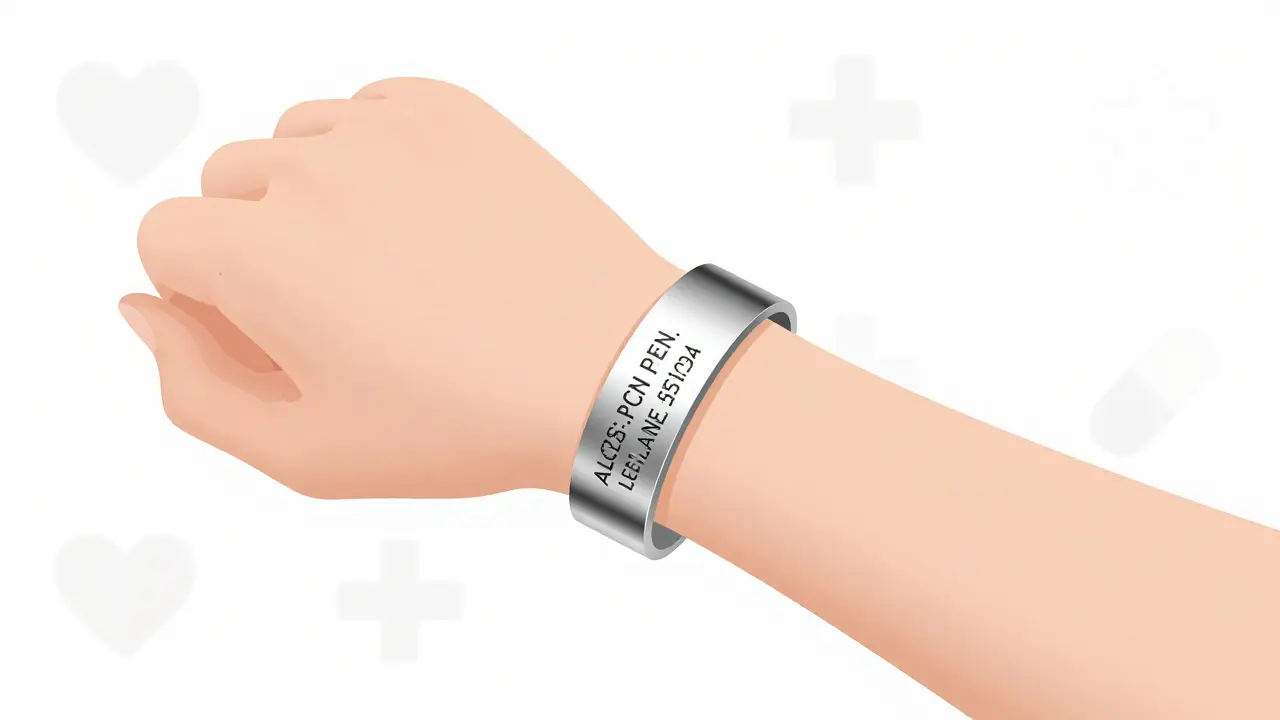
When you have a severe drug allergy, your life can change in seconds. One wrong medication, given in an emergency when you can’t speak, and you could go into anaphylaxis. That’s why wearing a medical alert bracelet isn’t just a good idea-it’s a lifesaver. More than 4.5 million people in the U.S. with serious drug allergies wear one. And for good reason: emergency responders check for them in 95% of cases. But wearing one isn’t enough. You have to wear it right, write the right info, and keep it updated. Here’s how to do it right.
What a Medical Alert Bracelet Should Say
Your bracelet isn’t a fashion statement. It’s a medical instruction. First responders don’t have time to guess. They need clear, fast-to-read facts. The most effective engraving uses standard medical abbreviations to fit critical info in a small space.Here’s what every severe drug allergy bracelet should include:
- Your full name (so they know who you are)
- Primary drug allergy (e.g., “ALGYS: PCN” for penicillin)
- Other drug allergies (e.g., “MORPHINE, SULFA”)
- Any life-saving device you carry (e.g., “EPI PEN”)
- Key medical conditions (e.g., “DIABETIC” or “CELIAC”)
- Two emergency contacts labeled “ICE” (In Case of Emergency)
Don’t write “Allergic to Penicillin.” That’s too long. Use “ALGYS: PCN.” Don’t say “I have an EpiPen.” Just write “EPI PEN.” Medical staff see these codes daily. They’re trained on them. Using full words wastes space and slows them down. A 2023 study from the MedicAlert Foundation found that bracelets using standard abbreviations were understood 89% faster than those with full sentences.
Where to Wear It
Wearing your bracelet on your left wrist? That might be wrong. Emergency responders check the wrist they can see easiest-usually the dominant hand. If you’re right-handed, wear it on your right wrist. If you’re left-handed, wear it on your left. This isn’t a suggestion. It’s based on how 95% of paramedics and ER nurses scan patients during trauma.Necklaces are also common. But studies show bracelets are checked 10% more often. Why? Hands are easier to grab than necks. In a car accident or seizure, a necklace might be hidden under clothing. A bracelet is still visible, even if you’re lying down. If you wear a necklace, make sure it’s high on the neck-not tucked under a shirt collar. You want it visible the second someone looks.
What Material to Choose
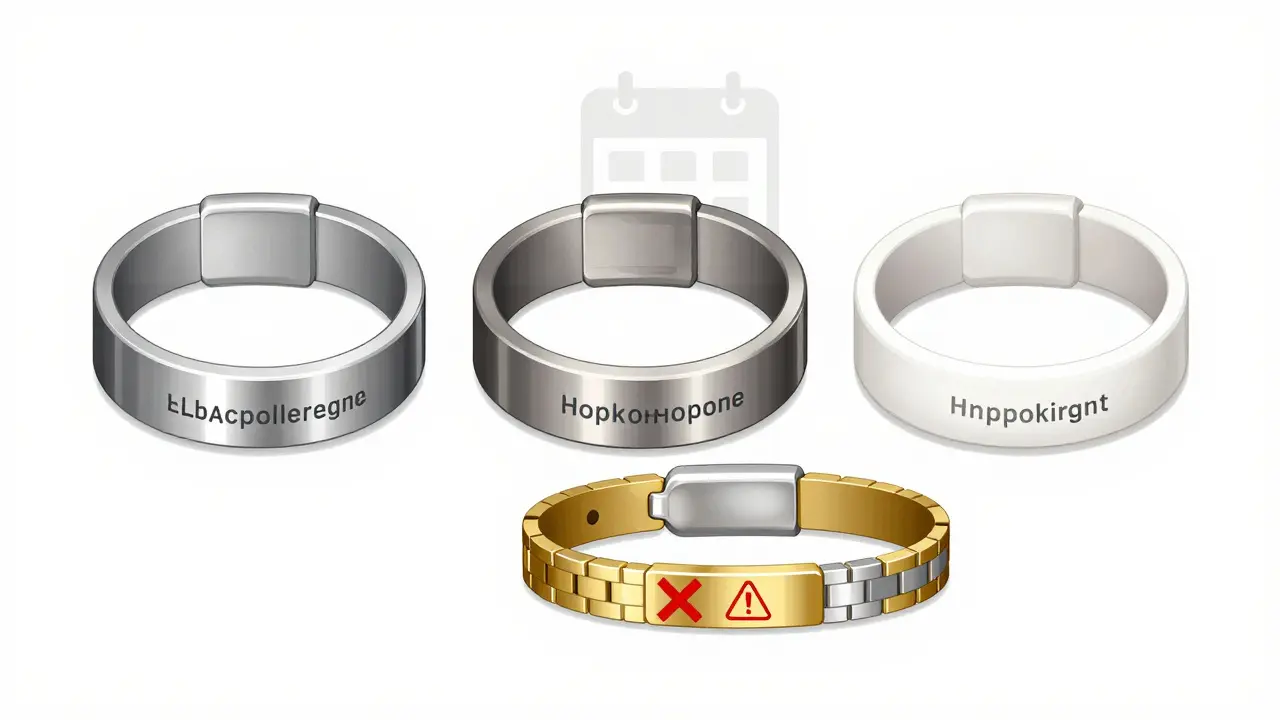
Not all medical IDs are made the same. Some materials can cause reactions of their own. If you’re allergic to nickel, a cheap metal bracelet could trigger a rash during an emergency-right when you need to stay calm.Stick to these three safe materials:
- Surgical stainless steel - Most common. Durable, hypoallergenic, and resistant to corrosion.
- Titanium - Lighter than steel, even less likely to cause reactions. Great if you have sensitive skin.
- Medical-grade silicone - Flexible, comfortable, and completely non-metallic. Perfect for kids, athletes, or people allergic to all metals.
Avoid plated jewelry, brass, or copper. Even if the engraving looks good, the base metal can irritate your skin or cause false alarms. In 2023, a case in Brisbane was reported where a patient’s metal bracelet caused contact dermatitis, delaying treatment because staff thought it was an allergic reaction to a drug.
Wear It 24/7
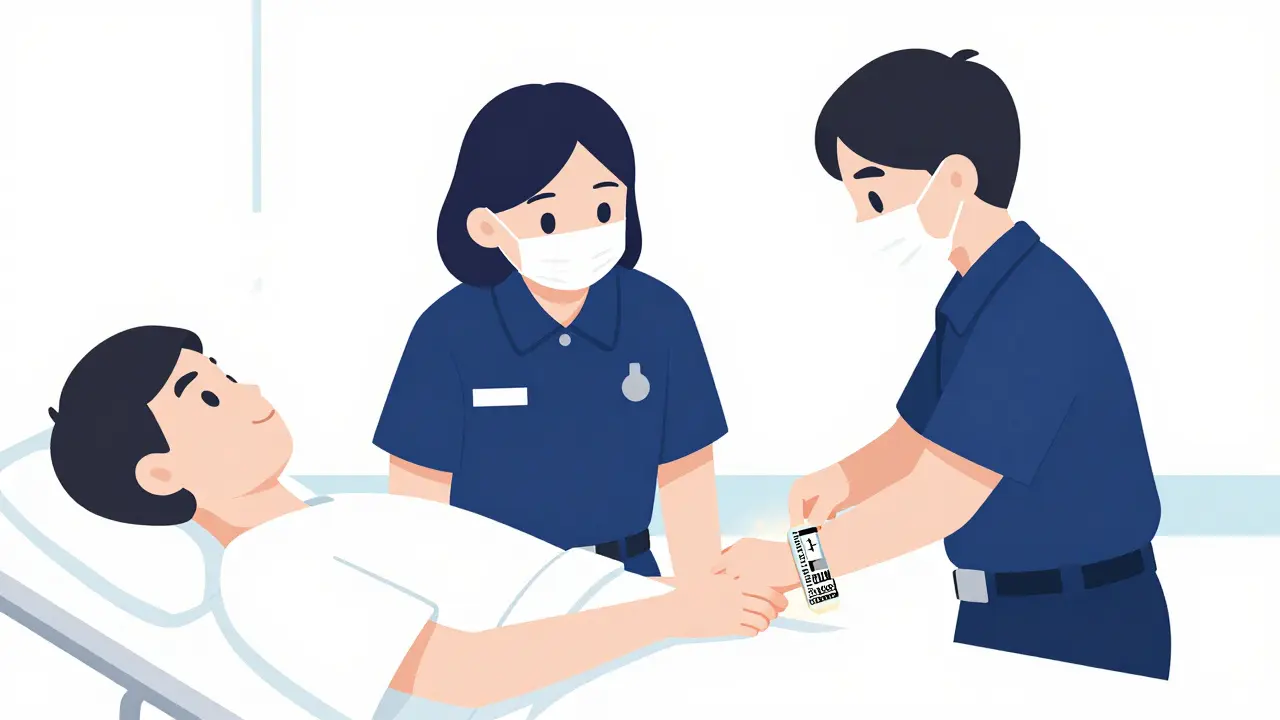
You might think, “I only need it when I go to the hospital.” Wrong. Most allergic reactions happen outside medical settings. A friend hands you a pill. You take it without thinking. You get dizzy. You collapse. No one knows why. That’s when your bracelet speaks for you.Studies show patients who wear their ID daily are 3.5 times more likely to receive correct emergency treatment than those who only wear it “sometimes.” The American College of Allergy, Asthma, and Immunology (ACAAI) says: “Wear it every day, every night. Don’t take it off for showers, workouts, or sleep.”
Most people adapt in 7 to 10 days. After that, it feels like a watch. If you’re worried about comfort, try a silicone band. They’re soft, flexible, and nearly invisible under clothing. Many users say they forget they’re wearing it-and that’s exactly how it should be.
Update It When Your Allergies Change
Allergies aren’t always permanent. Sometimes, you outgrow one. Sometimes, you develop a new one. A 2024 survey found that 33% of medical ID wearers had outdated info on their bracelet. That’s scary.If you get a new allergy diagnosis, replace your bracelet within 30 days. If you stop taking a drug and your doctor says it’s safe, update your ID. If you start carrying an EpiPen, add “EPI PEN” to the engraving. Don’t wait. Emergency rooms don’t have time to ask questions. They need answers on your wrist.
Some companies offer free replacement engraving if your medical status changes. Look for providers that offer lifetime updates. MedicAlert Foundation and Lauren’s Hope both include this in their premium plans.
Pair It With a Digital Profile
Your bracelet is your first line of defense. But it’s not your only one. In 2024, MedicAlert Foundation and American Medical ID both launched QR code and NFC chip systems. Scan the code on your bracelet, and first responders get your full medical history: allergies, medications, doctors, hospital records, even your preferred pharmacy.This doesn’t replace your bracelet. It enhances it. If the engraving wears down over time, the digital profile still works. If you’re unconscious and your bracelet is covered, a responder can scan it with a phone. It’s like having your whole medical file in your pocket.
Set up your profile with:
- Full list of allergies (with brand names and generic names)
- All current medications (doses included)
- Emergency contacts with phone numbers
- Primary care doctor and specialist info
- Any past anaphylaxis episodes
Many of these services sync with Apple Health and Google Health. That means if you’re in a crash, EMTs can pull your info from your phone-even if you didn’t bring your ID.
What Not to Do
Here are the mistakes people make-and they’re dangerous:- Using non-standard abbreviations - Writing “PEN ALGY” instead of “ALGYS: PCN” confuses staff. Stick to accepted codes.
- Forgetting emergency contacts - If you’re unconscious, they need to call someone. List two: ICE1 and ICE2.
- Wearing it on the wrong wrist - Don’t assume it’ll be seen. Wear it on your dominant side.
- Letting it get worn out - If the engraving fades, replace it. A blurry “PCN” could be misread as “PCN-1” or ignored entirely.
- Thinking it’s enough alone - Your bracelet is critical, but it’s not magic. Tell your family. Train your coworkers. Carry a wallet card too.
Real Stories
A man in Queensland had a severe allergy to cephalosporin. He wore a bracelet that said: “ALGYS: CEPHALOSPORIN, EPI PEN.” One night, he collapsed from low blood sugar. The ER team almost gave him a common antibiotic for his fever. Then they saw the bracelet. They stopped. They gave him glucose instead. He walked out the next day.Another woman in Sydney had a penicillin allergy. During a routine surgery, she was unconscious. The anesthesiologist was about to give her a drug that cross-reacts with penicillin. The nurse noticed the bracelet. They switched meds. She woke up fine.
These aren’t rare. They’re common. And they only happen because someone wore the right ID, the right way.
Final Checklist
Before you leave today, ask yourself:- Is my bracelet engraved with standard abbreviations?
- Is it on my dominant wrist?
- Is the material hypoallergenic (steel, titanium, or silicone)?
- Does it list all my drug allergies and EpiPen?
- Do I have two ICE contacts listed?
- Have I updated it in the last 6 months?
- Do I have a digital profile linked to it?
If you answered yes to all seven, you’re covered. If not, fix one thing today. Start with the engraving. Then the wrist. Then the digital profile. One step at a time.
Severe drug allergies don’t wait. Neither should you.
Can I use a medical alert necklace instead of a bracelet?
Yes, but bracelets are more likely to be seen. Emergency responders check wrists 95% of the time and necks 68% of the time. If you prefer a necklace, wear it high on your neck so it’s visible above clothing. But always pair it with a bracelet for maximum safety.
What if I’m allergic to the bracelet material?
Choose medical-grade silicone. It’s completely metal-free, flexible, and safe for even the most sensitive skin. Brands like Lauren’s Hope and MedicAlert offer silicone bands with laser-engraved text that lasts. Avoid plated metals, brass, or copper. If you’re unsure, test a sample on your skin for 48 hours before buying.
Do I need to wear it while sleeping or showering?
Yes. Most allergic reactions happen at home or during routine activities. A reaction could happen while you’re asleep, in the shower, or during exercise. Wearing it 24/7 is the only way to guarantee protection. Silicone bands are waterproof and designed for constant wear.
Can I use a phone app instead of a physical ID?
No-not as a replacement. Phone apps fail during power outages, crashes, or when your phone is locked or dead. Emergency responders can’t wait for you to unlock your phone. A physical ID works instantly, even if you’re unconscious. Use a digital profile as a backup, not your main tool.
How often should I replace my medical alert bracelet?
Replace it every 2-3 years, or sooner if the engraving fades, the band cracks, or the metal corrodes. If your allergies change, replace it immediately. Many providers offer free engraving updates if you’re a member. Check your provider’s policy.




Robin bremer
February 21, 2026 AT 08:02Ellen Spiers
February 22, 2026 AT 11:13John Cena
February 23, 2026 AT 07:38Irish Council
February 23, 2026 AT 14:03Freddy King
February 24, 2026 AT 12:31Laura B
February 25, 2026 AT 00:47Caleb Sciannella
February 25, 2026 AT 07:32Oana Iordachescu
February 25, 2026 AT 10:41Michaela Jorstad
February 27, 2026 AT 04:03Chris Beeley
February 28, 2026 AT 03:25Arshdeep Singh
March 1, 2026 AT 13:28Liam Crean
March 3, 2026 AT 05:07madison winter
March 4, 2026 AT 08:08Jeremy Williams
March 5, 2026 AT 07:12