
PDE5 Inhibitor & Nitrate Safety Checker
Safety Status
Required Waiting Period
--Risk Warning
Imagine taking a pill for heart pain and another for sexual health, thinking you are being proactive about your well-being. Now imagine your blood pressure plummeting so fast that the world goes black, and you hit the floor before you can call for help. This isn't a movie scene; it is the real-world consequence of mixing PDE5 inhibitors, a class of drugs used for erectile dysfunction and pulmonary arterial hypertension, with nitrates. This combination creates a perfect storm in your bloodstream, leading to life-threatening hypotension.
For decades, doctors have warned patients: do not mix these two types of medication. Yet, confusion persists. With new studies challenging old rules and millions of men seeking treatments, understanding this interaction is no longer just academic-it is a matter of safety. Let’s break down why this happens, which drugs are involved, and what the latest science says about keeping you safe.
The Mechanism: Why Your Blood Pressure Crashes
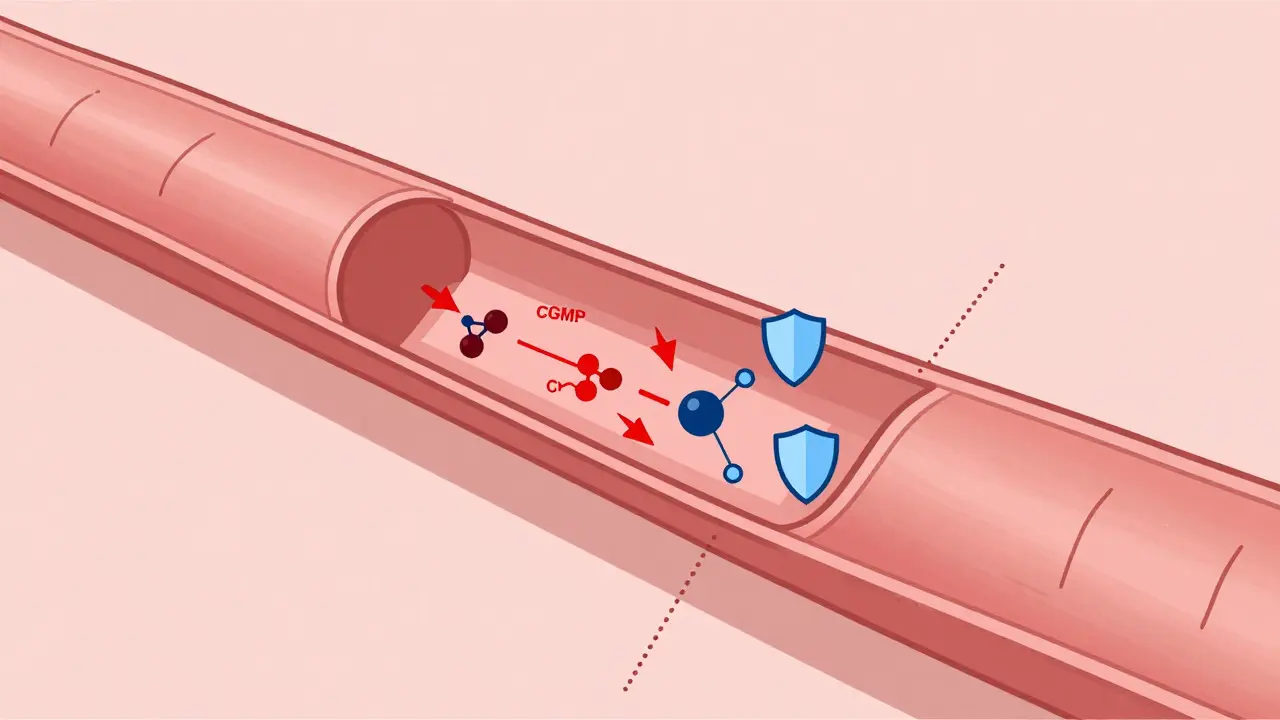
To understand the danger, we need to look at how these drugs work inside your body. It all comes down to a molecule called cyclic guanosine monophosphate (cGMP). Think of cGMP as a signal that tells your blood vessels to relax and widen. When your vessels widen, blood flows more easily, but your blood pressure drops.
Nitrates, such as glyceryl trinitrate (often known as nitroglycerin), work by stimulating the production of cGMP. They are standard treatment for angina pectoris because they quickly open up narrowed arteries to relieve chest pain. On the other hand, PDE5 inhibitors like sildenafil or tadalafil work by stopping the breakdown of cGMP. They keep the relaxation signal active for longer.
When you take them together, you get a double whammy. One drug floods the system with the relaxation signal, while the other prevents the body from clearing it out. The result? Excessive vasodilation. Your blood vessels expand far beyond normal limits, causing your blood pressure to crash. In clinical studies, systolic blood pressure reductions of 30 mmHg or more were observed in nearly a quarter of patients who combined avanafil with nitroglycerin. For some, standing blood pressure dropped below 85 mmHg, a level where fainting and organ damage become serious risks.
Which Drugs Are Involved?
You might know these medications by their brand names rather than their chemical classes. It is crucial to recognize both.
| Drug Name | Brand Names | Half-Life | Nitrate Avoidance Window |
|---|---|---|---|
| Sildenafil | Viagra, Revatio | 3-5 hours | 24 hours |
| Tadalafil | Cialis, Adcirca | 17.5 hours | 48 hours |
| Vardenafil | Levitra, Staxyn | 4-5 hours | 24 hours |
| Avanafil | Stendra | 5 hours | 24 hours |
Sildenafil was the first of its kind, approved by the FDA in 1998. Tadalafil followed in 2003, known for its longer duration of action. Vardenafil also arrived in 2003, while Avanafil was approved much later, in 2012. Despite differences in how long they stay in your system, all carry the same fundamental warning: avoid nitrates.
Nitrates come in many forms. You might use sublingual tablets (under the tongue) for sudden chest pain. Some patients wear transdermal patches or use ointments applied to the skin. Even recreational drugs like "poppers" (amyl nitrite) fall into this category. If you use any of these, the risk applies.
The Current Medical Consensus
Historically, the rule has been absolute. The American Heart Association and the FDA label PDE5 inhibitors as contraindicated with nitrates. The guidelines are strict: wait at least 24 hours after taking sildenafil, vardenafil, or avanafil before using nitrates. If you take tadalafil, you must wait 48 hours due to its longer half-life.
Dr. Martin M. Miner, co-director of the Men's Health Center at Miriam Hospital, emphasizes that the risk is higher for those with underlying heart issues. A sudden drop in blood pressure puts extra strain on the heart, potentially triggering heart attacks or strokes. This caution is rooted in pharmacological theory and early clinical trials that showed dramatic blood pressure drops when the drugs were mixed.
However, the landscape is shifting. A large Danish nationwide cohort study published in Circulation in 2022 tracked over 35,000 events between 2000 and 2018. Surprisingly, researchers found no statistically significant association between the concomitant use of these medications and cardiovascular adverse events. Dr. Jørgen Videbæk of Copenhagen University Hospital suggested that PDE5 inhibitors might not be as harmful as previously thought in patients with stable ischemic heart disease.
Despite this emerging evidence, major organizations like the American College of Cardiology maintain current restrictions. They argue that real-world data does not yet outweigh the theoretical risk, especially since most patients in these studies had stable conditions. Until more definitive randomized controlled trials conclude, the safe bet remains separation.
Why Do People Still Mix Them?
If the warning is so clear, why does this dangerous combination still happen? The answer lies in fragmented healthcare. Often, a cardiologist prescribes nitrates for heart health, while a urologist or primary care doctor prescribes an ED medication. These specialists may not communicate effectively.
Data from electronic medical records shows that approximately 1-4% of PDE5 inhibitor recipients also possess nitrates. In one analysis, only 27% of patients received adequate warnings about the interaction. Patient stories online reveal similar gaps. One user reported passing out after taking nitroglycerin just 12 hours after sildenafil, despite being told it was safe. Another admitted his urologist never mentioned the nitrate risk until he asked specifically after surgery.
A survey by the National Erectile Dysfunction Association found that 38% of men with cardiovascular disease were unaware of the nitrate interaction. Worse, 11% admitted to intentionally taking them together despite warnings. Pharmacy records indicate that 6.3% of sildenafil prescriptions were filled within 24 hours of nitrate prescriptions, highlighting persistent oversight failures even with computerized alert systems in place.

How to Stay Safe: Practical Steps
Knowledge is your best defense. Here is how you can protect yourself:
- Disclose Everything: Tell every doctor you see if you take nitrates. This includes cardiologists, urologists, and general practitioners. Mention recreational poppers too, as they contain nitrates.
- Check Your Medications: Look at your prescription labels. If you have been prescribed a PDE5 inhibitor, ensure your pharmacy record reflects your nitrate use. Pharmacists are trained to catch these interactions.
- Follow the Waiting Periods: If you must take both, adhere strictly to the timing windows. Wait 24 hours for sildenafil, vardenafil, or avanafil. Wait 48 hours for tadalafil. Do not guess.
- Monitor Symptoms: If you experience dizziness, lightheadedness, or fainting after taking either medication, seek medical attention immediately. These are signs of hypotension.
- Ask About Alternatives: If you need ED treatment but cannot safely separate your medications, ask your doctor about non-PDE5 options. Vacuum erection devices or penile injections may be safer alternatives in certain cases.
Electronic health record systems like Epic now include hard-stop alerts to prevent simultaneous e-prescribing. However, clinicians override these alerts in nearly 19% of cases, often deeming the restriction inappropriate for specific patients. This highlights the need for patient advocacy. Don't rely solely on the system; speak up.
What Does the Future Hold?
Science is always evolving. The National Institutes of Health launched a prospective study in January 2023, enrolling 500 patients with stable ischemic heart disease to assess the hypotensive risk during controlled co-administration. Results are expected in late 2025. This trial could provide the definitive data needed to update guidelines.
Meanwhile, pharmaceutical companies are developing next-generation PDE5 inhibitors with higher enzyme specificity. Mitsubishi Tanabe's Phase II compound, MT-4567, shows 99.8% PDE5 specificity compared to 92% for original avanafil. Higher specificity means fewer off-target effects, potentially reducing the risk of severe blood pressure drops. While these drugs are years away from widespread use, they offer hope for safer treatments in the future.
Until then, the old rules stand. The interaction between PDE5 inhibitors and nitrates remains a potent reminder that not all pills play nice together. By staying informed and communicating clearly with your healthcare providers, you can manage your health without risking a dangerous fall-literally.
Can I take Viagra if I use nitroglycerin for chest pain?
Generally, no. You should wait at least 24 hours after taking sildenafil (Viagra) before using nitroglycerin. Mixing them can cause a sudden, dangerous drop in blood pressure. Always consult your cardiologist for personalized advice.
How long does Cialis stay in your system regarding nitrate interactions?
Tadalafil (Cialis) has a long half-life of 17.5 hours. Because it stays in your body longer, you must wait 48 hours after taking Cialis before using any form of nitrate medication to avoid severe hypotension.
Are dietary nitrates like beets dangerous with PDE5 inhibitors?
No. Dietary nitrates found in foods like beets or supplements like L-arginine do not pose the same significant interaction risk as organic nitrate medications. They do not substantially increase plasma nitric oxide levels in the same way prescription nitrates do.
What are the symptoms of mixing PDE5 inhibitors and nitrates?
Symptoms include severe dizziness, lightheadedness, fainting (syncope), blurred vision, nausea, and a rapid heartbeat. In extreme cases, it can lead to shock, heart attack, or stroke due to critically low blood pressure.
Is the ban on mixing these drugs changing soon?
While recent studies suggest the risk might be lower in stable patients, official guidelines from the FDA and American Heart Association currently remain strict. Changes may occur after ongoing clinical trials conclude, but for now, adherence to separation periods is mandatory.