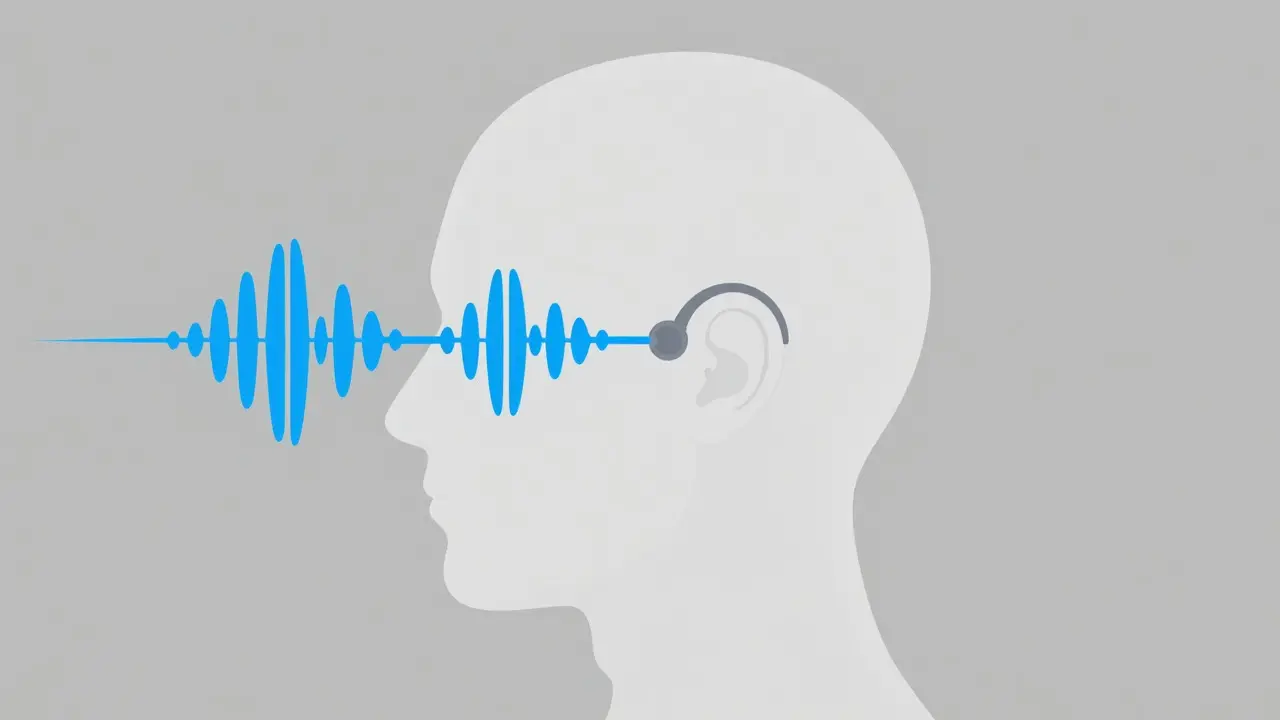
Imagine trying to hear a conversation in a noisy cafe, but one ear is completely plugged with wax or infected. You lean in, squint, and still miss half the words. For millions of people, this isn't just an inconvenience-it's a daily reality caused by issues in the outer or middle ear. Standard hearing aids often fail here because they try to push sound through a blocked path. This is where bone-conduction hearing aids change the game. Instead of shouting into your ear canal, these devices send vibrations directly through your skull bone to the inner ear, bypassing the blockage entirely.
If you or a loved one has been told that traditional hearing aids won't work due to chronic infections, missing ear canals, or single-sided deafness, this technology offers a lifeline. But how does it actually work? Is surgery required? And which type is right for you? Let’s break down the science, the options, and the real-world experience of using bone-conduction devices.
How Bone Conduction Bypasses the Ear
To understand why these devices are so effective, we first need to look at how normal hearing works. Typically, sound waves travel through the air, hit your eardrum, vibrate tiny bones in the middle ear, and finally reach the cochlea (the snail-shaped organ in your inner ear) where they turn into electrical signals for the brain. This is called air conduction.
In cases of conductive hearing loss, mixed hearing loss, or single-sided deafness, something blocks or disrupts this path. Maybe you have a chronic ear infection, a hole in your eardrum, or a congenital condition where the ear canal didn't form correctly. Standard hearing aids amplify sound, but if the door to the inner ear is locked, amplifying the knock doesn't help.
Bone conduction takes a different route. It relies on the principle of osseointegration-the ability of living bone to fuse with titanium. When sound vibrations are sent through the skull bone, they travel directly to the cochlea. The cochlea doesn't care how the vibration arrived; as long as it vibrates, it sends signals to the brain. Research by Dr. Stenfelt shows that about 60% of this transmission comes from the inertia of the fluids inside the cochlea itself. Essentially, you are turning your skull into a speaker driver.
Who Actually Needs These Devices?
Bone-conduction hearing aids aren't for everyone. If you have standard age-related hearing loss (sensorineural), a regular behind-the-ear aid is usually better and cheaper. Bone conduction is specifically designed for three main groups:
- Conductive Hearing Loss: Conditions like chronic otitis media (ear infections), cholesteatoma, or ossicular chain discontinuity where sound cannot pass through the middle ear efficiently.
- Congenital Malformations: People born with microtia (underdeveloped outer ear) or aural atresia (missing or closed ear canal). Since there is no canal to put a device in, bone conduction is often the only option.
- Single-Sided Deafness (SSD): Individuals who have normal hearing in one ear but profound loss in the other. This causes severe difficulty locating sounds and hearing in noise. Bone conduction transmits sound from the deaf side to the good ear.
According to the American Academy of Otolaryngology, these systems are medically necessary when conventional aids are contraindicated. For example, if you have a draining ear infection, putting a plastic dome in your ear canal can trap moisture and worsen the infection. Bone conduction keeps the ear canal open and dry.
The Two Main Types: Percutaneous vs. Transcutaneous
When considering bone conduction, you’ll encounter two primary technologies. The choice between them often depends on your lifestyle, skin sensitivity, and personal preference regarding visibility.
| Feature | Percutaneous (e.g., Cochlear BAHA Connect, Oticon Ponto) | Transcutaneous (e.g., MED-EL Bonebridge, Cochlear BAHA Attract) |
|---|---|---|
| Connection Method | Titanium abutment passes through the skin | Magnets couple through intact skin |
| Surgery Complexity | Less invasive; smaller implant | More invasive; requires deeper bone bed and larger implant |
| Sound Quality | Higher fidelity; no signal loss through skin | Slight attenuation (10-15 dB loss) due to skin thickness |
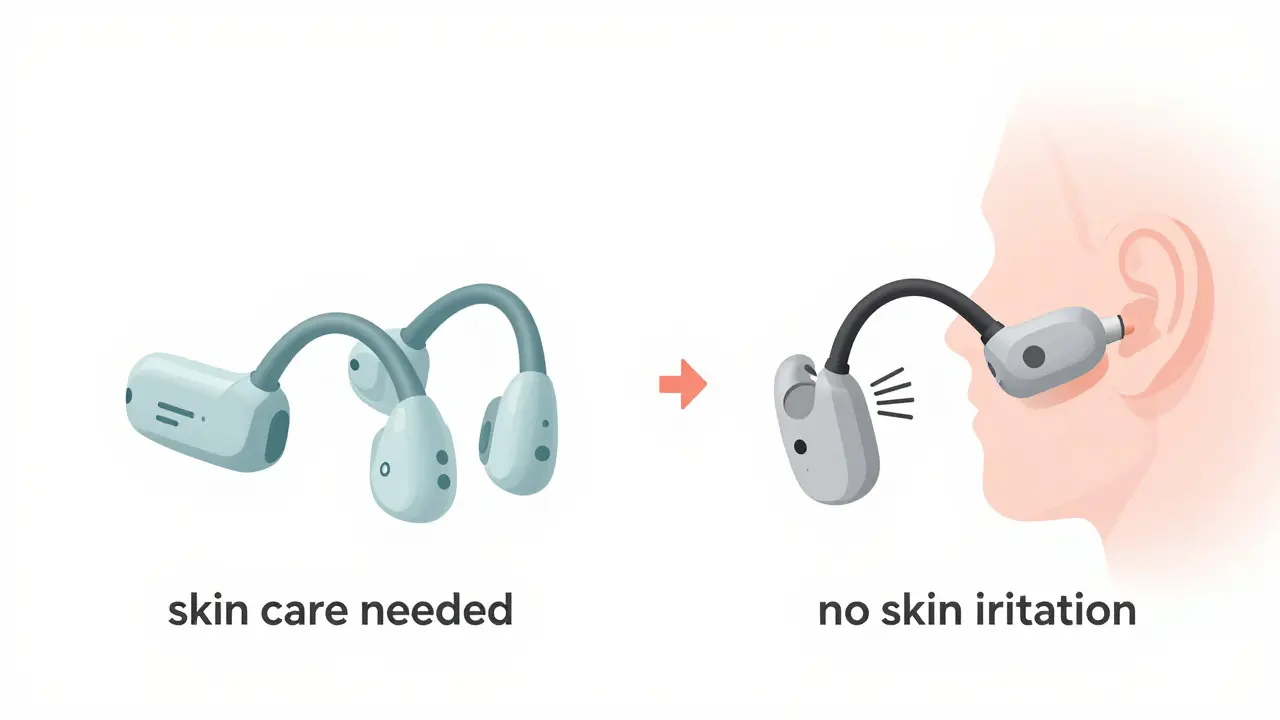
| Skin Care | Daily cleaning required around abutment | No special skin care needed |
| Aesthetics | Visible metal post under hair | Completely invisible; processor looks like a standard hearing aid |
| Best For | Active users, those needing maximum power | Users concerned about appearance or skin irritation |
Percutaneous Systems
These are the original bone-anchored devices, pioneered in Sweden in the 1970s. A small titanium screw is implanted into the skull bone. After 3-4 months, the bone fuses with the titanium (osseointegration). A small metal post (abutment) protrudes through the skin, and the external sound processor snaps onto it.
Pros: They provide the clearest sound because there is no skin barrier to dampen vibrations. They are also lighter and less expensive than transcutaneous options. Models like the Cochlear BAHA Connect 6 offer Bluetooth connectivity and up to 50 dB of gain.
Cons: The visible abutment can be a cosmetic concern for some. More importantly, skin reactions occur in about 15-30% of users. This can range from mild redness to granulation tissue (overgrowth of skin cells) requiring daily cleaning with alcohol or even minor surgical revision.
Transcutaneous Systems
These newer devices, such as the MED-EL Bonebridge or Cochlear BAHA Attract, keep the skin intact. An internal magnet is screwed into the bone, and an external magnet sits on the skin above it. The sound processor attaches to the external magnet.
Pros: No skin irritation issues. The device is completely hidden under the hair, looking like a stylish accessory or a standard hearing aid. Patient satisfaction for aesthetics is significantly higher (92% for Bonebridge vs. 76% for percutaneous, according to MED-EL surveys).
Cons: Skin acts as a dampener. Thicker skin means weaker sound transmission. This results in a 10-15 dB loss in signal quality compared to percutaneous systems. The surgery is also more complex, requiring a deeper pocket in the bone to secure the larger implant.
The Surgical Process and Recovery
Many people fear the word "surgery," but bone conduction implantation is typically a minor outpatient procedure. Here is what you can expect:
- Anesthesia: Most surgeries are done under local anesthesia with sedation, meaning you stay awake but relaxed. General anesthesia is an option, especially for children.
- Duration: The procedure takes 30-60 minutes. The surgeon makes a small incision, drills a pilot hole in the temporal bone (behind the ear), and places the implant.
- Recovery: You can usually go home the same day. Swelling and bruising last for a few days. Most people return to normal activities within 48 hours.
- Healing Time: For percutaneous devices, you must wait 3-4 months for the bone to heal around the implant before activating the sound processor. For transcutaneous magnetic devices, you can often use the processor immediately after surgery, though full integration takes time.
Complications are rare but possible. Infection occurs in less than 5% of cases. The most common issue, particularly with percutaneous devices, is skin allergy or granulation tissue around the abutment. This is manageable with topical creams or minor debridement procedures.
Cost and Insurance Coverage
Let’s talk money. Bone-conduction devices are significantly more expensive than traditional hearing aids. A premium conventional hearing aid might cost $1,500-$3,500 per ear. In contrast, an implantable bone conduction system ranges from $4,000 to $7,000 per ear, plus surgical costs.
However, insurance coverage is much better for bone conduction because it is considered a medical necessity rather than a lifestyle device. In the United States, Medicare and most private insurers cover BAHA and similar devices for qualifying conditions like aural atresia or chronic ear disease. For single-sided deafness, coverage varies by insurer, as SSD is sometimes viewed as less "medically urgent." Always check with your provider and get pre-authorization.
In Australia, the Hearing Services Program may subsidize fittings for eligible patients, particularly children with congenital conditions. Private health insurance extras often contribute towards the cost of the external processor, which needs replacement every 3-5 years.

User Experience: What Does It Feel Like?
Technology specs are important, but how does it feel to wear one? Users report a distinct learning curve. Because the sound enters differently, your brain needs 2-4 weeks to adapt. Initially, voices might sound "hollow" or too loud. Audiologists recommend structured auditory training during this period.
For those with single-sided deafness, the relief is profound. One user described "hearing birds chirping from the deaf side for the first time in 15 years." The ability to localize sound improves dramatically, making crossing streets and navigating busy rooms safer and less stressful.
Comfort is another major win. People with chronic ear infections rejoice at not having anything inserted into their ear canal. The freedom from itching, moisture buildup, and pain is life-changing for many.
However, there are drawbacks. MRI compatibility is a significant issue. Most implants contain metal and must be removed surgically before undergoing an MRI scan, or a special non-magnetic adapter must be used. About 23% of users report frustration with this limitation. Additionally, active athletes sometimes find the external processor catches on helmets or sports gear, though retention bands and softbands solve this for many.
Future Trends and Innovations
The field is evolving rapidly. We are seeing a shift toward transcutaneous systems, which now account for over 60% of new implantations due to lower complication rates. Manufacturers are also integrating advanced AI sound processing to reduce background noise further.
Looking ahead, fully implantable bone conduction devices are in clinical trials. Imagine a system with no external parts at all-just a button press on the neck to activate hearing. While not yet widely available, this represents the next frontier in hearing restoration.
Is bone conduction painful?
The surgery itself is minimally invasive and performed under anesthesia, so you feel no pain during the procedure. Post-surgery, you may experience mild swelling and soreness for a few days, manageable with over-the-counter pain relievers. Wearing the external processor is generally painless, though some users adjust to the sensation of vibration on their skull.
Can I swim with a bone conduction hearing aid?
You must remove the external sound processor before swimming, as it is not waterproof. However, the internal implant is sealed and safe underwater. Some manufacturers offer waterproof adapters or softbands that allow for light water activities, but full submersion usually requires removing the external unit.
How long do bone conduction implants last?
The internal titanium implant is designed to last a lifetime. The external sound processor, however, is an electronic device that typically lasts 3-5 years before needing replacement due to battery degradation or technological obsolescence.
Are bone conduction hearing aids covered by Medicare?
In many cases, yes. Medicare Part B often covers bone-anchored hearing systems for medically necessary conditions like conductive hearing loss or aural atresia. Coverage for single-sided deafness varies. You will likely pay 20% of the Medicare-approved amount after meeting your deductible. Always verify with your specific plan.
What is the difference between BAHA and Ponto?
BAHA (Bone-Anchored Hearing Aid) is a brand name owned by Cochlear Limited, while Ponto is a brand owned by Oticon Medical. Both are percutaneous bone conduction devices with similar performance. The choice often depends on which audiologist you see, aesthetic preferences, and specific feature sets like Bluetooth connectivity or battery life.