

Finding out you have glaucoma is stressful, but the real worry is often the thought of surgery. For years, the goal has been simple: lower the intraocular pressure (IOP) to stop the optic nerve from dying. If eye drops aren't doing the trick, surgery is the next step. But surgery isn't a one-size-fits-all deal. Depending on how advanced your condition is, you might be looking at a gold-standard traditional procedure or a modern, "micro" approach that gets you back on your feet in days rather than weeks.
Quick Summary: What You Need to Know
- MIGS is best for mild-to-moderate cases, offering faster recovery and fewer risks.
- Trabeculectomy is the heavy hitter for advanced glaucoma, providing the lowest possible pressure.
- SLT (Laser) is now often the first line of defense before any surgery is considered.
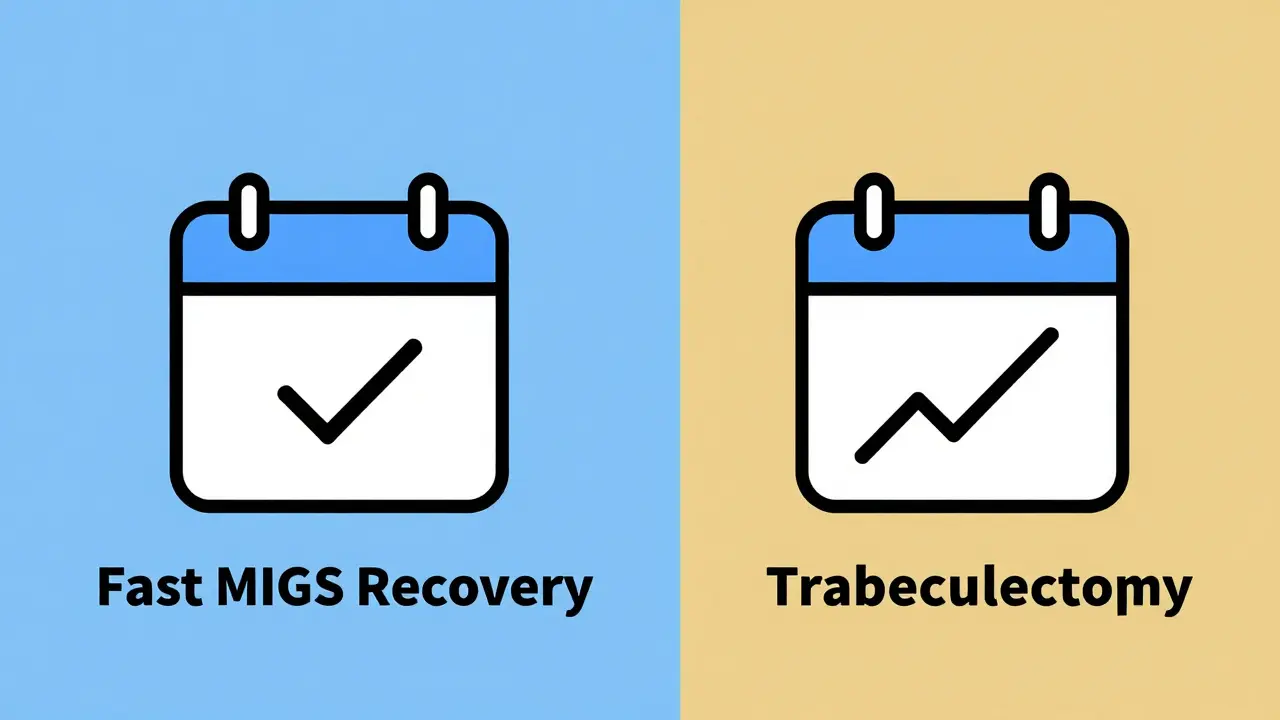
- Recovery ranges from 1-2 weeks for MIGS to over a month for traditional surgery.
The New First Line: Selective Laser Trabeculoplasty
Before we even talk about cutting into the eye, most doctors now start with Selective Laser Trabeculoplasty (SLT). This isn't "surgery" in the traditional sense; it's a laser treatment that takes about 5 to 10 minutes. It works by stimulating the eye's natural drainage system to work better.
Why is everyone talking about SLT? The 2023 LiGHT trial proved that SLT is just as effective as daily eye drops for primary open-angle glaucoma. In fact, about 75.3% of patients maintained their target pressure at three years with the laser, compared to 73.2% using drops. Since it doesn't require downtime and can be repeated, it's become the go-to starting point for many specialists. There's even a newer version called Direct SLT (DSLT) that treats the entire 360-degree area of the eye automatically, though some patients find it a bit more irritating immediately after the procedure.
Understanding MIGS: The Modern, Low-Impact Approach
Minimally Invasive Glaucoma Surgery (MIGS) is a paradigm shift in eye care. Instead of creating a large "leak" for fluid to escape, MIGS uses tiny implants or micro-incisions (usually less than 1.5mm) to clear a path for fluid. Because the incisions are so small, these procedures are often done at the same time as cataract surgery.
There are several types of MIGS devices depending on where the blockage is. For example, the iStent inject uses two tiny stents only 1mm long to bypass the drainage block. The Hydrus Microstent uses a slightly larger 8mm scaffold, while the Xen Gel Stent acts as a micro-shunt to move fluid to the outside of the eye.
For most people, MIGS is attractive because it's safe. Complication rates are very low (usually under 3%), and you're back to your normal routine in 1 to 2 weeks. However, the trade-off is power. MIGS typically reduces pressure by 20-30%, which is great for moderate cases but might not be enough for someone with severe vision loss.

Trabeculectomy: The Gold Standard for Advanced Cases
When the pressure is dangerously high or MIGS hasn't worked, doctors turn to Trabeculectomy. This is a more invasive procedure where the surgeon creates a small hole in the eye's drainage system and a "flap" (a scleral flap) to allow fluid to drain into a small pocket under the eyelid, called a bleb.
If you need your eye pressure to drop significantly-say, down to 5-15 mmHg-this is the procedure that does it. It can reduce IOP by 40-60% in the majority of cases. But that power comes with a price. The recovery is much slower, often taking 4 to 6 weeks, and requires a strict follow-up schedule for several months to ensure the "bleb" doesn't scar over or leak too much fluid.
The risks are also higher here. While MIGS has a tiny risk profile, trabeculectomy carries a 5-15% chance of serious complications, such as hypotony (pressure that is too low) or endophthalmitis (a severe internal infection). Because of this, it's usually reserved for patients with advanced disease or those who can't be managed by less invasive means.
Comparing the Two: Which Path is Right?
Choosing between a "micro" approach and a traditional one depends on your target pressure and your risk tolerance. If you are an active person who can't afford a month of downtime and your glaucoma is mild, MIGS is a logical choice. If you are facing imminent blindness or have a very aggressive form of the disease, the traditional route is often the only safe bet.
| Feature | MIGS (Micro-stents) | Trabeculectomy | SLT (Laser) |
|---|---|---|---|
| IOP Reduction | 20-30% (Moderate) | 40-60% (High) | Varies (Initial) |
| Recovery Time | 1-2 Weeks | 4-6 Weeks | No downtime |
| Risk Level | Very Low (1-3%) | Moderate (5-15%) | Negligible |
| Target Pressure | 15-18 mmHg | 5-15 mmHg | Varies |
| Average Cost | $6,300 (e.g., Xen) | $4,200 | Lowest |
Managing Expectations and Long-Term Outcomes
No surgery "cures" glaucoma; they simply manage the pressure to prevent further damage. One of the biggest hurdles with trabeculectomy is the "bleb failure" rate, where the new drainage site scars shut over time. About 10-20% of patients experience this within five years, meaning they might need a second surgery or return to heavy medication use.
MIGS is still relatively new in the grand scheme of things. While we know it's safer and easier on the body, we don't have 30 years of data on these stents like we do for trabeculectomy. However, the trend is clear: the medical community is moving toward "earlier intervention." Instead of waiting until a patient is nearly blind to operate, doctors are using MIGS and lasers much sooner to preserve the vision that's still there.
If you're weighing these options, ask your surgeon about your "target pressure." If your doctor says you need to be under 12 mmHg to save your sight, a stent might not be enough. But if 16 mmHg is acceptable, the lower-risk MIGS path is often the better quality-of-life choice.
Is glaucoma surgery painful?
Most procedures are performed under local anesthesia or light sedation, so you won't feel the surgery itself. MIGS usually involves very minimal post-op discomfort. Trabeculectomy can be more irritating due to the larger incision and the presence of sutures, but pain is managed with medicated drops.
Can I go back to using eye drops after surgery?
Yes. In many cases, surgery is used to reduce the number of drops you need, not necessarily eliminate them entirely. Some patients can stop drops completely, while others use one mild drop to keep the pressure stable alongside the surgical implant.
How long does a MIGS stent actually last?
Long-term data is still being gathered, but most stents are designed for permanent implantation. Because they are made of biocompatible materials, they generally stay functional for years, though some may require a "revision" if the drainage path becomes blocked by natural tissue.
What happens if a trabeculectomy fails?
If the bleb (the drainage pocket) scars over, the pressure will rise again. In these cases, surgeons can perform "bleb needling" to break up the scar tissue, or they may recommend a tube shunt surgery, which is a more permanent, mechanical way to drain fluid.
Will surgery restore the vision I've already lost?
Unfortunately, no. Glaucoma damages the optic nerve, and that damage is permanent. The sole purpose of these surgeries is to stop further vision loss by keeping the pressure at a safe level. It's about protecting what you have left, not restoring what's gone.
Next Steps and Troubleshooting
If you've just been told you need surgery, don't rush into it without a clear plan. Start by asking your doctor for your current IOP reading and what your specific "target pressure" is. This number is the key to deciding between MIGS and traditional surgery.
For those who have already had a procedure, watch for these red flags: sudden, sharp pain, a sudden increase in floaters, or a dramatic drop in vision. These can be signs of hypotony or infection and require an immediate visit to the clinic. For MIGS patients, the recovery is fast, but you still need to avoid heavy lifting or rubbing your eye for a few weeks to ensure the stents stay perfectly in place.





Joshua Nicholson
April 15, 2026 AT 17:21kinda a lot of info but i guess it works lol
Cheryl C
April 16, 2026 AT 19:09USA healthcare is the best period!! 🇺🇸🇺🇸 these doctors know what they are doin and its just crazy how much tech we got now compared to other places 🎆🦅
Autumn Bridwell
April 17, 2026 AT 11:32OMIGOD I literally cannot even imagine having someone poke around in my eye with a stent! I had a cousin who got a similar procedure and she cried for like three days straight because the pressure felt so weird and it's just absolutely terrifying to think about your vision just slipping away like that! I'm actually shaking just thinking about the 'bleb' thing, like imagine having a little pocket of fluid under your skin, that is just too much for me to handle emotionally!
william wang
April 18, 2026 AT 04:44It's definitely scary, but modern anesthesia makes the actual process very smooth and the goal is to keep those scary outcomes from ever happening.
Nell O'Leary
April 20, 2026 AT 01:09Exactly! The prophylactic nature of early MIGS integration really optimizes the hemodynamic flow within the anterior chamber and minimizes the risk of hypotony ✌️(^_^)✌️
Nathan Berlin
April 20, 2026 AT 04:05imagine thinking this is revolutionary when the best clinics in India are already doing this stuff with way more precision 🇮🇳🇮🇳 we are just on another level of medicine and you lot are just catching up lol 🙄💅
Rob Schlautman
April 20, 2026 AT 07:29honestly the way people just trust these micro-stents without any long term data is just wild to me and i feel like we are all just lab rats in a giant experiment where we trade long term stability for a shorter recovery window which is just typical of modern medicine wanting a quick fix without the actual work of a long healing process and i just find the whole thing a bit naive if you ask me
ira fitriani
April 21, 2026 AT 02:46It is so important to stay positive and fight for your sight! 🌟 You've got this! Just trust the process and keep that spirit high because a positive mindset helps the body heal so much faster! ✨💖
Ben Ferguson
April 22, 2026 AT 18:49I remember talking to a friend who went through the traditional trabeculectomy and the way he described the psychological toll of the month-long recovery was just heart-wrenching because he felt completely disconnected from his daily life and his work and it really makes you appreciate the sheer brilliance of the MIGS approach which allows a person to maintain their dignity and their routine while still getting the medical help they desperately need to save their vision which is the most precious gift we have in this world.
Michael Lewis
April 23, 2026 AT 13:56Stop overthinking the risks and just get the consultation. If your pressure is high, you don't have time to wait around. Get the data, find your target number, and execute the plan. That's how you save your eyes.
Bonnie Piersall
April 24, 2026 AT 08:27Listen up, sugar! Just keep your chin up and don't let the medical jargon spook you into a tizzy. You're tougher than any little stent and as long as you follow the doc's orders to a T, you'll be seeing clearly in no time!