
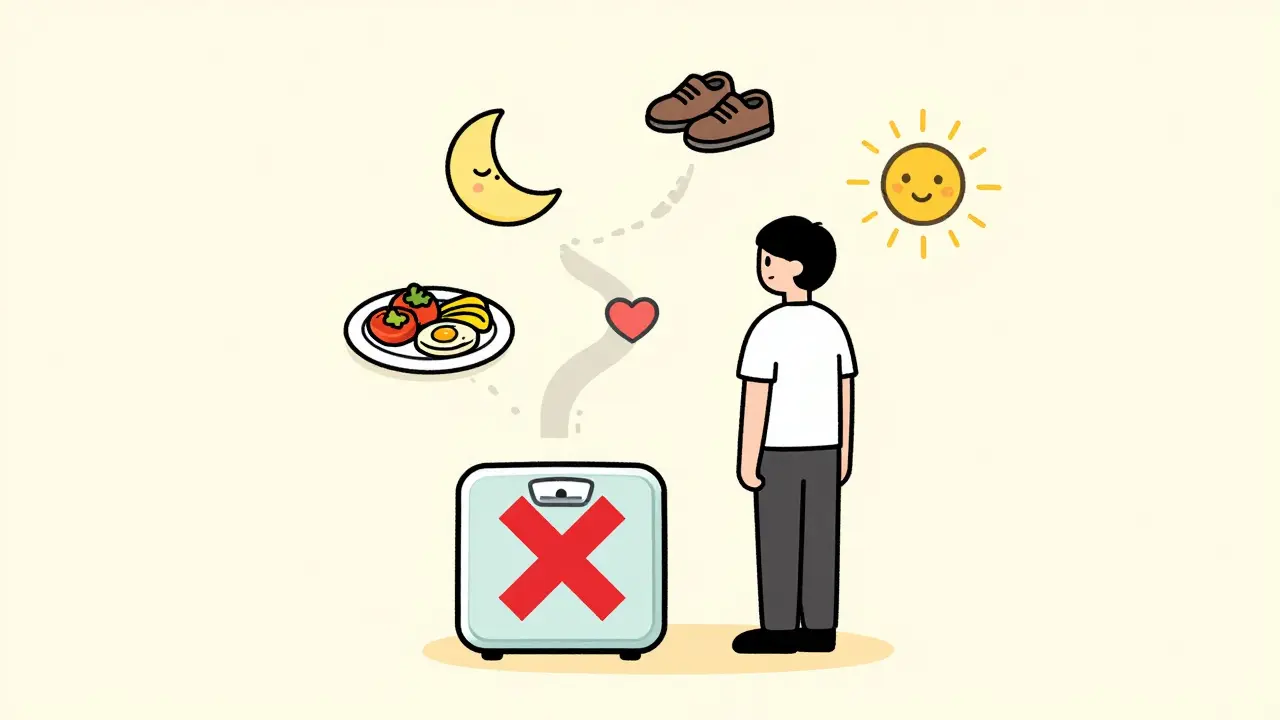
Ever stepped on the scale after weeks of eating better, moving more, and sleeping well-only to see the same number or worse? You’re not failing. The scale is lying to you.
Weight doesn’t tell you if your blood sugar is steadier, if your joints feel lighter, or if you finally slept through the night without reaching for that third cup of coffee. It doesn’t know if you cooked a meal from scratch for the first time in months, or if you walked up the stairs without gasping. It can’t measure the quiet confidence that comes from not obsessing over every bite.
That’s where non-scale victories come in. They’re the real wins-the ones that don’t show up on a digital readout but change your life just as much, if not more.
Why the Scale Doesn’t Tell the Whole Story
The scale measures one thing: total weight. That includes water, food in your gut, muscle, fat, even the clothes you’re wearing. A 2-pound jump after a salty meal? Not fat gain. A 3-pound drop after a long day of sweating? Not fat loss. These fluctuations happen daily, and they’re completely normal.
Studies show that weight can swing up to 5 pounds in a single day due to hydration, hormones, sodium intake, and even the time of day you weigh yourself. For women, the week before menstruation can add 3-4 pounds of water weight. That’s not a setback-it’s biology.
Yet most weight loss programs still treat the scale like a moral judge. If the number goes down, you’re doing well. If it doesn’t, you’ve failed. That mindset burns people out. It makes progress feel invisible. And it ignores the fact that you can lose inches, gain strength, lower your blood pressure, and improve your mood-all without the scale moving an ounce.
What Counts as a Non-Scale Victory?
Non-scale victories are real, measurable improvements in your health that have nothing to do with pounds. They fall into four key areas: biochemical, functional, behavioral, and psychosocial.
- Biochemical: Better lab results. Lower HbA1C. Improved cholesterol. Stable blood sugar. Reduced liver enzymes. These are hard numbers that doctors track-and they matter far more than your weight for long-term health.
- Functional: Physical changes in how your body moves and feels. You can now tie your shoes without bending over awkwardly. You no longer need a seatbelt extender on flights. You climb stairs without stopping. You carry groceries without your back screaming.
- Behavioral: Changes in your habits. You’re cooking at home four nights a week. You drink water before reaching for soda. You eat when you’re hungry and stop when you’re full. You skip the midnight snack without guilt.
- Psychosocial: Mental and emotional shifts. You feel less anxious about food. You’re not checking your reflection in every window. You laugh more. You sleep deeper. You say no to social pressure without feeling guilty.
One patient I worked with lost zero pounds over six months. But her HbA1C dropped from 7.2 to 5.8-off diabetic range. She stopped taking two medications. She started walking her dog every morning. She wore jeans she hadn’t fit into in seven years. Was she a failure? No. She was thriving.
Real Examples People Actually Experience
Here are the non-scale victories real people report-not the fluffy, Instagram-perfect ones, but the quiet, everyday wins:
- Waking up without an alarm because you naturally feel rested.
- Not needing caffeine after 3 p.m. to stay awake.
- Being able to cross your legs while sitting.
- Putting on socks without using a grabber stick.
- Feeling less bloated after meals.
- Having energy to play with your kids or grandkids without needing a nap.
- Choosing a salad over fries-and not feeling guilty afterward.
- Being able to fit into a car without adjusting the seat all the way back.
- Not checking your weight for three weeks-and not missing it.
- Being able to jog for 10 minutes without stopping.
These aren’t lucky accidents. They’re the result of consistent, small choices. And they’re far more meaningful than a number that changes with your last meal.
How to Track Your Own Non-Scale Victories
Tracking wins is only useful if you notice them. Most people don’t. Here’s how to start:
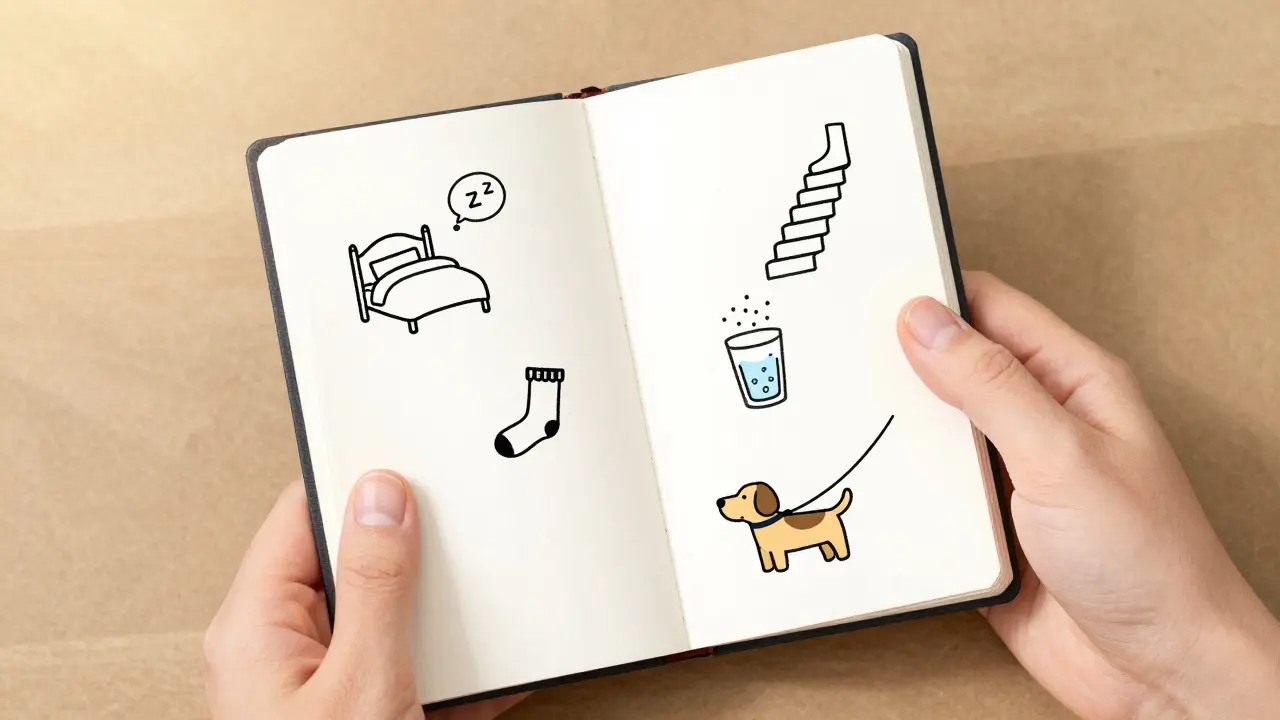
- Write them down. Keep a simple notebook or use your phone. Every Sunday, ask: What changed this week that wasn’t about weight?
- Be specific. Instead of “I feel better,” write: “I walked to the corner store without stopping. I used to need to rest halfway.”
- Use SMART goals. Make victories measurable and time-bound. “Cook three home-cooked meals a week for the next month.” “Drink 8 glasses of water daily for 30 days.”
- Review them monthly. Look back at your list. You’ll see patterns: more energy, less pain, better sleep. That’s progress.
- Celebrate them. Reward yourself with a massage, a new book, a movie night. Not with food. Not with shopping. With joy.
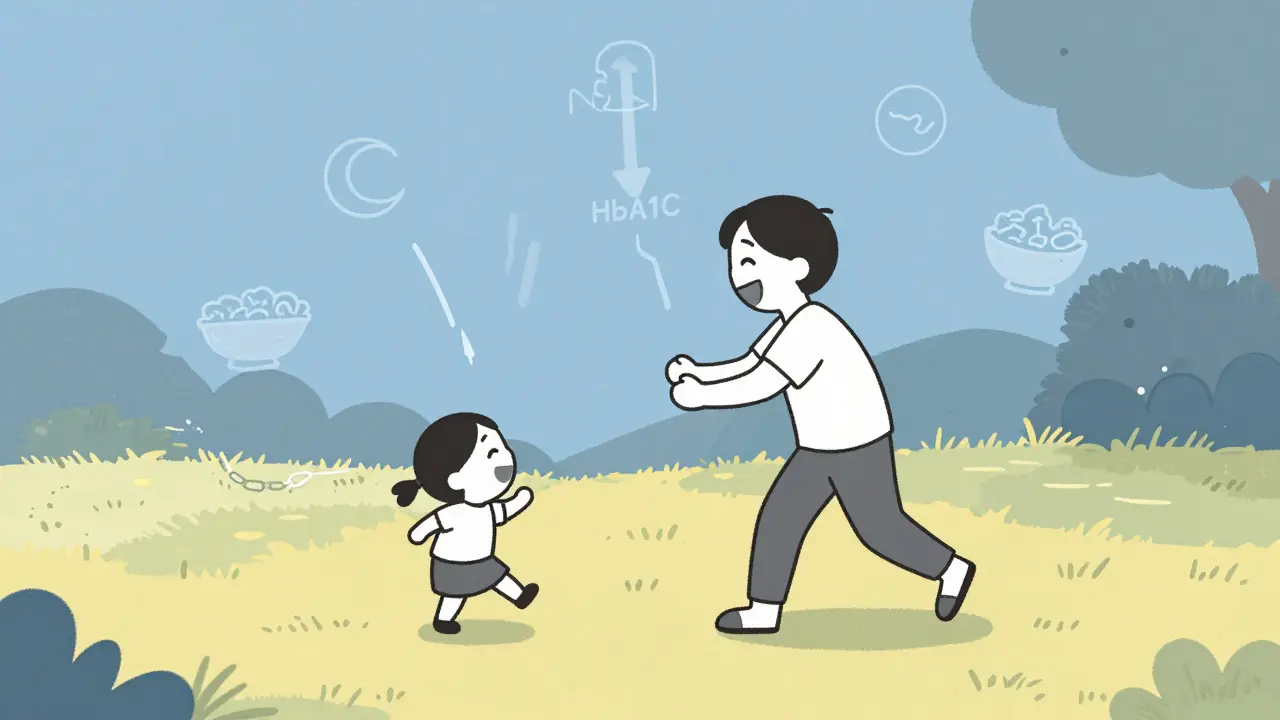
One woman I coached set a goal: “I want to be able to play with my grandson without getting winded.” Six months later, she ran around the backyard with him for 20 minutes. She didn’t lose a pound. But she cried when she told me. That was her victory.
Why This Works Better Than Weight Loss Alone
Weight loss often leads to short-term results. Non-scale victories lead to lifelong change.
Why? Because they focus on behavior, not punishment. When you celebrate cooking a healthy meal instead of berating yourself for eating cake, you build a new identity: I’m someone who cares for my body. That sticks.
Research from the National Institutes of Health shows that people in obesity treatment programs rate non-scale victories as equally important as weight loss for feeling successful. Why? Because they’re tied to real quality-of-life improvements.
When your goal is “lose 20 pounds,” you’re chasing a number. When your goal is “I want to walk without pain,” you’re chasing a better life. And that’s what lasts.
What to Do When You Feel Stuck
It’s normal to hit plateaus. If the scale isn’t moving and you’re not seeing wins, ask yourself:
- Have I slept better this week?
- Am I eating more vegetables than last month?
- Do I feel less stressed about food?
- Have I tried a new activity I actually enjoy?
If you answered yes to even one, you’re progressing. The scale doesn’t get to decide that.
And if you’re still stuck? Talk to a dietitian or health coach. Not to fix your weight-but to help you identify the non-scale victories you’ve been overlooking.
The Bigger Picture: Health Isn’t a Number
We’ve been sold a lie: that your worth is tied to your weight. That if you’re not shrinking, you’re not succeeding.
But health isn’t about fitting into a size. It’s about having energy. Feeling strong. Sleeping well. Managing stress. Enjoying food without guilt. Moving without pain.
Non-scale victories remind us that progress isn’t always visible. Sometimes, it’s silent. It’s the quiet moment when you realize you haven’t thought about your weight all day. It’s the first time you’ve worn your favorite shirt in years-and you don’t care if it’s tight. It’s knowing you’re not broken, you’re becoming.
Let go of the scale. Start noticing the real wins. They’re already there.
Can I still weigh myself if I focus on non-scale victories?
Yes, but don’t let it dictate your mood or self-worth. Weigh yourself no more than once a week, at the same time of day, wearing similar clothes. Use it as a data point-not a verdict. Your non-scale victories are the real indicators of progress.
What if I don’t see any non-scale victories after a few weeks?
Progress isn’t always obvious at first. Start small. Did you drink more water? Walk for 10 minutes? Eat breakfast without rushing? Those count. Keep a journal for two weeks. You’ll start noticing patterns. If you’re still stuck, talk to a professional. Sometimes, underlying issues like sleep apnea, thyroid problems, or stress hormones are blocking progress-and they’re not about willpower.
Do non-scale victories work for people with chronic conditions like diabetes?
Absolutely. For people with diabetes, a drop in HbA1C from 8.0 to 6.5 is a massive win-even if weight hasn’t changed. Improved energy, fewer blood sugar spikes, and less medication are all non-scale victories that directly reduce long-term health risks. These outcomes matter more than pounds.
Are non-scale victories only for people trying to lose weight?
No. They’re for anyone who wants to feel better. People maintaining weight, gaining muscle, recovering from illness, or managing chronic pain all benefit from tracking non-scale victories. Health isn’t just about losing-it’s about thriving.
How long does it take to notice non-scale victories?
Some people notice them within days-better sleep, less bloating, more energy. Others take weeks. It depends on your starting point and what changes you’re making. The key is consistency. Focus on small daily actions. The wins will show up when you stop looking for them on the scale.


Tim Goodfellow
December 20, 2025 AT 14:06Man I love this post. Last month I finally stopped checking the scale and started noticing how I actually feel. I can now chase my niece around the park without gasping. No weight loss. Total win.
holly Sinclair
December 22, 2025 AT 00:42It's fascinating how our culture has conflated numerical outcomes with moral virtue. The scale becomes a proxy for discipline, for worth, for control-but in reality, it's just a mechanical device responding to hydration, hormonal flux, sodium retention, and the gravitational pull of a planet we barely understand. When we stop assigning narrative to a digital readout, we begin to perceive the actual architecture of health: sleep quality, emotional resilience, metabolic efficiency, cognitive clarity-all of which operate in silent, invisible symphonies far beyond the reach of a bathroom scale.
Chris Davidson
December 22, 2025 AT 22:27Non scale victories are just a distraction for people who can't stick to a diet. If you're not losing weight you're not trying. The scale doesn't lie. Your excuses do.
Monte Pareek
December 24, 2025 AT 11:00Chris you're missing the point entirely. The scale is a tool not a judge. I've had clients lose 15 pounds of fat and gain 8 of muscle and the scale didn't budge. But their clothes fell off their bodies. Their blood pressure dropped. They slept like babies. That's the real win. The number is noise. Your mindset is the problem not the scale.
Nicole Rutherford
December 25, 2025 AT 20:06Ugh. This is why people stay fat. You're glorifying mediocrity. If you're not losing weight you're just lazy and this post is enabling it.
Dikshita Mehta
December 27, 2025 AT 07:54I'm from India and this resonates so much. My mother stopped weighing herself after her knee surgery. She started walking daily. Now she dances with my nephew every Sunday. No weight loss. But she's alive again. This isn't just health. It's joy.
Kelly Mulder
December 28, 2025 AT 20:57Non-scale victories? How quaint. Let me guess you also believe in chakras and crystal healing. The only metric that matters is BMI. Everything else is performative pseudoscience masquerading as wellness. You're not healing. You're self-deceiving.
Glen Arreglo
December 30, 2025 AT 04:20Kelly I get where you're coming from but reducing health to a single number ignores decades of medical research. The NIH has published over 200 studies showing that metabolic health improvements without weight loss correlate with lower mortality. This isn't woo. It's evidence. Let's not throw out the baby with the bathwater.
Alex Curran
December 30, 2025 AT 08:05Been doing this for 8 months. My HbA1c dropped from 6.9 to 5.6. I haven't lost a pound. My doctor said I'm now in the non-diabetic range. I didn't even know that counted as a win until I read this. Thanks for putting it in words.
pascal pantel
December 30, 2025 AT 17:45Let's be real. Non-scale victories are just a coping mechanism for people who are statistically unlikely to lose weight. You're trading measurable outcomes for subjective feelings. That's not progress. That's rationalization wrapped in feel-good language. The data doesn't care about your emotional narrative.
Mark Able
January 1, 2026 AT 01:16Wait so you're saying I can eat whatever I want and still be healthy as long as I feel good? That's the dumbest thing I've ever heard. You're literally telling people to ignore biology.