
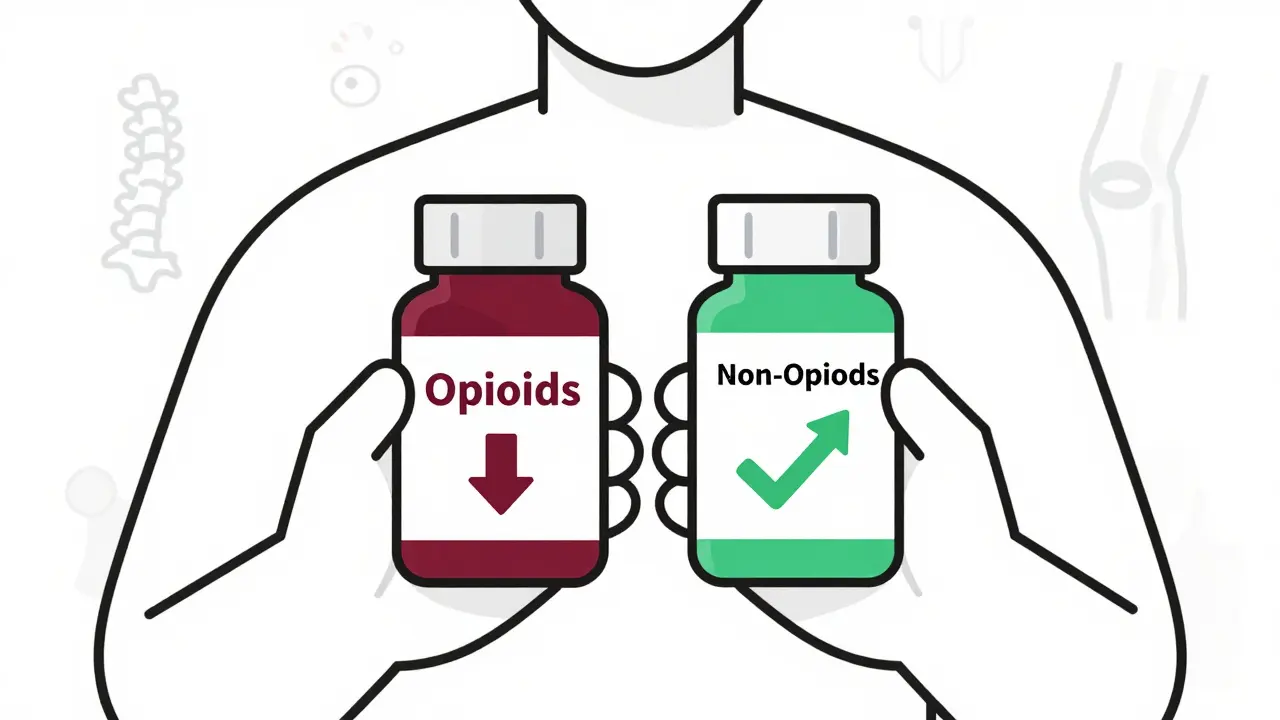
When you hurt - whether it’s a bad back, a sore knee, or post-surgery pain - the first thing you want is relief. But not all pain meds are created equal. For decades, opioids like oxycodone and hydrocodone were the go-to solution. Today, doctors are thinking differently. The truth? opioids aren’t the safest or even the most effective choice for most people - especially over time.
What Are Opioids, Really?
Opioids are drugs that bind to special receptors in your brain and spinal cord to block pain signals. They include prescription pills like oxycodone (OxyContin), hydrocodone (Vicodin), and morphine, as well as illegal drugs like heroin. They work fast and can take severe pain down to a manageable level - which is why they were overprescribed for years.
But here’s the catch: opioids don’t fix the cause of pain. They just mute the signal. And your body adapts. Over time, you need more to get the same effect. That’s tolerance. Then comes dependence. Then addiction. The CDC reported over 80,000 opioid-related overdose deaths in the U.S. in 2021 alone. That’s not a small risk - it’s a public health crisis.
What Are Non-Opioid Pain Relievers?
Non-opioid options include common over-the-counter drugs like ibuprofen (Advil), naproxen (Aleve), and acetaminophen (Tylenol), plus newer prescription drugs like Journavx, approved by the FDA in March 2024. These work differently - they reduce inflammation, block pain chemicals, or target nerve signals without touching opioid receptors.
Unlike opioids, these drugs don’t create physical dependence. They don’t cause euphoria. And they don’t carry the same risk of fatal overdose. That’s huge. But they’re not magic bullets either. Taking too much acetaminophen can wreck your liver. Long-term NSAID use can lead to stomach ulcers or kidney damage. Still, these risks are predictable, manageable, and far lower than those tied to opioids.
Do Opioids Work Better for Chronic Pain?
Here’s the surprising part: no, they don’t.
A major 12-month study published in JAMA in 2018 followed 240 people with chronic back or joint pain. Half got opioids. Half got non-opioid meds like ibuprofen and acetaminophen. At the end of the year, both groups had similar levels of pain relief. But the non-opioid group had slightly better function - they moved better, slept better, and reported less interference from pain.
And the side effects? The opioid group had way more. Nausea, constipation, dizziness, fatigue. One in five dropped out because they couldn’t handle it. The non-opioid group? Far fewer side effects. More people stuck with their treatment.
Another study of nearly 300,000 patients found that people on long-term opioids had a 2.66 times higher risk of heart attack. Even at low doses, the risk went up. That’s not just about addiction - it’s about your heart, your gut, your brain.

What About Kids?
You might think opioids are safer for children after surgery or a broken bone. But a 2024 review of five clinical trials involving kids showed something startling: opioids didn’t work better than ibuprofen or acetaminophen. In fact, kids on morphine or codeine had more nausea, vomiting, drowsiness - and in some cases, dangerous drops in oxygen levels.
One study with 48 children compared codeine and tramadol. Half the kids had vomiting or constipation. Not one group showed better pain control. Yet, the opioid group had more trips to the ER because of side effects.
For children, the message is clear: start with what’s safe. Ibuprofen and acetaminophen are just as effective, with far fewer risks.
Why Are Guidelines Changing?
In 2017, the American College of Physicians said opioids had limited evidence for long-term pain relief - and clear risks. In 2022, the CDC updated its guidelines to say: non-opioid therapy should be the first choice for chronic pain. Not the second. Not the backup. The first.
California’s medical board says the same: try physical therapy, NSAIDs, or other non-drug options before even thinking about opioids. The VA - which treats hundreds of thousands of veterans with chronic pain - confirms this. Their data shows opioids aren’t more effective, but they come with way more side effects.
Even the FDA is stepping in. In 2024, they approved Journavx - the first new non-opioid painkiller in decades. It’s not a miracle drug, but it’s proof that the medical world is moving away from opioids. Not because they’re useless - but because better, safer options exist.
When Might Opioids Still Make Sense?
They’re not all bad. For short-term, severe pain - like after major surgery, a broken bone, or cancer treatment - opioids can be life-changing. A few days, maybe a week or two. That’s fine.
But if your pain lasts longer than a few weeks? The odds shift. The risks grow. The benefits shrink. That’s why doctors now ask: Why start here? Why risk addiction, heart problems, and overdose when safer drugs work just as well?
Even among opioids, some are riskier than others. A 2023 study found that sustained-release oxycodone had a lower risk of overdose and death than sustained-release morphine in veterans. That means not all opioids are equal - but none are risk-free over time.
What Should You Do If You’re on Opioids?
If you’ve been taking opioids for months or years, don’t stop cold turkey. Talk to your doctor. Ask:
- Is this still helping me, or am I just taking it because I’m used to it?
- Have I tried physical therapy, heat, exercise, or NSAIDs?
- What’s my daily morphine equivalent dose? Anything over 120 mg/day doubles the risk of heart problems.
- Can we try cutting back slowly and adding a non-opioid option?
Many people find they feel better - not worse - when they reduce opioids. Less fog. Better sleep. More energy. Less constipation. Their pain doesn’t spike. Their life improves.
The Bottom Line
Pain is real. So are the risks of the drugs we use to treat it. Opioids have a place - but only for a short time, in specific situations. For most people with ongoing pain, non-opioid options are just as effective, safer, and far less likely to ruin your life.
The science isn’t complicated. The data is clear. The guidelines are updated. The FDA is approving new alternatives. The question isn’t whether opioids work - it’s whether you want to risk your health for a benefit you might not even be getting.
Start with ibuprofen. Try acetaminophen. Get moving. See a physiotherapist. Ask about Journavx if your pain is acute. And if you’re on opioids - talk to your doctor. You don’t have to live with fear. You don’t have to live with dependence. Better, safer relief is out there.
Ben Harris
December 24, 2025 AT 23:11Anyone else notice how the FDA just approved Journavx right after Big Pharma started lobbying for it? Of course they’re pushing non-opioids now - they need a new cash cow. Opioids are bad? Sure. But so is paying $1,200 a month for some new ‘miracle’ pill that’s just a rebranded NSAID with a patent
Zabihullah Saleh
December 26, 2025 AT 22:27There’s a quiet truth here that nobody says out loud: pain isn’t just a biological signal. It’s a story your body tells you. Opioids don’t just mute pain - they mute the story. And sometimes, the story needs to be heard. But we’ve turned pain into a problem to be erased, not a teacher to be listened to. Maybe the real crisis isn’t opioids - it’s our refusal to sit with discomfort.
Winni Victor
December 27, 2025 AT 18:23Oh wow so now we’re supposed to believe ibuprofen is the new holy grail? LOL. My aunt took Tylenol for 15 years and ended up with liver failure. Meanwhile my cousin got a spinal fusion and was on oxycodone for two weeks - he’s back hiking. You want to tell me which option is safer? The one that didn’t turn him into a zombie or the one that turned his liver into a brick?
Rick Kimberly
December 28, 2025 AT 18:12It is imperative to acknowledge that the data presented in this article is both statistically significant and methodologically sound. The JAMA study, with its longitudinal design and controlled variables, provides compelling evidence that non-opioid pharmacotherapy yields comparable analgesic outcomes with significantly reduced adverse event profiles. The CDC guidelines, grounded in meta-analytic review, represent a paradigm shift grounded in evidence-based medicine.
Terry Free
December 29, 2025 AT 21:25Oh so now we’re all supposed to be ‘responsible’ and ‘listen to our doctors’? Yeah right. The same doctors who prescribed opioids like candy in the 90s? The same ones who didn’t even check if you had a history of addiction? I’m not trusting another pill. I use heat, ice, and yoga. And I don’t need a $200 pill to tell me I’m in pain.
Lindsay Hensel
December 30, 2025 AT 12:14Every person’s pain is different. Some need opioids. Some don’t. But the system doesn’t let us choose - it pushes one-size-fits-all. And that’s the real tragedy. Not the drugs. The lack of compassion in the way we treat suffering.
Linda B.
December 31, 2025 AT 06:22Did you know the CDC got funding from Gates Foundation to push non-opioid protocols? And who owns Journavx? A subsidiary of a company that also makes antidepressants. Coincidence? Or is this about controlling how we feel? They don’t want you in pain - they want you medicated. Always medicated. Always dependent. Just not on opioids. On their drugs.
Christopher King
January 1, 2026 AT 22:29Let me tell you something - the opioid crisis was manufactured. It wasn’t doctors being greedy - it was the government letting Big Pharma write the rules. Now they’re flipping the script to make you believe non-opioids are the answer. But guess what? They’re still pushing pills. They just changed the label. Wake up. The system doesn’t care if you’re in pain - it cares if you’re profitable.
Michael Dillon
January 1, 2026 AT 23:36I’ve been on opioids for chronic back pain for 7 years. I’m not addicted. I’m not high. I’m functional. I work. I raise kids. I hike. I’ve tried everything else - NSAIDs made me dizzy, PT didn’t touch the pain. Opioids let me live. Don’t shame people who need them just because you read a study.
Gary Hartung
January 3, 2026 AT 01:29It’s fascinating - and frankly, predictable - that the medical establishment, having spent two decades normalizing opioid use, now pivots with such moral certainty to non-opioid alternatives… as if they never once considered the psychological, social, and neurobiological complexity of chronic pain. The rebranding is almost poetic: we’ve replaced one form of chemical control with another - and called it ‘progress’.
Jason Jasper
January 4, 2026 AT 13:01I’ve been off opioids for a year now. Started with naproxen, then added acupuncture, then physical therapy. Took time. Felt worse before I felt better. But now? I sleep through the night. I don’t feel foggy. I don’t dread the next refill. I’m not cured - but I’m alive. And that’s worth the struggle.
Carlos Narvaez
January 5, 2026 AT 02:27Non-opioids work. But they’re not magic. And if you’re telling people to ‘just take ibuprofen’ like it’s a vitamin, you’re ignoring the reality of severe chronic pain. The system’s broken. Not the drugs.
Harbans Singh
January 6, 2026 AT 06:15In India, we’ve always used turmeric, heat, and movement for pain. No pills. No drama. Just patience. Maybe we don’t need new FDA-approved drugs - maybe we need to remember old ways. Not as replacements. As companions.
Justin James
January 7, 2026 AT 14:17Here’s the real story they don’t want you to hear - the opioid crisis was used to justify mass surveillance of chronic pain patients. Now every prescription is tracked. Every refill questioned. Every doctor monitored. They didn’t fix the problem - they turned patients into suspects. And now they’re selling you a new drug to keep you quiet while they keep watching. You think Journavx is for you? Or for them?
Sophie Stallkind
January 8, 2026 AT 11:02Thank you for this comprehensive and well-researched summary. The ethical imperative to prioritize patient safety over convenience is unequivocal. The data is unequivocal. The moral responsibility is clear. We must advocate for systemic change that centers dignity, not dependency.