
What QD and QID Really Mean (And Why It Matters)
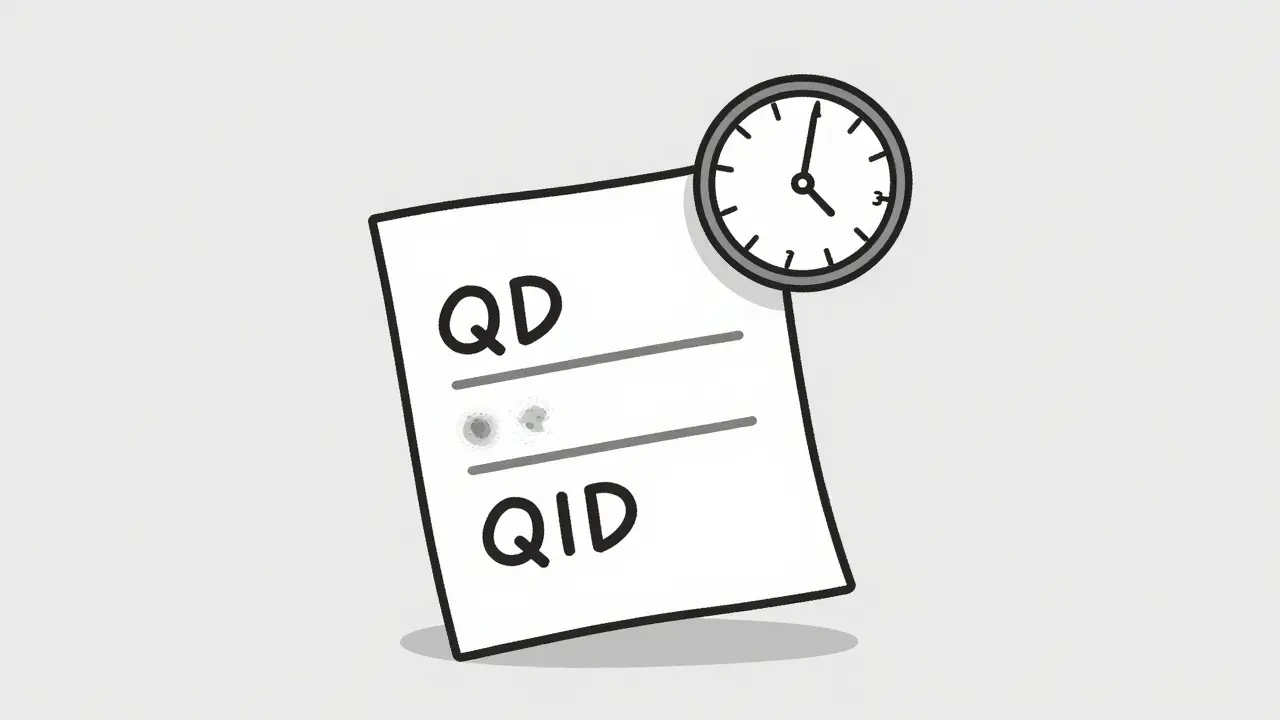
QD and QID sound harmless-just two letters on a prescription. But mix them up, and someone could take four times the medicine they’re supposed to. QD stands for quaque die, Latin for "once daily." QID means quater in die, or "four times daily." Simple, right? Except in the real world, they’re not. A handwritten "QD" can look like "QID" if the doctor’s pen slips or the ink smudges. Even in digital systems, clicking the wrong dropdown can send the wrong instruction to the pharmacy. And when that happens, patients end up with too much medication-and sometimes, serious harm.
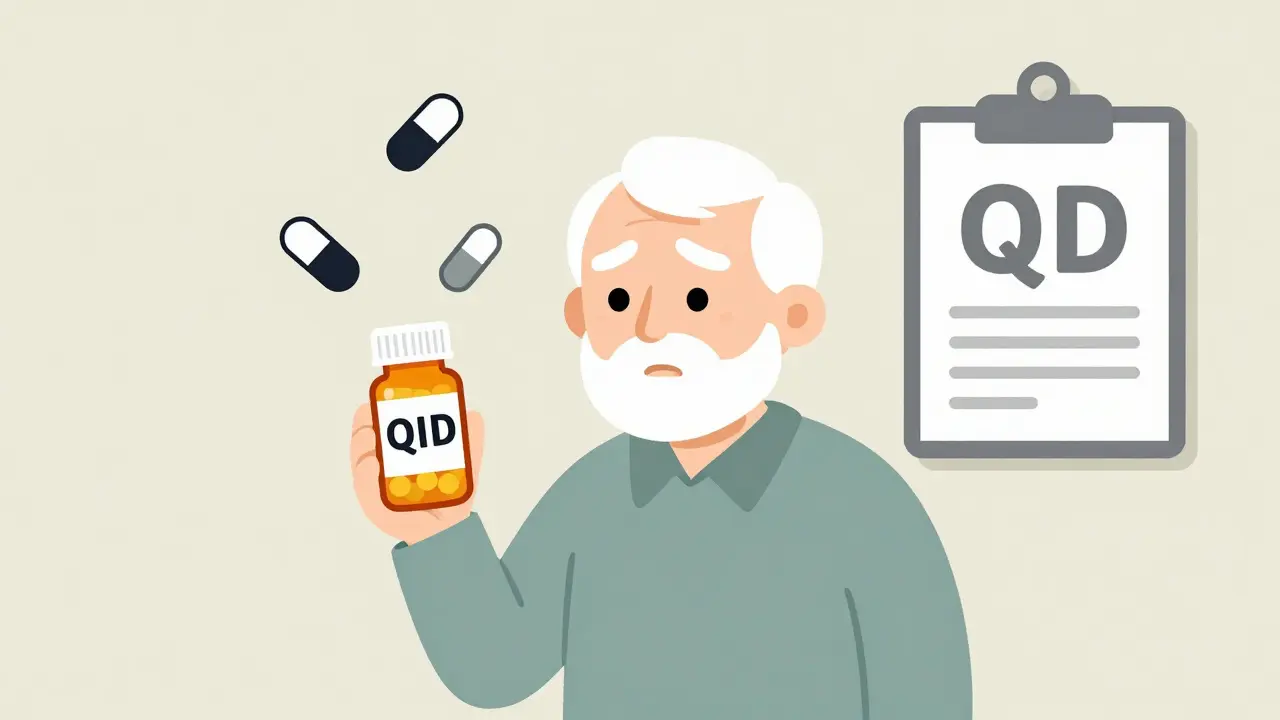
One real case from Minnesota involved an elderly man prescribed a sedative once a day. He took it four times a day for a week. He was still driving his granddaughter to school, working as a construction inspector, and barely noticed he was too drowsy to think straight. It wasn’t until he went back for a refill that the pharmacist caught the mistake. That’s not rare. According to the U.S. Food and Drug Administration, about 5% of all medication errors reported come from confusing abbreviations like these. And QD/QID mix-ups are among the most common.
Why These Abbreviations Are Still Around
You’d think by now, after being banned for over 20 years, doctors would stop using QD and QID. But they haven’t. The Institute for Safe Medication Practices flagged them as dangerous in 2001. The Joint Commission added them to their "Do Not Use" list in 2004. Yet, a 2015 study by the American Medical Association found that nearly one in three handwritten prescriptions still used these abbreviations. Why? Habit. Speed. Outdated training.
Many older doctors learned Latin abbreviations in medical school decades ago. They’ve been writing "QD" for 30 years. Switching to "daily" feels slower, even though it’s safer. And in busy clinics, time is tight. Some still think, "It’s obvious what I meant." But it’s not obvious to the pharmacist, the nurse, or the patient trying to read the tiny print on the label.
Even electronic systems don’t fix everything. A 2021 study from the Agency for Healthcare Research and Quality found that 3.8% of errors still happen in EHR systems-because providers manually override the safe defaults. They type "QID" instead of selecting "four times daily" from the dropdown. Why? Because they’re used to it. Because they don’t see the warning. Because the system lets them.
The Real Cost of a Mistake
It’s not just about drowsiness or confusion. Taking a blood thinner like warfarin four times instead of once can spike your INR to dangerous levels-12.3, in one documented Reddit case. That’s more than double the safe range. The patient ended up in the hospital with internal bleeding. Another patient had blood pressure crash to 80/50 after a nurse misread "QD" as "QID" on a hypertension script. That’s not a typo. That’s a medical emergency.
These aren’t hypotheticals. The National Coordinating Council for Medication Error Reporting and Prevention says 78% of QD/QID mix-ups cause actual harm-Category E errors. That means the patient needed treatment, hospitalization, or had prolonged injury. The Medicare Payment Advisory Commission estimates these kinds of errors cost the U.S. healthcare system $780 million a year just from dosing confusion. Add in lost wages, emergency visits, and long-term care, and the real cost is far higher.
And who pays the most? Elderly patients. The American Geriatrics Society found that 68% of documented QD/QID errors happen in people over 65. Why? They’re often on five, ten, or more medications. Their eyesight isn’t what it used to be. They might not speak English well. They trust the doctor. They trust the pharmacy. They don’t question the label. And when the label says "QID," they take it four times-because that’s what it says.
How Patients Get Caught in the Crossfire
Patients aren’t the problem. They’re the victims. A 2021 survey by the National Patient Safety Foundation found that 63% of people admitted they’ve been unsure about how often to take their medicine at least once. "QD vs QID" ranked as the third most confusing instruction-right after "take with food" and "take on empty stomach." One patient on Healthgrades wrote: "I took my pill four times a day because the script said QID. I didn’t know QD meant once. I thought it was a typo. I felt awful for days." That’s not ignorance. That’s a system failure.
Pharmacists are catching these errors-but too late. On forums like Student Doctor Network, pharmacists report intercepting an average of 2.7 QD/QID mix-ups per week in community pharmacies. That’s nearly 140 a month. Each one requires a phone call to the doctor, a new label, and a patient education session. It’s exhausting. And it doesn’t fix the root problem.
What’s Being Done to Fix It
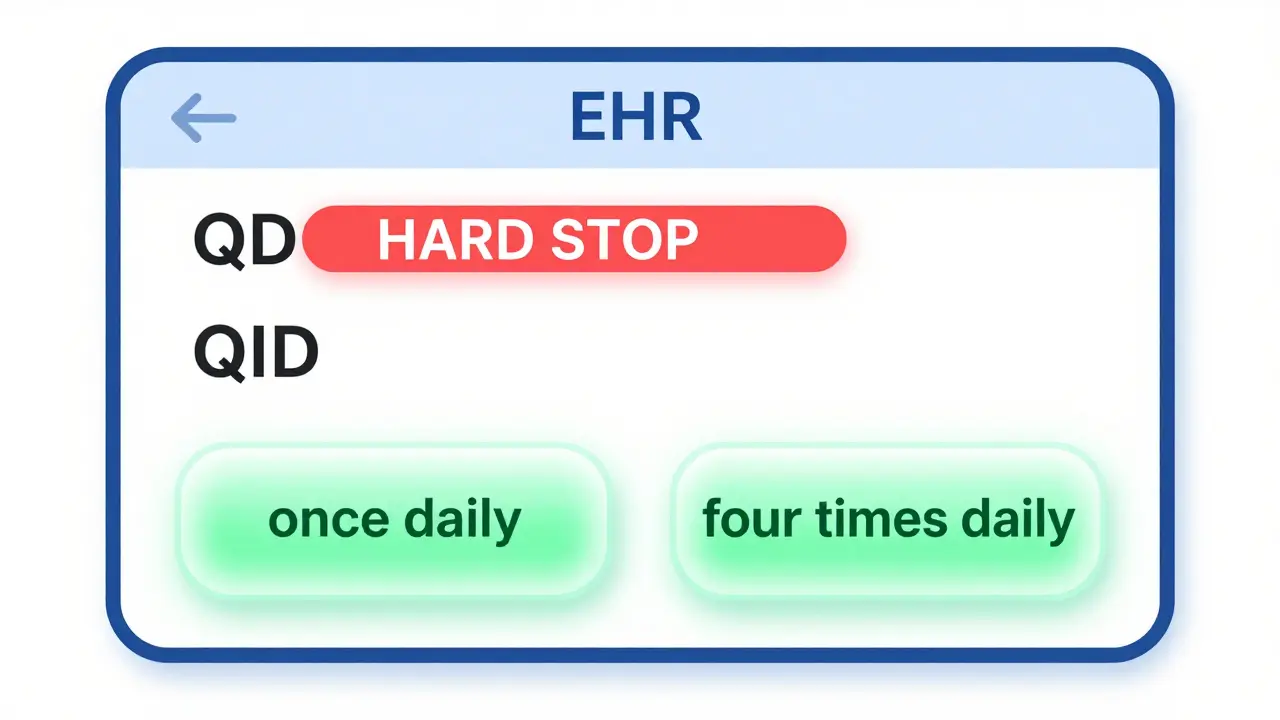
Change is happening-but slowly. In 2023, the American Medical Association updated its guidelines to mandate writing "daily" instead of "QD". The FDA followed with draft guidance urging the complete end of Latin abbreviations. Epic and Cerner, the two biggest EHR systems, now have "hard stops"-if you type "QD" or "QID," the system won’t let you save the prescription. You have to pick "once daily" or "four times daily" from a menu.
Hospitals that banned these abbreviations saw dosing errors drop by 42% in just 12 months. The University of Michigan found that requiring pharmacists to verbally confirm dosing frequency with every new patient cut errors by 67%. That’s huge. It’s simple, too: "Can you tell me how often you’re supposed to take this?" not "Is this QD?"
The National Action Alliance for Patient Safety launched the "Clear Communication Campaign" in April 2023 with $45 million in funding. Their goal? Reduce abbreviation-related errors by 90% by 2026. That’s ambitious. But doable-if everyone plays their part.
How to Prevent These Errors-For Everyone
If you’re a doctor: Write it out. Say "once daily," not "QD." Say "four times daily," not "QID." It takes three extra letters. It saves lives.
If you’re a pharmacist: Don’t assume. When you see "QD" or "QID," call the prescriber. Verify. And if you’re in a hurry, still call. One extra minute now prevents a hospital stay later.
If you’re a nurse or technician: Double-check. If a patient says they’re taking something "every six hours," ask why. QID doesn’t mean every six hours-it means four times during waking hours. That’s usually 7 AM, 1 PM, 7 PM, and 11 PM. Not midnight.
If you’re a patient: Speak up. If the label says "QD" or "QID," ask. "Does this mean once a day or four times?" Write it down. Use your phone to take a picture of the label and show it to a family member. Don’t be embarrassed. You’re not the first person to be confused. And you won’t be the last.
Health systems should also use visual aids. A Johns Hopkins study in late 2023 showed that adding simple icons-like a sun for "daily" or four suns for "four times a day"-reduced confusion by 82%. A picture beats a letter every time.
What’s Next
The global market for medication safety tech is growing fast-projected to hit $4.5 billion by 2030. That’s because hospitals, pharmacies, and insurers are realizing that preventing one error saves thousands. Training staff costs $8,500 to $12,000 per hospital. But the cost of one preventable death? Priceless.
By 2026, QD and QID should be relics-like typewriters and fax machines. But until then, every single person in the chain has a role. The doctor writes it clearly. The pharmacist checks it. The nurse explains it. The patient asks. And together, we stop the next mistake before it happens.




Beth Cooper
January 31, 2026 AT 20:23Donna Fleetwood
February 2, 2026 AT 02:17Melissa Cogswell
February 2, 2026 AT 11:20Diana Dougan
February 4, 2026 AT 00:39Bobbi Van Riet
February 4, 2026 AT 05:49Holly Robin
February 5, 2026 AT 19:41Shubham Dixit
February 6, 2026 AT 21:03KATHRYN JOHNSON
February 7, 2026 AT 00:48Sazzy De
February 8, 2026 AT 08:17Blair Kelly
February 10, 2026 AT 03:13Rohit Kumar
February 11, 2026 AT 02:48Lily Steele
February 12, 2026 AT 02:50