
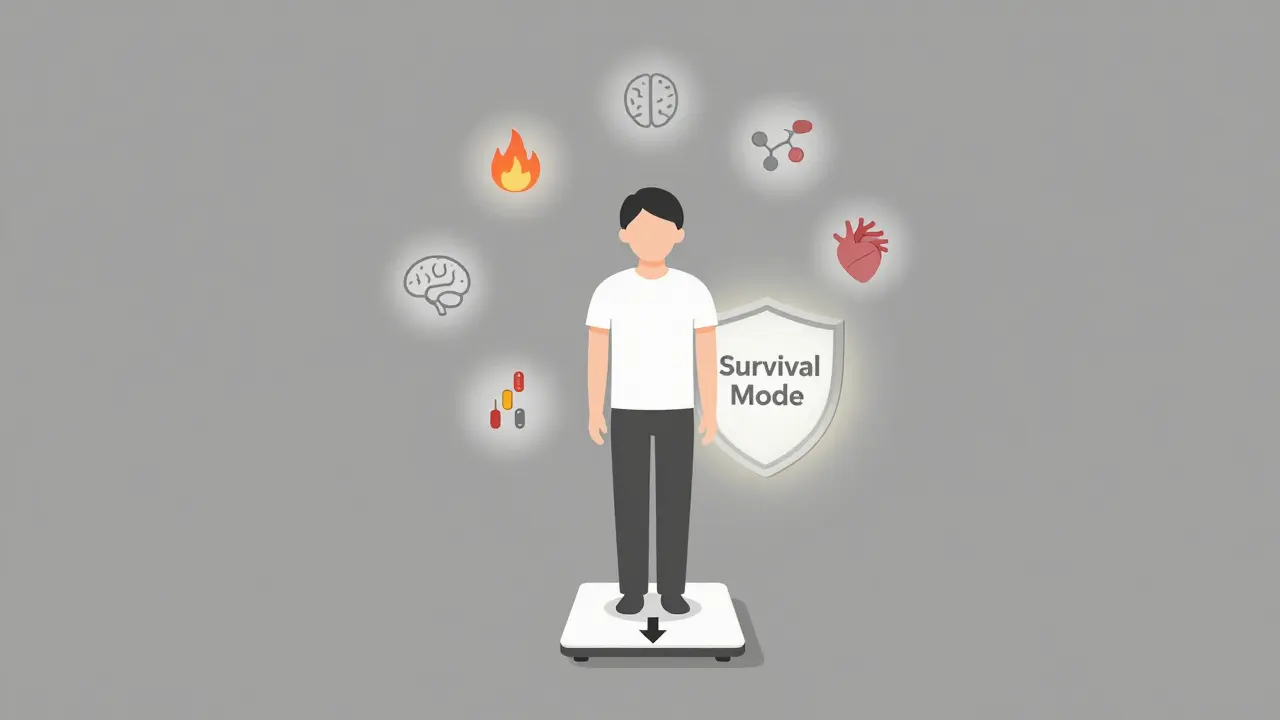
You’ve been eating clean, hitting the gym, tracking every calorie-and yet, the scale won’t budge. It’s been weeks. Maybe months. You’re not lazy. You’re not failing. You’re just hitting something your body was designed to do: defend its weight.
Why Your Weight Loss Stopped (It’s Not Your Fault)
When you lose weight, your body doesn’t just shrug and say, ‘Okay, less mass, less energy needed.’ It fights back. Hard. This isn’t a glitch. It’s biology.
Research from the University of Alabama at Birmingham shows that after weight loss, your resting metabolic rate drops more than expected-sometimes by over 100 calories a day-just because you’re lighter. That’s not just from losing fat. Your body actively slows down energy use to hold onto what it thinks is survival mode. This is called adaptive thermogenesis. It’s the same mechanism that kept people alive during famines, like in the Minnesota Starvation Experiment of the 1940s, where participants’ metabolisms dropped nearly 40% beyond what their new weight should have required.
Leptin, the hormone that tells your brain you’re full, can plummet by up to 70% after significant weight loss. Your thyroid activity slows. Cortisol, the stress hormone, rises. Your brown fat-your body’s natural furnace-becomes less active. All of this adds up to one thing: you’re burning fewer calories now than you did before you lost weight, even if you’re eating the same amount.
And here’s the kicker: this doesn’t go away after a few weeks. Studies show these metabolic changes stick around for over a year-even after you’ve stabilized at your new weight. That’s why so many people regain weight. It’s not lack of willpower. It’s your metabolism playing defense.
The Myth of ‘Just Eat Less’
Most people respond to a plateau by cutting calories even further. 1,500 becomes 1,200. Then 1,000. But here’s what happens: your body adapts even more. You get hungrier. You feel exhausted. Your workouts suffer. You’re not losing fat-you’re losing muscle, energy, and motivation.
A 2023 Reddit analysis of 1,200 posts from people stuck in plateaus found that 78% were eating between 1,200 and 1,500 calories a day. And yet, they weren’t losing. Why? Because their metabolism had already adjusted. Cutting more calories doesn’t restart weight loss-it deepens the adaptation.
The Mayo Clinic says it plainly: as you lose weight, your metabolism declines. You burn fewer calories than you did at your heavier weight. That’s not a failure. It’s physics. And if you keep treating it like a discipline problem, you’ll end up in a cycle of restriction, burnout, and regain.
What Actually Works: Breaking the Plateau
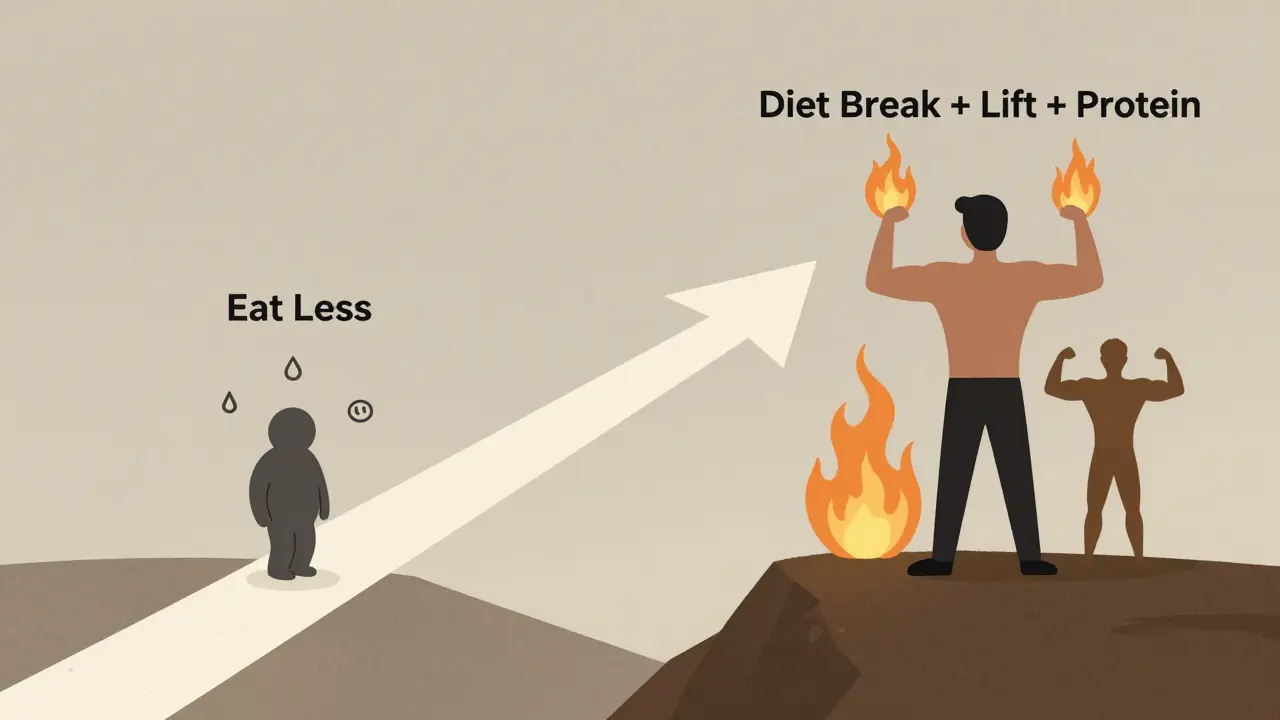
There are three science-backed ways to reset your metabolism and get moving again.
1. Take a Diet Break
Instead of pushing harder, pause. Go back to eating at your maintenance calories for 1-2 weeks every 8-12 weeks. No tracking. No guilt. Just eat like you did before you started losing weight.
Why? Because this tells your body, ‘We’re not in danger anymore.’ Leptin levels bounce back. Thyroid function improves. Your metabolism starts to creep upward again. A 2018 study found that diet breaks reduced metabolic adaptation by up to 50%. That’s like getting your metabolism’s volume turned back up after it was muted.
One woman from Brisbane lost 32 pounds over 6 months, then hit a 14-week plateau. She took a 10-day break, eating 2,100 calories a day (her maintenance), and came back to weight loss within days. She didn’t gain weight. She reset her body.
2. Lift Weights
Cardio burns calories. But muscle burns calories all day, every day. When you lose weight, your body tends to lose muscle along with fat-especially if you’re not lifting. And every pound of muscle you lose drops your resting metabolic rate by 6-10 calories per day.
Studies show that people who lift weights 3-4 times a week during weight loss lose 8-10% less muscle than those who only do cardio. That means their metabolism doesn’t crash as hard. You don’t need to be a bodybuilder. Squats, push-ups, rows, and deadlifts-even with light dumbbells-make a difference.
One 2000 study found that women who lifted weights during weight loss maintained more muscle and lost more fat than those who didn’t-even when both groups ate the same calories.
3. Eat More Protein
Protein isn’t just for building muscle. It’s your best friend during weight loss. It keeps you full longer. It protects your muscles. And it takes more energy to digest than carbs or fat.
Research shows that eating 1.6-2.2 grams of protein per kilogram of body weight during a calorie deficit leads to 3.2 kg more fat loss and 1.3 kg less muscle loss than lower protein diets. That’s huge.
For a 70kg person, that’s 112-154 grams of protein a day. That’s 3 eggs at breakfast, a chicken breast at lunch, a can of tuna for a snack, and a Greek yogurt or protein shake at night. It’s not hard. It’s just different from what most ‘low-calorie’ meal plans suggest.
What Doesn’t Work (And Why)
There are a lot of quick fixes out there. Detox teas. Fat-burning pills. 12-hour fasts. Intermittent fasting might help some people, but it doesn’t fix metabolic adaptation. If you’re eating the same calories, fasting just shifts when you eat-it doesn’t change your metabolic rate.
And don’t fall for the ‘eat less, move more’ myth. That’s like saying, ‘If your car’s running out of gas, just drive slower.’ It ignores the fact that the engine is failing.
Even the most popular apps and programs often ignore this. WW updated their Points system in 2021 to account for metabolic adaptation. Noom added ‘metabolic reset’ features in 2022. But most free online plans? Still pushing the same old advice: cut more. Move more. Try harder.
The Bigger Picture: Weight Loss Isn’t Linear
Think of your body like a thermostat. It’s not trying to make you fat. It’s trying to keep you alive. Your ‘defended weight’ range-the weight your body thinks is safe-isn’t fixed. But it’s stubborn.
That’s why bariatric surgery works so well for severe obesity: it changes your hormones and gut signals so your body stops defending its old weight as fiercely. GLP-1 agonists like semaglutide help by reducing the hunger surge that comes with weight loss. But you don’t need surgery or drugs to reset your metabolism.
You just need to stop fighting it. Start working with it.
What Comes Next: The Future of Weight Loss
By 2025, experts predict 85% of science-backed weight loss programs will include strategies to manage metabolic adaptation. Cold exposure to activate brown fat. Targeted supplements to boost UCP-1. Personalized calorie adjustments based on hormone levels.
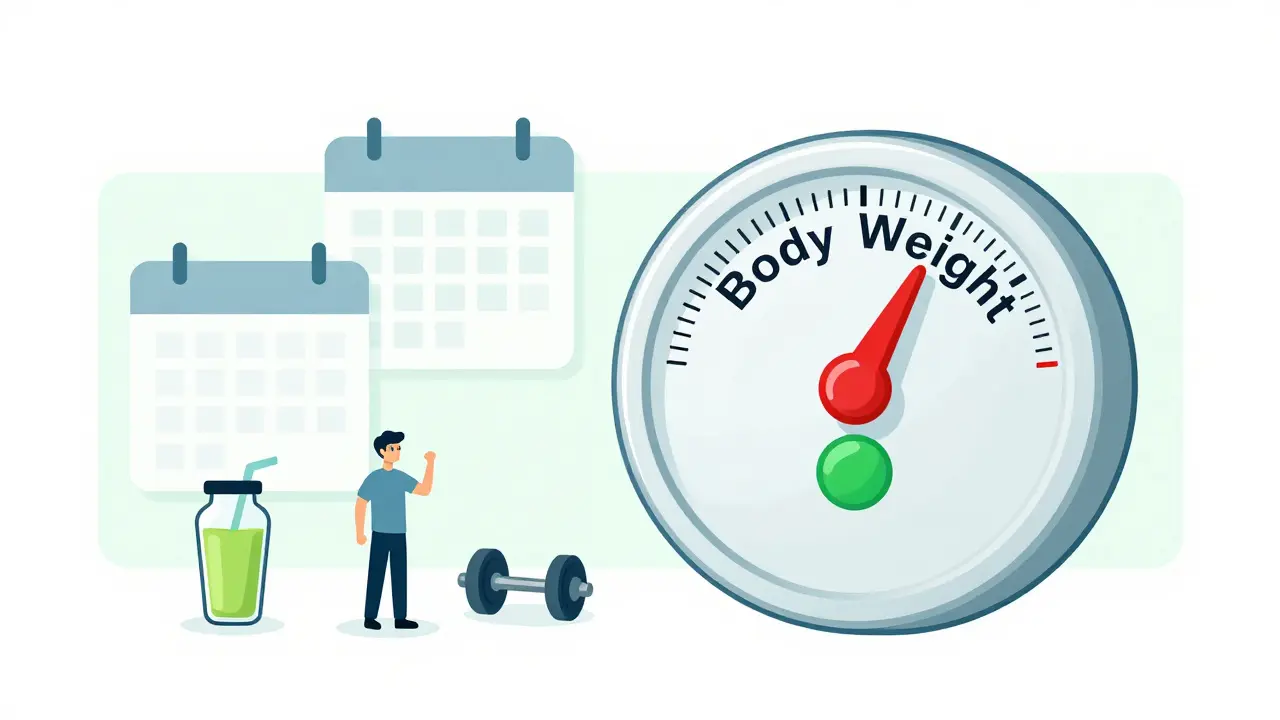
But you don’t have to wait for the next breakthrough. The tools are already here: diet breaks, strength training, and enough protein. These aren’t hacks. They’re biology.
Weight loss isn’t about how hard you push. It’s about how smart you work with your body. The plateau isn’t the end. It’s a signal. Listen to it. Adjust. Reset. Then keep going.
How long does a weight loss plateau usually last?
Most plateaus last between 4 and 12 weeks. If you’ve been stuck for more than 12 weeks despite consistent effort, metabolic adaptation is likely the main cause-not lack of discipline. Taking a diet break or adjusting protein and training can often restart progress within days.
Can you reset your metabolism after a plateau?
Yes. Your metabolism isn’t broken-it’s just in survival mode. Diet breaks, strength training, and higher protein intake can restore metabolic rate by reducing adaptive thermogenesis. Studies show these methods can reverse up to half of the metabolic slowdown within 2-4 weeks.
Do diet breaks cause weight gain?
Short-term diet breaks (1-2 weeks at maintenance calories) typically cause minimal or no weight gain. Any increase is usually water weight from glycogen replenishment. After the break, most people resume losing weight at the same or even faster rate than before.
Is reverse dieting the same as a diet break?
Not exactly. A diet break is a short pause at maintenance calories to reset hormones and metabolism. Reverse dieting is a longer-term strategy of slowly increasing calories over weeks or months to raise your metabolic rate after prolonged restriction. Both help, but diet breaks are faster and simpler for most people.
Why do women hit plateaus more often than men?
Women naturally have more brown fat and higher levels of leptin, which makes their bodies more sensitive to energy deficits. During weight loss, women often experience greater drops in leptin and thyroid activity, leading to stronger metabolic adaptation. They also tend to lose more muscle if protein and resistance training aren’t prioritized.
Should I count calories forever?
No. Calorie counting is a tool, not a lifestyle. Once you understand portion sizes, protein needs, and how your body responds to food, you can transition to intuitive eating. Many people find that after a plateau and a reset, they naturally eat better without tracking-because their hunger cues are back.
When should I see a doctor about a plateau?
If you’ve tried diet breaks, increased protein, and strength training for 6-8 weeks with no progress, it’s worth checking for underlying issues like thyroid dysfunction, insulin resistance, or PCOS. But for most people, the plateau is metabolic adaptation-not a medical problem.
Final Thought: This Isn’t a Race
Weight loss isn’t about speed. It’s about sustainability. The body that adapted to protect you during famine isn’t going to give up easily. But it will listen-if you speak its language.
Stop punishing yourself. Start respecting your biology. Take a break. Lift heavier. Eat more protein. Then come back. The scale will move again.


John Chapman
December 31, 2025 AT 22:16This is the most accurate breakdown I’ve ever read on plateaus 🙌 I’ve been stuck for 5 months and just took a 10-day break - lost 0.5lbs but felt like a new person. My energy? Back. My cravings? Gone. My willpower? Not needed anymore.
Urvi Patel
January 1, 2026 AT 01:40Wow another ‘eat more protein’ article. Did you even read the 2021 meta-analysis on protein and metabolic rate? The effect size is negligible after 1.2g/kg. This is just keto-adjacent marketing dressed as science. You’re selling hope not biology.
Joy Nickles
January 2, 2026 AT 19:45Okay but like… why do we always assume the body is ‘defending’ weight?? What if it’s just… tired?? Like, your body’s been on a calorie deficit for 14 months, of course it’s like ‘nah, I’m done, I need a nap, a nap and a napkin full of pizza’?? Also, I think the leptin thing is overblown. I’m a woman, I’ve been in deficit for 18 months, my period came back after I stopped tracking, and I didn’t even do a diet break. Just… stopped caring. And now I’m losing again. Weird, right?
Emma Hooper
January 3, 2026 AT 09:52Y’all are missing the forest for the trees. This isn’t about calories or protein or lifting weights - it’s about trauma. Your body holds onto fat because it remembers famine, yes, but also emotional starvation. You starve yourself for years, then wonder why it won’t let go? Honey, it’s not a metabolic glitch - it’s a survival story. You didn’t break your metabolism. You broke your relationship with food. And no amount of ‘maintenance calories’ fixes that. Therapy. Not protein shakes.
Martin Viau
January 4, 2026 AT 23:25As a Canadian who’s seen the American ‘wellness’ industrial complex go full cult mode, I gotta say - this is peak overcomplication. We used to just eat real food and move. Now we need 12 studies, 3 hormones, and a damn spreadsheet just to lose 5 lbs? You don’t need to ‘reset’ your metabolism. You need to stop listening to influencers who monetize your insecurity. Eat a burger. Lift a dumbbell. Walk. Sleep. Done.
Aaron Bales
January 5, 2026 AT 13:20Protein at 1.6-2.2g/kg is the golden standard. If you’re under 1.2g/kg, you’re losing muscle. Period. No magic. Just math. Track it for 2 weeks. You’ll see the difference.
Lawver Stanton
January 5, 2026 AT 23:28I’ve been reading this for 20 minutes and I’m still not sure if this is a blog post or a TED Talk written by a nutritionist who got lost in the NIH database. Look. I lost 60 lbs. I did it by eating less. I didn’t need a ‘diet break’. I didn’t need to lift weights. I just stopped eating snacks. I stopped drinking soda. I walked after dinner. That’s it. You’re over-engineering this because you want to sell a course. The truth is simple: if you’re not losing, you’re eating too much. Stop hiding behind ‘adaptive thermogenesis’ like it’s some mystical force. It’s just calories in vs calories out - with a side of laziness.
Sara Stinnett
January 6, 2026 AT 16:32Let’s be honest - this entire framework is a capitalist fantasy. The body doesn’t ‘defend’ weight. It responds to scarcity. And scarcity is manufactured by an industry that profits from your guilt. You’re being sold a narrative that makes you feel broken so you’ll buy the fix - the protein powder, the coaching program, the ‘metabolic reset’ ebook. The real solution? Stop dieting. Stop tracking. Stop believing you’re broken. The system is broken, not you.
linda permata sari
January 7, 2026 AT 03:05As someone from Indonesia where we eat rice every day and still stay lean - I can tell you, it’s not about protein or lifting. It’s about movement. We walk everywhere. We don’t sit for 8 hours. We eat fresh food, not ‘macros’. We don’t count calories - we eat until we’re 80% full. Your body isn’t broken. Your lifestyle is. Try walking 10k steps a day. No gym. No shakes. Just walk. You’ll be shocked.
Brandon Boyd
January 8, 2026 AT 02:01Listen - I was at my heaviest at 280 lbs. I lost 90 lbs. I hit a plateau for 11 months. I tried everything. Then I did one thing: I started lifting heavy. Not light weights. Not 3x a week. 4x a week. Squats, deadlifts, bench. Heavy. Like, ‘can’t get up the next day’ heavy. And guess what? The scale started moving again. Not because I ate more. Not because I took a break. Because I built muscle. Muscle doesn’t care about your leptin levels. It just burns. All day. Every day. If you’re not lifting, you’re just dieting in circles. Stop. Lift. Repeat.
Branden Temew
January 8, 2026 AT 22:22If your body is ‘defending’ weight, then what’s it defending? A number? Or a story you’ve told yourself for years? ‘I’m the person who can’t lose weight.’ Maybe the plateau isn’t your metabolism. Maybe it’s your identity. What happens when you stop trying to lose weight… and start becoming someone who doesn’t need to?
Frank SSS
January 9, 2026 AT 20:57I’m sorry but this is just another version of ‘you’re not trying hard enough’ wrapped in fancy jargon. I’ve been doing all this - diet breaks, protein, lifting - and still stuck. My thyroid is fine. My cortisol is fine. I sleep 8 hours. I’m not stressed. I’m just… stuck. And now you’re telling me to ‘listen to my body’? My body is screaming ‘I’m tired of this’ and I’m screaming ‘I’m tired of listening’. Maybe the system is rigged. Maybe some people just can’t lose weight no matter what they do. And that’s okay. But don’t make me feel guilty for it.
Hanna Spittel
January 10, 2026 AT 06:56They’re lying. The real reason your metabolism slows? Glyphosate. GMOs. Fluoride in the water. The FDA knows. Big Pharma knows. But they won’t tell you because they make billions selling you protein shakes and ‘metabolic reset’ supplements. You’re not broken. You’re poisoned. And the only cure? Organic kale. And a tin foil hat.