
Imagine needing a life-saving medication but being unable to afford it. For millions of Australians, this scenario is largely prevented by one massive government program. The Pharmaceutical Benefits Scheme, commonly known as the PBS, is not just a subsidy; it is the backbone of Australia’s healthcare affordability. But how does it actually work, and why are generic drugs so central to its success? If you’ve ever paid a co-payment at the pharmacy, you’ve interacted with this system. Understanding the mechanics behind the PBS reveals why Australia has some of the most affordable drug prices in the developed world, despite rising global costs.
What Is the Pharmaceutical Benefits Scheme?
To understand the impact on the generic market, we first need to define the engine driving it. The Pharmaceutical Benefits Scheme (PBS) is a government-funded program that subsidizes prescription medications for eligible Australians. Established in 1948 under the National Health Act, its goal was simple: ensure universal access to essential medicines. Today, administered by the Department of Health and Aged Care through Services Australia, the PBS covers over 5,400 listed medicines. Approximately 87% of all prescriptions dispensed in Australia fall under this scheme. This isn’t just about convenience; it’s about equity. Whether you’re a high-income earner or a pensioner, the PBS ensures that the financial barrier to treatment is significantly lowered. In 2022-23, total expenditure hit $13.5 billion, representing about 1.1% of Australia’s GDP. That’s a massive investment, but one that saves households billions in out-of-pocket costs.
The Gatekeepers: How Medicines Get Listed
Not every pill makes it onto the PBS list. The decision-making process is rigorous and centered on the Pharmaceutical Benefits Advisory Committee (PBAC). This independent expert committee evaluates new medicines based on clinical effectiveness, comparative cost-effectiveness, and budget impact. They use a benchmark of approximately AU$50,000 per quality-adjusted life year (QALY). While this isn’t a hard cap-exceptions exist for rare diseases-it provides a strict filter. If a drug doesn’t offer good value compared to existing treatments, it likely won’t be listed. This gatekeeping function directly influences the generic market. By prioritizing cost-effective options, the PBAC creates an environment where generic manufacturers can compete aggressively once patents expire. It also means that while access to brand-new biologics might be delayed (median time from global launch to listing is 587 days), the long-term stability of the system remains intact.
Reference Pricing: The Engine of Generic Competition
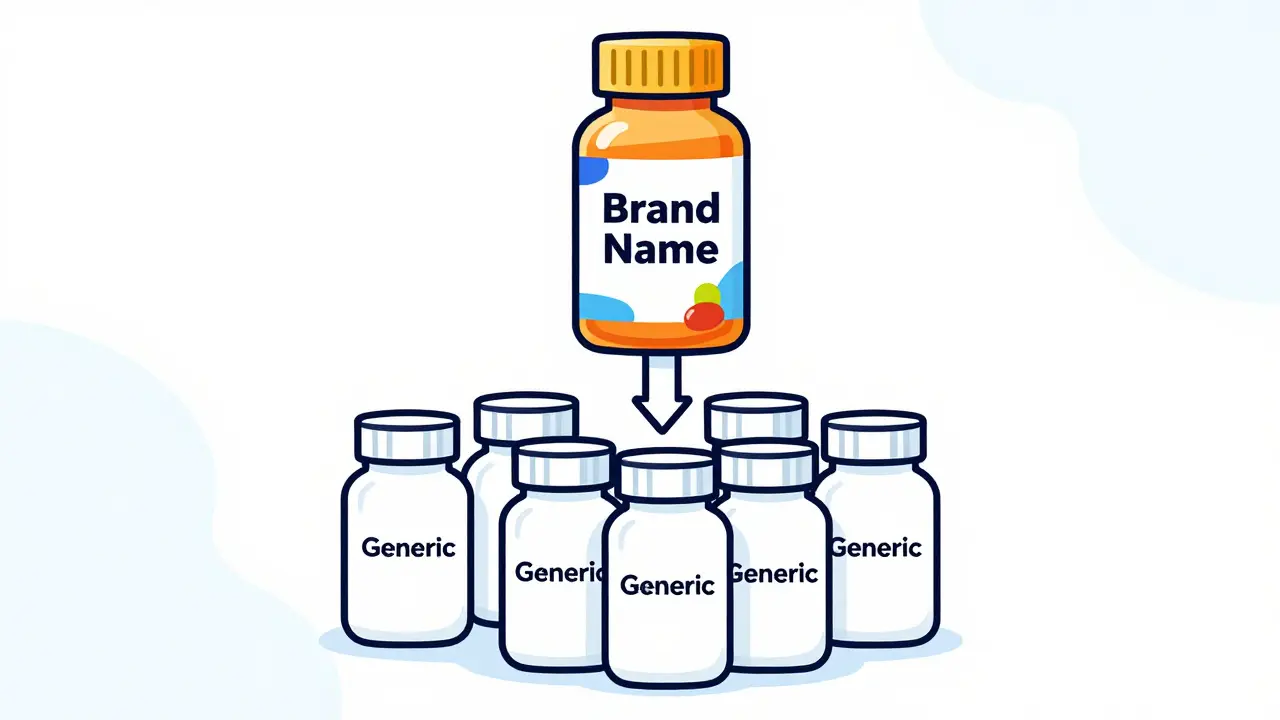
If the PBAC is the gatekeeper, reference pricing is the fuel for generic competition. Introduced in 2007, this system groups therapeutically similar medicines into ‘price disclosure groups.’ Here’s the kicker: the government subsidy is based on the lowest-priced medicine in that group. Let’s say Brand A costs $100 and Generic B costs $20. The PBS pays the pharmacist $20 plus the patient co-payment. If you choose Brand A, you pay the difference. This structure forces originator brands to lower their prices or lose market share rapidly. It incentivizes patients and prescribers to choose generics. As a result, generic penetration in Australia reached 84% by volume for off-patent medicines in 2024, higher than the OECD average of 78%. This mechanism is crucial because it drives down the overall cost of the PBS basket, allowing more funds to be allocated to new, innovative therapies.
| Patient Type | Current Co-Payment (July 2024 - Dec 2025) | New Co-Payment (Jan 2026 Onwards) | Annual Safety Net Threshold (2025) |
|---|---|---|---|
| Concession Card Holders | $7.70 | $7.70 (Indexed annually) | $724.70 |
| General Patients | $31.60 | $25.00 | $1,571.70 |
The Financial Reality: Co-Payments and Safety Nets
Even with subsidies, patients still pay a portion of the cost. These co-payments are indexed to inflation, but recent legislative changes have intervened. Under the National Health Amendment (Cheaper Medicines) Bill 2025, general patient co-payments drop from $31.60 to $25.00 starting January 1, 2026. Concession card holders remain at $7.70, which is incredibly low globally. To prevent catastrophic costs for those with chronic conditions, the PBS has a safety net. Once a general patient spends $1,571.70 (2025 figure) in a calendar year, their co-payment drops significantly. For concession holders, it’s even lower. However, disparities remain. Data shows that 12.3% of general patients skip doses due to cost, compared to only 4.7% of concession holders. This highlights that while the PBS is robust, the gap between concession and general status still creates financial strain for vulnerable populations.

The Generic Market Landscape
Australia’s generic pharmaceutical market is a multi-billion dollar industry. In 2024, it accounted for AU$6.2 billion, or 46% of total PBS expenditure. Despite making up nearly half the spending, generics represent 84% of the volume. This disparity exists because generics are vastly cheaper than originators. The top five manufacturers-Symbion, Sigma, Mylan, Aspen, and Hospira-control 68% of this market. The introduction of the Generic Medicines Pricing Framework in 2020 accelerated price drops. After six months post-patent expiry, the reference price for generics falls to 60% of the originator price, and after 12 months, it drops to 43%. Within a year of multiple generic entries, prices can fall by 62%. This aggressive pricing pressure benefits the PBS budget but squeezes manufacturer margins, leading to consolidation in the industry.
Challenges and Future Pressures
The system isn’t perfect. Critics point to the ‘PBS black hole,’ where approved medicines take an average of 14.2 months to get listed, leaving patients paying full price. There’s also the issue of ultra-orphan drugs. The Highly Specialised Drugs Program (HSDP) manages these rare disease treatments, but its eight strict criteria often create barriers. While reforms in November 2025 will relax two of these criteria, access remains a contentious issue. Furthermore, fiscal sustainability is a growing concern. Projections suggest PBS costs could reach 2.6% of GDP by 2045. With an aging population and expensive biologics entering the market, the government must balance innovation with affordability. Digitization initiatives, including AI-driven utilization reviews, aim to cut the estimated $1.2 billion in annual inappropriate expenditure. The future of the PBS lies in maintaining its cost-effectiveness while adapting to a more complex therapeutic landscape.
Who is eligible for the PBS?
Eligibility extends to all Australian residents holding a current Medicare card. Additionally, overseas visitors from 11 countries with Reciprocal Health Care Agreements (including New Zealand, the UK, Ireland, and several European nations) are eligible for limited PBS benefits during their stay.
Why are generic drugs cheaper on the PBS?
The PBS uses a reference pricing system. The government sets the subsidy amount based on the cheapest medicine in a therapeutic group. Patients who choose more expensive brands pay the difference, incentivizing the uptake of lower-cost generics. This competition drives prices down significantly after patent expiry.
What happens when I hit the PBS safety net?
Once your out-of-pocket costs exceed the annual threshold ($1,571.70 for general patients in 2025), your co-payment for subsequent prescriptions drops substantially. For concession card holders, the threshold is lower, and the reduced co-payment is minimal, ensuring ongoing affordability for chronic conditions.
How does the PBAC decide which medicines to list?
The PBAC evaluates medicines based on clinical effectiveness, cost-effectiveness (using a QALY benchmark of ~AU$50,000), and budget impact. They compare new drugs against existing treatments to ensure they provide additional health benefits worth the extra cost.
Are there plans to change PBS co-payments in 2026?
Yes. Effective January 1, 2026, the general patient co-payment will reduce from $31.60 to $25.00 under the Cheaper Medicines Bill. Concession card holder co-payments remain at $7.70, subject to annual CPI indexing.