
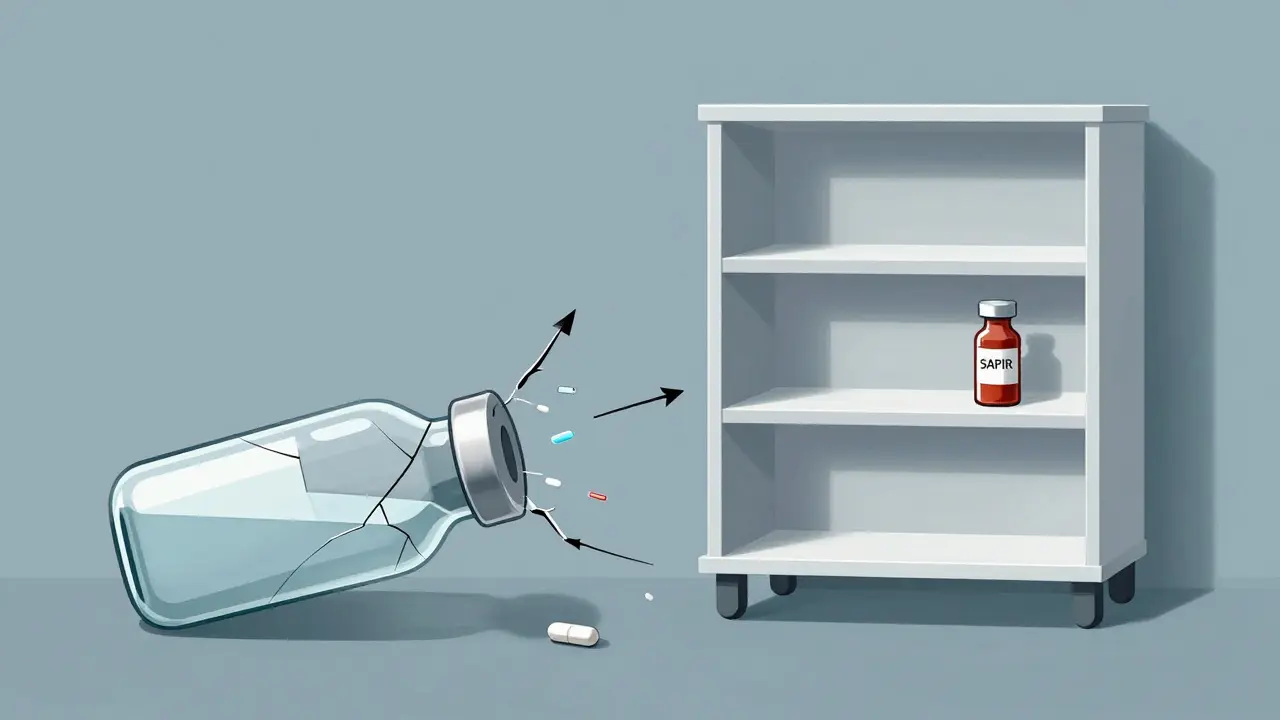
The U.S. is facing its worst drug shortage crisis in history. As of late 2024, drug shortages hit 277 active cases nationwide - a number that’s been climbing for years. Hospitals are scrambling. Pharmacists are spending hours every week just trying to find replacements. Patients are skipping doses or delaying life-saving treatments. And while everyone talks about the problem, the federal government’s response is a patchwork of conflicting policies, underfunded programs, and missed opportunities.
What’s Really Causing the Shortages?
It’s not one thing. It’s a system built on thin margins, foreign dependence, and fragile supply chains. Over 80% of the active pharmaceutical ingredients (APIs) used in U.S. medications come from just two countries: China and India. These ingredients are the raw building blocks of pills and injections. But they’re cheap to make overseas, and U.S. manufacturers have long avoided investing in domestic production because the profit margins are too slim. A generic antibiotic might cost $0.10 per dose to make - and hospitals pay $1.50. That’s not enough to justify building a new factory, upgrading equipment, or hiring trained staff. Meanwhile, production is concentrated in a handful of facilities. Just five plants handle 78% of all sterile injectables - the kind used in emergency rooms, ICUs, and cancer wards. If one of those facilities shuts down for a quality issue, or if a shipping container gets stuck at a port, hundreds of hospitals go dark overnight.The Strategic Active Pharmaceutical Ingredients Reserve (SAPIR)
In August 2025, President Trump signed Executive Order 14178, expanding the Strategic Active Pharmaceutical Ingredients Reserve - or SAPIR. This program now stockpiles raw APIs for 26 critical drugs: antibiotics like vancomycin, anesthetics like propofol, and cancer drugs like cisplatin. The idea? Instead of storing finished vials that expire in 1-2 years, stockpile the ingredients. They last 3-5 times longer and cost 40-60% less to store. It sounds smart. And in theory, it is. But here’s the catch: these 26 drugs make up only 4% of all shortage incidents. The FDA’s own data shows that oncology drugs alone account for 31% of shortages - yet only 2 of them are on the SAPIR list. Meanwhile, insulin, dialysis solutions, and common heart medications - all frequently out of stock - aren’t covered at all. The reserve has reportedly prevented 12 potential shortages since its expansion. But there’s no public audit. No independent verification. And no clear plan for how these ingredients will be distributed when needed. Hospitals aren’t being trained to use them. Manufacturers aren’t being incentivized to convert them into finished products faster.Why Reporting Rules Are Falling Apart
Back in 2012, Congress passed a law requiring drugmakers to report potential shortages six months in advance. Simple. Preventive. Effective. Except compliance is below 60%. Small manufacturers - the ones most likely to face production hiccups - are 82% non-compliant. Why? No penalties. No enforcement. The FDA issued just 17 warning letters between 2020 and 2024. In the EU, under similar rules, they issued 142. The FDA’s public Drug Shortage Database lists over 1,200 resolved and active shortages. But it’s outdated. Hospitals report shortages directly through the portal - over 3,200 submissions since April 2025 - yet 62% of those were for drugs already listed. That means providers aren’t even using the system properly. Or they don’t trust it.The New HHS Action Plan: Good Intentions, Poor Execution
In September 2025, the Department of Health and Human Services (HHS) released its 2025-2028 Draft Action Plan. It has four goals: Coordinate, Assess, Respond, Prevent. Sounds solid. But here’s the reality: only 35% of HHS’s own recommended interventions have been implemented across federal agencies. Only 28 of 50 states have set up the required supply chain mapping tools. Rural hospitals say it takes 6 months just to get the software installed. And funding? The 2026 HHS budget cut $1.2 billion from FEMA’s emergency response and $850 million from state public health grants. It slashed BARDA’s budget - the agency that helped fund breakthroughs in continuous manufacturing - by 22%. Meanwhile, the EU is mandating national stockpiles and funding centralized monitoring. The U.S. is doing the opposite.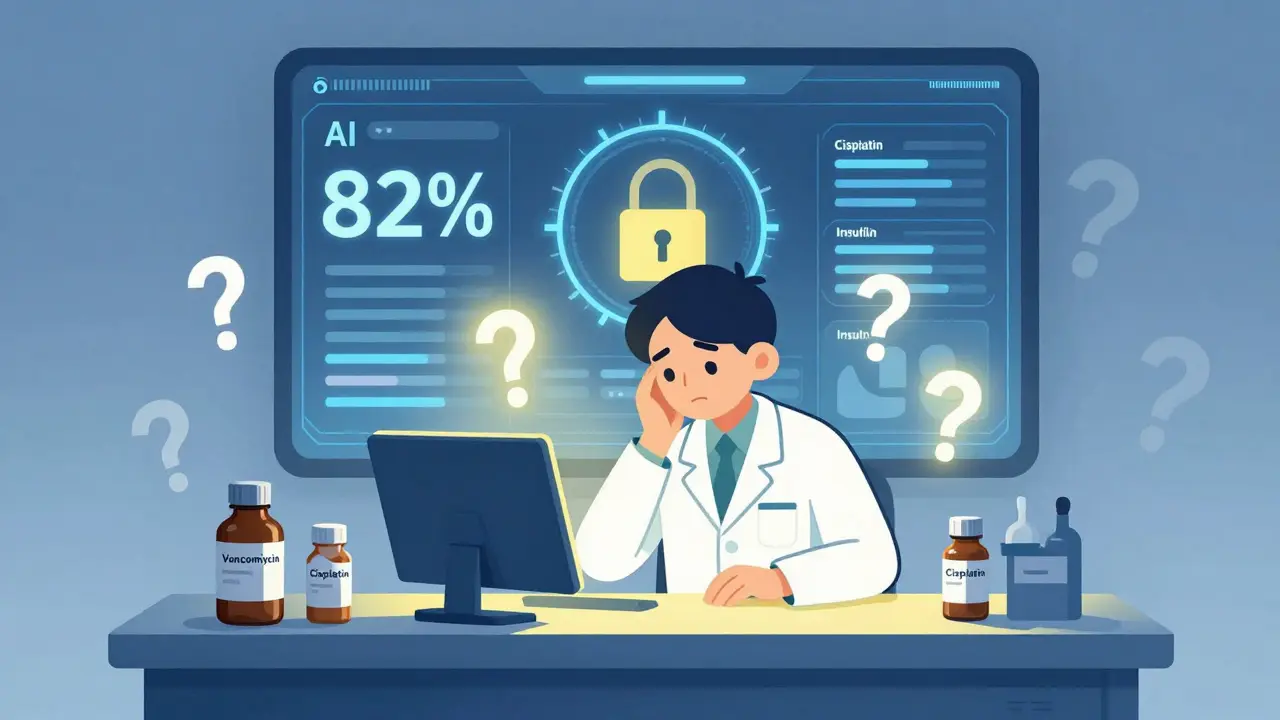
What’s Working? The FDA’s Early Notification Pilot
One bright spot: the FDA’s Early Notification Pilot Program. Hospitals and manufacturers that voluntarily report early see shortages last 28% less time. Why? Because they get a head start. They can find alternatives. They can adjust orders. They can warn patients. Johns Hopkins researchers found this was the single most effective intervention ever tested. Yet the administration is weakening it. They’re rolling back mandatory reporting rules. They’re removing penalties for non-compliance. It’s like installing a smoke alarm - then taking the batteries out.The AI Breakthrough: FDA’s Enhanced Monitoring System
In November 2025, the FDA launched its Enhanced Shortage Monitoring System. It uses AI to predict shortages 90 days in advance with 82% accuracy. It pulls data from shipping logs, factory output, hospital inventory levels, and even pharmacy purchasing patterns. This is the first time the government has moved from reactive to predictive. And it’s working. Early tests show it flagged 14 potential shortages before they hit hospitals - including a critical shortage of midazolam, a sedative used in emergency rooms. But here’s the problem: this system is still internal. Hospitals don’t have access. Pharmacists can’t use it. It’s a tool for regulators, not frontline workers. And without integration into hospital systems, it’s just a dashboard nobody can act on.The Real Problem: Economics, Not Engineering
No amount of stockpiling or AI will fix this if the underlying economics don’t change. The U.S. pays the lowest prices for generic drugs in the developed world. Manufacturers can’t make money on them. So they stop making them. Or they make them overseas, where labor is cheaper and regulations looser. The market is dominated by three companies that control 68% of sterile injectables. If one of them cuts production to focus on more profitable drugs, the entire system shudders. The EU solved this by requiring member states to maintain minimum stockpiles and offering price guarantees for essential medicines. The U.S. has tried voluntary incentives. They haven’t worked.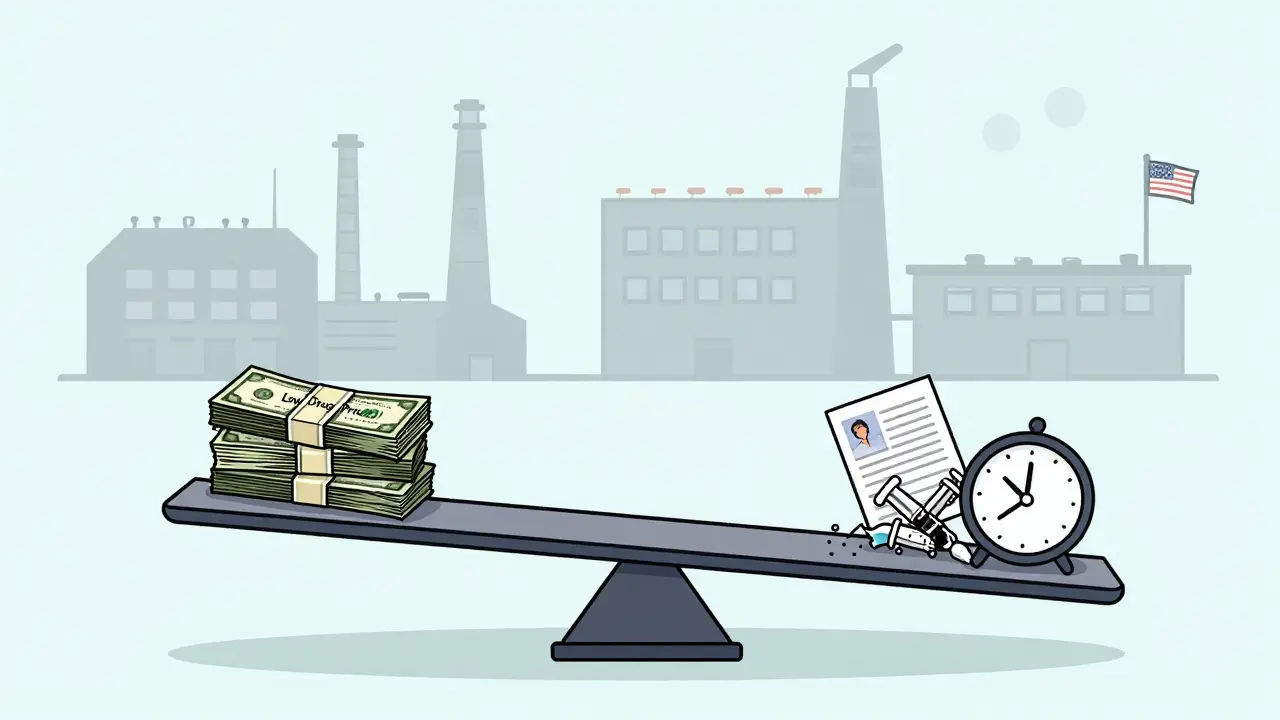
What’s Happening on the Ground?
Pharmacists are doing impossible things. On Reddit, one pharmacist wrote: “We compounded cisplatin from raw powder because the vials were gone for three weeks.” Another said: “I used five different manufacturers for the same drug in one week. Each had a different dosing guide.” Hospitals report spending $1.2 million a year just managing shortages. Nurses spend hours double-checking substitutions. Patients get the wrong dose. Some skip treatments. One in four Americans has missed a dose because the drug wasn’t available - not because they couldn’t afford it, but because it simply wasn’t there. Cancer patients are hit hardest. A survey of 1,200 oncology clinics found 68% had to change treatment plans due to drug shortages. Some delayed chemotherapy. Others switched to less effective drugs. A few patients died.What Needs to Change?
The current federal response is a mix of smart ideas and self-sabotage. Stockpiling APIs? Good. But only for 26 drugs? Pathetic. AI forecasting? Brilliant. But locked behind government firewalls? Useless. Real solutions need three things:- Price guarantees for essential, low-margin drugs - so companies know they won’t lose money making them.
- Mandatory reporting with real penalties - not suggestions.
- Domestic manufacturing incentives - tax breaks, fast-track approvals, and grants for second-source facilities.
Bottom Line
The federal government isn’t fixing drug shortages. It’s managing them. And the people paying the price aren’t politicians or CEOs. They’re patients. Nurses. Pharmacists. Families waiting for a drug that should be easy to make - but isn’t, because the system was designed to ignore the most basic needs. We don’t need more reports. We need action. And we need it before the next shortage hits - and this time, it might not be a rare drug. It might be insulin. Or blood pressure medicine. Or a simple antibiotic you can’t find anywhere.What is the Strategic Active Pharmaceutical Ingredients Reserve (SAPIR)?
SAPIR is a federal program that stockpiles raw active pharmaceutical ingredients (APIs) - not finished drugs - for 26 essential medicines like antibiotics, anesthetics, and cancer treatments. Launched in 2020 and expanded in August 2025, it aims to prevent shortages by ensuring a ready supply of the building blocks needed to make these drugs. APIs are cheaper to store and last longer than finished products, reducing reliance on foreign suppliers.
Why are drug shortages getting worse?
Drug shortages are worsening because the U.S. pharmaceutical supply chain is fragile and profit-driven. Over 80% of active ingredients come from China and India. Production is concentrated in just a few facilities, and manufacturers avoid making low-margin generic drugs because they can’t make money on them. Regulatory delays, lack of enforcement, and underfunded domestic production efforts have made the problem worse over time.
How does the FDA track drug shortages?
The FDA maintains a public Drug Shortage Database that lists active and resolved shortages. Manufacturers are legally required to report potential shortages six months in advance, but compliance is only about 58%. The FDA also launched an AI-powered Enhanced Shortage Monitoring System in November 2025 that uses real-time data from shipping, manufacturing, and hospital inventories to predict shortages with 82% accuracy 90 days ahead.
What impact do drug shortages have on patients?
Drug shortages directly affect patient safety. A 2025 survey found 29% of Americans skipped doses due to unavailability, and 68% of cancer patients had to change treatment plans. Hospitals report treatment delays, medication errors, and increased clinical monitoring. Pharmacists spend over 10 hours a week managing shortages, and 41% have experienced near-miss errors from substitutions.
Is the U.S. doing better than other countries?
No. The European Union reduced shortages by 37% between 2022 and 2024 by requiring member states to maintain mandatory stockpiles and using a centralized monitoring system. The U.S. relies on voluntary reporting, limited stockpiling, and inconsistent funding. Experts say the EU’s approach is more proactive, while the U.S. remains reactive and fragmented.
What’s being done to boost domestic drug manufacturing?
In September 2025, the Department of Commerce announced $285 million in CHIPS Act funding for domestic pharmaceutical facilities. However, industry analysts say this covers less than 5% of the $6 billion needed to meaningfully diversify production. The FDA has approved 56 new manufacturing sites in 2024, but 42% of them are outside the U.S. Regulatory approval for new domestic facilities still takes 28-36 months - longer than in the EU.

William James
February 23, 2026 AT 01:12you know what really gets me? we talk about stockpiling APIs like it’s some magic bullet, but we’re still letting the market decide what gets made. if we really cared about people’s lives, we’d stop treating medicine like a commodity and start treating it like infrastructure-like roads or power grids. no one complains when the grid goes down. we fix it. why is a life-saving drug any different?
David McKie
February 23, 2026 AT 18:02oh please. another ‘systemic failure’ essay. the real problem? lazy manufacturers and hospitals that refuse to plan ahead. if you can’t keep 3 months of inventory on hand for critical meds, you shouldn’t be running a hospital. stop pretending this is a federal policy issue-it’s a failure of basic business hygiene. and don’t get me started on the ‘pharmacists compounding from powder’ hero narrative. that’s not innovation, that’s desperation dressed up as bravery.
Southern Indiana Paleontology Institute
February 24, 2026 AT 04:41china and india are stealing our medicine supply. we let them build factories while our guys sit around. 80% of our pills come from overseas? that’s not a shortage-that’s a national security crisis. we need tariffs. we need walls. we need to make this stuff here. period. no more excuses. if you can’t make it here, you don’t get to sell it here. america first, baby.
Anil bhardwaj
February 24, 2026 AT 22:44i live in india and we make a lot of these APIs. honestly, the quality is good, and the cost is low because labor is cheaper, not because they cut corners. the problem isn’t where it’s made-it’s that the u.s. system doesn’t pay enough to keep it here. if you want domestic production, pay more. simple.
lela izzani
February 25, 2026 AT 19:22the ai system is actually brilliant-if it were accessible. imagine if every hospital pharmacy had real-time alerts built into their inventory software. no more manual reporting. no more lag. just a quiet notification: ‘midazolam supply at 12%-alternative options available.’ why is this still locked behind a firewall? it’s like having a weather radar but only letting the national weather service see it.
Joanna Reyes
February 27, 2026 AT 08:58let’s not forget that the 26 drugs in sapi r are the ones that are easiest to stockpile-antibiotics, anesthetics, some chemo. but what about insulin? dialysis fluids? hypertension meds? those are the ones people are dying without. and we’re not even talking about the fact that the supply chain is so brittle because we’ve eliminated redundancy on purpose-because ‘efficiency’ is more important than resilience. we built a house of cards and now we’re surprised when the wind blows.
Nerina Devi
February 27, 2026 AT 17:47the fact that pharmacists are compounding cisplatin from raw powder speaks volumes. these are highly trained professionals forced into dangerous, unregulated work because the system failed them. we need to honor their courage-not romanticize it. they’re not heroes. they’re victims of policy neglect. and we owe them better.
Dinesh Dawn
February 27, 2026 AT 19:29my cousin works in a rural hospital in kentucky. they went 11 days without a single dose of vancomycin last year. they used old, expired vials because they had no choice. the fda database didn’t update for weeks. no one called. no one cared. this isn’t about policy-it’s about people being treated like afterthoughts.
Vanessa Drummond
February 28, 2026 AT 11:14the fact that the eu has 37% fewer shortages and we’re still arguing about ‘voluntary incentives’ is embarrassing. we have the tech, the data, the money-but we’d rather have a committee meet for 6 months than actually fix this. and the worst part? the people who benefit from the status quo are the ones writing the rules. big pharma doesn’t want price guarantees. they want monopoly pricing. that’s the real enemy here.
Nick Hamby
March 2, 2026 AT 10:51there’s a philosophical tension here that we rarely acknowledge: medicine as a public good versus medicine as a market product. if we believe health is a right, then the production and distribution of essential drugs must be treated as a public utility. if we believe it’s a commodity, then shortages are inevitable-because markets don’t care about human survival. we’ve chosen the latter. now we’re surprised when the system collapses under its own logic.
Gabrielle Conroy
March 2, 2026 AT 13:59the ai system is SO cool!!! like, imagine if your pharmacy app just told you, ‘hey, your blood pressure med is running low-here’s a substitute, and here’s where to get it!’ and it auto-updates with real-time inventory?!?!?!?! we need this yesterday!!! why is this not on every hospital’s dashboard??!!?? this is the future, and we’re still using fax machines!!
Spenser Bickett
March 4, 2026 AT 01:23so let me get this straight… we spent 20 years outsourcing our medicine, then got mad when it broke? and now we’re gonna ‘fix’ it by… doing more of the same? the ‘chips act’ for drugs? really? $285 million? that’s what you call a ‘solution’? we’re not fixing the system-we’re just putting a bandaid on a hemorrhage and calling it a miracle.
Christopher Wiedenhaupt
March 4, 2026 AT 08:34the lack of enforcement on reporting is the quiet killer. no penalties, no audits, no consequences. it’s like having a fire alarm that doesn’t go off unless you manually press the button-and then wondering why no one woke up. if you don’t punish non-compliance, you’re not enforcing a rule-you’re just suggesting a nice idea.
Natanya Green
March 5, 2026 AT 09:52just read that one pharmacist said they used FIVE different manufacturers for the same drug in one week… and each had a different dosing guide??!!?? that’s not a shortage-that’s a horror movie. i’m not even kidding. someone’s going to die from this. and it’s not gonna be a headline. it’s gonna be a quiet, lonely, preventable tragedy. and we’re all gonna pretend we didn’t see it coming.