
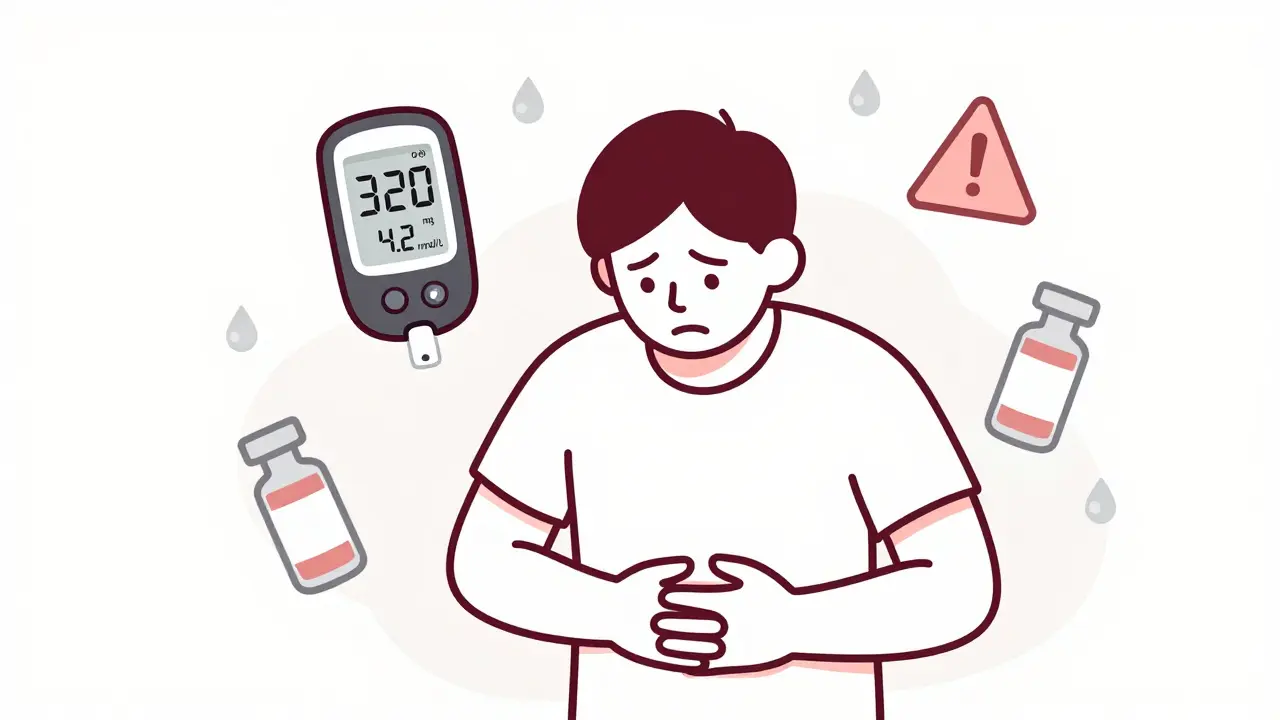
Diabetic ketoacidosis, or DKA, isn’t just a scary term you hear in medical dramas-it’s a real, life-threatening emergency that can strike people with diabetes, often without warning. Every year in the U.S. alone, over half a million hospital stays are linked to DKA. And while it’s most common in type 1 diabetes, it can also happen in type 2, especially when insulin is skipped, during illness, or with certain new medications. The worst part? Many people don’t realize they’re in danger until it’s too late. If you or someone you care about has diabetes, knowing the early signs and what happens in the hospital could save a life.
What Happens When Your Body Runs Out of Insulin
Insulin is the key that lets your cells use glucose for energy. Without enough insulin, glucose builds up in your blood-but your cells are still starving. So your body starts breaking down fat for fuel. That process creates ketones, acidic chemicals that flood your bloodstream. When ketones pile up faster than your body can flush them out, your blood turns acidic. That’s DKA.
It doesn’t happen overnight. Usually, it builds over 4 to 12 hours. Blood sugar climbs above 250 mg/dL, but sometimes it stays normal or even low-this is called euglycemic DKA, and it’s becoming more common with newer diabetes drugs like SGLT2 inhibitors. That’s why checking ketones matters, even if your glucose seems fine.
Early Warning Signs You Can’t Ignore
The first red flags are easy to miss because they look like a bad cold or the flu. You feel thirsty-like, crazy thirsty-and you’re peeing constantly, maybe more than 3 liters a day. Your mouth feels dry as sandpaper. These aren’t just inconveniences. They’re your body screaming for help.
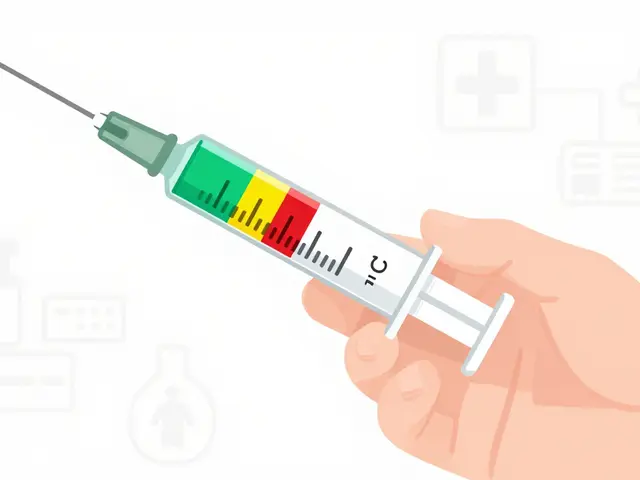
At this stage, you might feel unusually tired. Not just ‘I stayed up late’ tired-more like ‘I can’t get out of bed’ tired. Your muscles feel weak. You might lose your appetite. If you’re checking your blood sugar and it’s over 240 mg/dL, it’s time to test for ketones. Urine strips work, but blood ketone meters are faster and more accurate. A reading above 3 mmol/L means you need medical help now.
When Symptoms Get Dangerous
If you ignore the early signs, things escalate fast. Within 12 to 24 hours, nausea and vomiting kick in. About 75% of people with DKA feel sick to their stomach. Around half report sharp abdominal pain-so intense that some end up in the ER thinking it’s appendicitis. That’s a major reason why DKA gets misdiagnosed as gastroenteritis.
Then comes the breathing. You start taking deep, fast breaths-25 to 30 per minute. It’s called Kussmaul respirations. Your body’s trying to blow off acid by exhaling carbon dioxide. You might also notice a sweet, fruity smell on your breath-like nail polish remover. That’s acetone, one of the ketones your body’s burning.
By this point, confusion sets in. You might feel disoriented, forget where you are, or struggle to answer simple questions. If your blood pH drops below 7.1, you could lose consciousness. This is a full-blown medical emergency. Waiting even an hour can increase your risk of death by 15% per hour, according to experts at the University of Washington.
What Happens in the Hospital
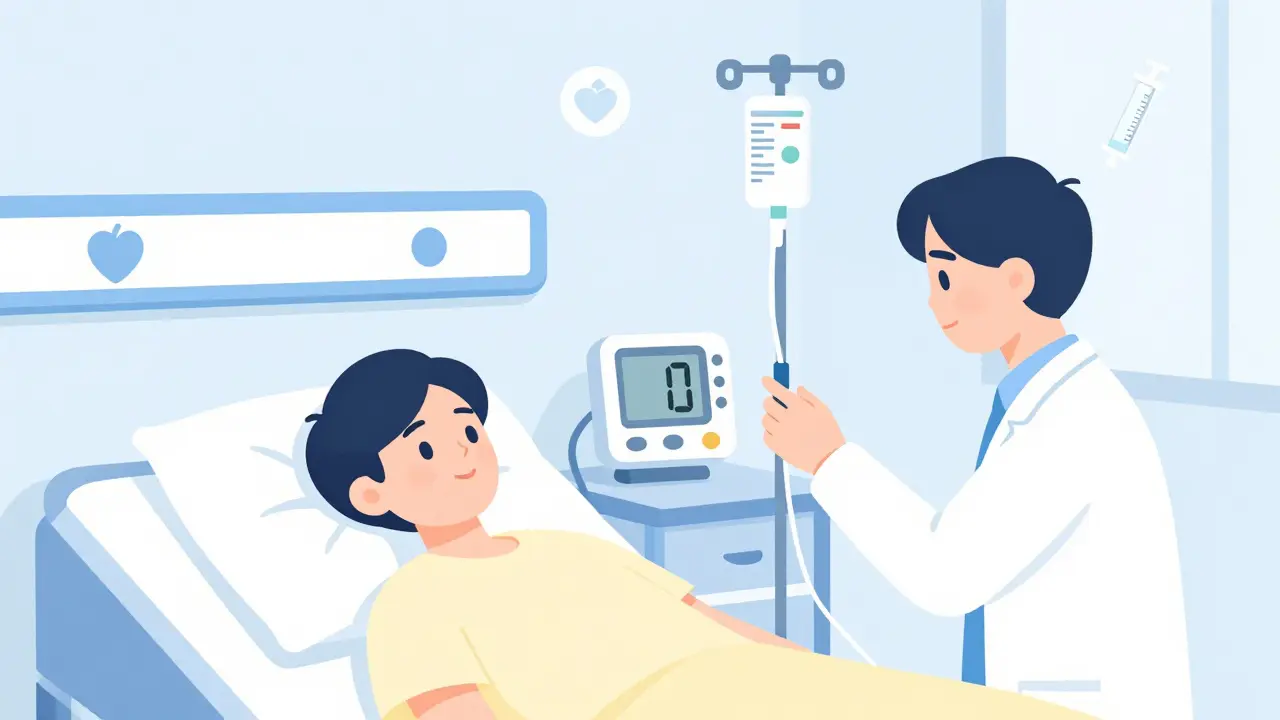
If you’re admitted for DKA, you won’t be sent home with a prescription. You’ll be hooked up to monitors, IV lines, and frequent blood tests. The treatment is straightforward but intense-and it has to be done right.
First, fluids. You’re severely dehydrated. Doctors give you 1 to 1.5 liters of saline in the first hour, then slow it down. This isn’t just about quenching thirst-it’s about restoring blood pressure, flushing out ketones, and helping insulin work.
Then comes insulin. Not a shot. Not pills. Continuous IV insulin at a steady rate. It’s started with a small bolus, then kept going at 0.1 units per kilogram per hour. The goal? Lower your blood sugar by 50 to 75 mg/dL per hour. Too fast, and you risk brain swelling-especially dangerous in kids. That’s why speed matters, but so does control.
Electrolytes are just as critical. Even if your blood test shows normal potassium, your body is completely depleted. You’ll get potassium through your IV, often 20 to 30 mEq per hour. Magnesium and phosphate get replaced too. These aren’t optional extras-they’re lifesavers.
Bicarbonate? Rarely used. Only if your blood pH drops below 6.9. Most hospitals have moved away from it because it doesn’t improve outcomes and can cause harm. The American Diabetes Association says it’s unnecessary in 95% of cases.
What Doctors Watch For
Every hour, your blood sugar gets checked. Every 2 to 4 hours, ketones are measured. Electrolytes are retested every few hours. You’re not stable until your blood pH is above 7.3, your bicarbonate is over 18 mmol/L, and your ketones are below 0.6 mmol/L-on two separate tests.
Most people stay in the hospital for 2.5 to 4 days. But if your pH was below 7.0 when you arrived, expect to stay longer-up to 4 days on average. Recovery isn’t just about numbers. It’s about feeling like yourself again. Fatigue can linger for days. You’ll need to slowly get back to your insulin routine.
Why DKA Keeps Happening
Even with all we know, DKA rates are rising. In the U.S., they’re up 5.3% every year. Why? Cost. One in three people with type 1 diabetes admit to rationing insulin because it’s too expensive. The average monthly cost is $374. That’s not sustainable. People skip doses. Then, they get sick. Then, DKA hits.
Another big reason? Lack of awareness. A survey of over 1,200 people with diabetes found that 68% waited more than 6 hours before seeking help. Half didn’t realize their symptoms were serious. And in emergency rooms, 18% of adult DKA cases are misdiagnosed as stomach bugs.
Children are especially vulnerable. About 30% of pediatric DKA cases are the first sign of type 1 diabetes. And cerebral edema-the brain swelling that can happen during treatment-is the leading cause of death in kids with DKA. That’s why fluid management is so tightly controlled in hospitals.
How to Prevent It
Prevention starts with knowing your triggers. Illness, stress, missed insulin doses, pump failures-any of these can spark DKA. If you’re sick, check your blood sugar and ketones every 4 hours. Don’t wait until you feel awful.
If you use an insulin pump, switch to injections when you’re ill. About 35% of pump-related DKA cases happen because the infusion set got clogged or dislodged during infection.
Continuous glucose monitors (CGMs) are game-changers. People using devices like Dexcom G7 cut their DKA risk by 76%. Why? Because they get alerts when glucose and ketones rise together. One user said, “The alarm saved me. I didn’t even know I was in danger.”
And if you’re on an SGLT2 inhibitor-meds like Jardiance or Farxiga-know this: they can cause euglycemic DKA. Even with normal glucose, you can still have dangerous ketones. Always check ketones if you feel unwell.
What Comes After
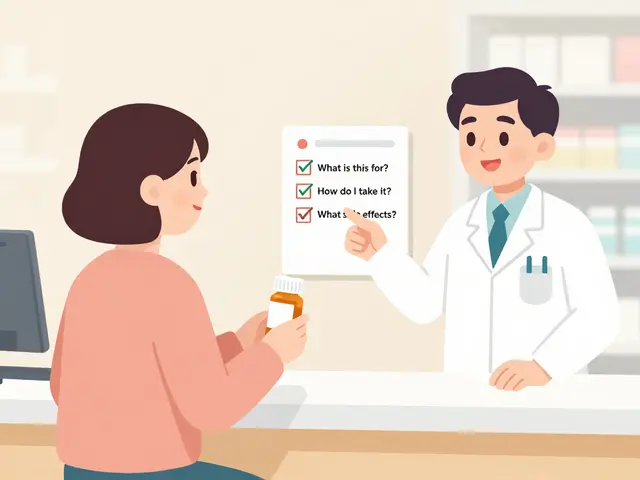
Leaving the hospital isn’t the end. You need follow-up care. A diabetes educator will help you reset your insulin plan. You’ll learn how to adjust during illness. You might get a ketone meter if you don’t already have one.
And if you’re uninsured or underinsured, ask about patient assistance programs. Many drug companies offer insulin for $35 a month. There are also nonprofit groups that help with supplies. DKA isn’t inevitable. It’s preventable-if you have access to care.
Technology is getting better. A new AI tool called DiaMonTech can predict DKA up to 12 hours before it happens, based on glucose trends. It’s not widely available yet, but it’s coming. In the meantime, your best tools are awareness, ketone testing, and never delaying care.
When to Call 911
If you have diabetes and you’re experiencing:
- Blood sugar over 250 mg/dL and two or more symptoms like vomiting, abdominal pain, confusion, or fruity breath
- Any level of ketones above 3 mmol/L on a blood meter
- Difficulty breathing, extreme drowsiness, or loss of consciousness
Call emergency services immediately. Don’t drive yourself. Don’t wait to see if it gets better. DKA doesn’t wait. And neither should you.
Can you have diabetic ketoacidosis with normal blood sugar?
Yes. This is called euglycemic DKA, and it’s becoming more common, especially in people using SGLT2 inhibitors like Jardiance or Farxiga. Even if your blood glucose is below 250 mg/dL, you can still have dangerous levels of ketones and acid in your blood. Always check ketones if you feel unwell, regardless of your glucose reading.
How long does it take to recover from DKA in the hospital?
Most people stay in the hospital for 2.5 to 4 days. Recovery time depends on how severe the DKA was. If your blood pH was below 7.0 when you arrived, you’ll likely stay longer-around 3.8 days on average. You’re considered stable when your ketones are below 0.6 mmol/L, your bicarbonate is over 18 mmol/L, and your pH is above 7.3 on two consecutive tests.
Is DKA only a problem for people with type 1 diabetes?
No. While 80% of DKA cases happen in type 1 diabetes, it can also occur in type 2, especially during serious illness, infection, or if insulin is stopped. People on SGLT2 inhibitors are also at risk, even if they don’t usually take insulin. Any person with insulin deficiency can develop DKA.
Can insulin pumps cause DKA?
Yes. About 35% of pump-related DKA cases happen because of infusion set failures-like clogs, kinks, or dislodged tubing-especially during illness when insulin needs increase. That’s why experts recommend switching to insulin injections during sickness. Always check your pump site and have backup supplies ready.
Why do doctors avoid giving bicarbonate for DKA?
Bicarbonate was once commonly used to correct acidosis, but studies show it doesn’t improve survival and can cause harm-like worsening low potassium levels or brain swelling. It’s only recommended if blood pH drops below 6.9, which is rare. Less than 5% of DKA patients now receive bicarbonate, and guidelines from the ADA strongly discourage routine use.
What’s the biggest mistake people make with DKA?
Waiting too long to seek help. Nearly 70% of people delay treatment for over 6 hours because they don’t recognize the symptoms as serious. Many think vomiting and fatigue are just the flu. But DKA kills fast. The moment you have high blood sugar plus nausea, vomiting, or confusion, call for emergency help. Don’t wait.


shivam utkresth
January 27, 2026 AT 15:01Man, I just got back from a trip to Delhi and saw a guy in the train station with a CGM alert going off-no idea he was diabetic till he started sweating and muttering about ketones. We got him to the ER and they confirmed DKA. Dude had been skipping insulin for a week because his prescription ran out and he couldn’t afford the refill. This post? Absolute gold. People need to know it’s not just ‘bad diabetes’-it’s a silent killer with a fruity breath.
John Wippler
January 28, 2026 AT 07:37It’s wild how we treat DKA like it’s a glitch in the system when really it’s the system failing people. Insulin pricing isn’t just unethical-it’s murderous. And the fact that SGLT2 inhibitors can trigger euglycemic DKA without warning? That’s pharmaceutical negligence dressed up as innovation. We’re optimizing for profit, not survival. If your life depends on a drug that costs more than your rent, something’s broken beyond repair.
Kipper Pickens
January 28, 2026 AT 17:58Let’s get technical for a sec: the osmotic diuresis from hyperglycemia in DKA drives massive electrolyte shifts-Na+, K+, Cl-, Mg++, PO4-everything gets diluted and dumped. IV fluids aren’t just hydration-they’re volume resuscitation to restore glomerular filtration and renal clearance of ketones. Insulin infusion suppresses lipolysis and halts ketogenesis at the hepatic level. And bicarbonate? Don’t even get me started. It’s a band-aid on a hemorrhage. pH correction happens naturally with insulin + fluids. Administering bicarb risks paradoxical CNS acidosis and hypokalemia-induced arrhythmias. The ADA’s stance? Spot on.
Aurelie L.
January 29, 2026 AT 02:02I read this at 3am. My cousin died from DKA last year. They thought it was food poisoning.
Joanna Domżalska
January 30, 2026 AT 02:17So let me get this straight. You’re saying if you’re on Farxiga and feel a little tired, you should panic and test for ketones? What’s next? Should we all carry ketone strips like fire extinguishers? This feels like fearmongering. Maybe people just need to stop being so anxious about their bodies. Not every weird feeling is a medical emergency.
Faisal Mohamed
January 31, 2026 AT 14:56Bro this is why I live for tech 🤖🩸. DiaMonTech predicting DKA 12hrs ahead? That’s sci-fi becoming real. Imagine waking up to a notification: ‘Your body is about to go full acid storm. Take insulin now.’ No more ER runs. No more confusion. Just data saving lives. Also, CGMs are the real MVPs. My Dexcom saved me last winter when I had a cold and skipped my pump check. KETONES AT 3.8. I called 911. Still alive. Tech > fear.
Josh josh
February 2, 2026 AT 08:24my pump got clogged during a fever last month and i thought i was just sick as hell turns out my blood sugar was 480 and my breath smelled like a nail salon i called my bro to drive me to the hospital and he was like are you high or something i said no i think im dying he took me anyway thanks god i lived
bella nash
February 3, 2026 AT 18:29It is imperative to underscore that the administration of intravenous insulin in a controlled, titrated fashion remains the cornerstone of therapeutic intervention in diabetic ketoacidosis. Furthermore, the maintenance of euvolemia through judicious fluid resuscitation, coupled with meticulous electrolyte replacement, constitutes the principal determinants of favorable clinical outcomes. It is also noteworthy that the utilization of sodium bicarbonate is contraindicated in all but the most extreme cases of metabolic acidosis, as per current evidence-based guidelines.
Geoff Miskinis
February 5, 2026 AT 12:17How many times must we be told that insulin is expensive? This isn’t news-it’s a political talking point dressed in medical jargon. The real issue? People don’t monitor. They don’t educate themselves. They wait until they’re unconscious. This isn’t a systemic failure-it’s a personal one. If you’re on insulin and skip doses because you’re ‘too busy,’ then you’re not a victim. You’re negligent. And no, your CGM won’t save you if you ignore it.
Sally Dalton
February 6, 2026 AT 23:45thank you for writing this i cried reading it. my sister had dka when she was 12 and it took them 5 hours to diagnose it because the er doc thought it was the flu. she almost didn’t make it. now she tests ketones every time she’s sick and carries a ketone meter in her purse like a safety blanket. i wish everyone knew how fast this can happen. please share this. i’m sending it to every diabetic friend i have.