
Visual Dosing Aid Selector
Select your scenario to find the most appropriate visual dosing aid:
Getting the right dose of medicine isn’t just about following instructions-it’s about seeing it clearly. A wrong drop, a misread line, or a confusing syringe marking can lead to serious mistakes, especially with kids, older adults, or emergency meds like epinephrine. That’s where visual dosing aids come in. These aren’t fancy gadgets. They’re simple, smart tools designed to cut out guesswork. Think color-coded lines, big numbers, and clear windows that tell you exactly when you’ve got the right amount. No math. No guesswork. Just see it, do it, safely.
Why Visual Dosing Matters More Than You Think
Medication errors are one of the leading causes of preventable harm in healthcare. In the U.S. alone, at least 1.5 million avoidable adverse drug events happen every year. Many of those come down to simple mistakes: misreading milliliters, mixing up syringe units, or guessing how much to give a child based on weight. In emergency situations, seconds count. In pediatric care, precision matters. That’s why visual dosing aids were developed-not to replace training, but to support it.
One real-world example comes from pediatric HIV treatment. Kids grow fast. Their weight changes. Dosing needs to adjust constantly. In resource-limited clinics, nurses were making calculation errors because they had to convert weight to dose manually. The solution? A visual dosing aid with color bands matching weight ranges. Just match the child’s weight to the color, and the syringe shows the exact amount. No math needed. That’s the power of visual design.
How Syringes Are Built for Visual Accuracy
Not all syringes are created equal. A standard plastic syringe might have tiny lines and faint numbers. A visual dosing syringe? It’s built differently.
- Enlarged markings: Numbers are bigger, bolder, and spaced out. No squinting.
- Contrast backgrounds: The barrel is often white or light-colored, while the graduations are dark black or even colored. This makes it easy to see the liquid level.
- Removed clutter: Instead of every 0.1 mL being marked (which can confuse), only key doses like 0.5 mL, 1 mL, 2 mL are shown. Less noise, clearer signal.
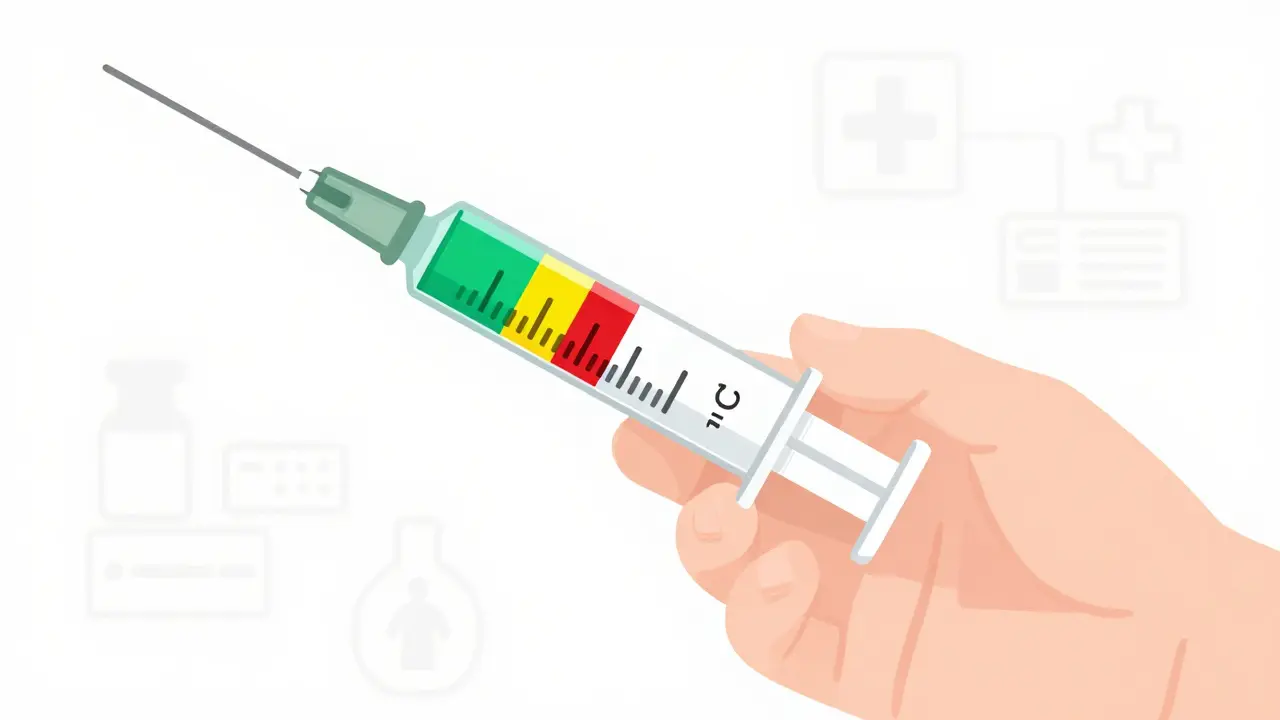
- Color zones: Some syringes have green for safe dose, yellow for caution, red for overdose. This helps avoid accidental over-dosing.
These features aren’t just nice-to-haves. In a 2018 study of radiologists managing contrast reactions, those using visual syringes made 54.5% fewer dosing errors than those using standard ones. And they gave the medicine 36% faster-97 seconds versus 152 seconds. In an emergency, that’s life or death.
Droppers That Don’t Lie
Droppers are everywhere-infant medicine, eye drops, nasal sprays. But most droppers are terrible at measuring. They’re cheap, flexible, and the drops vary in size depending on how you hold them. That’s why visual droppers exist.
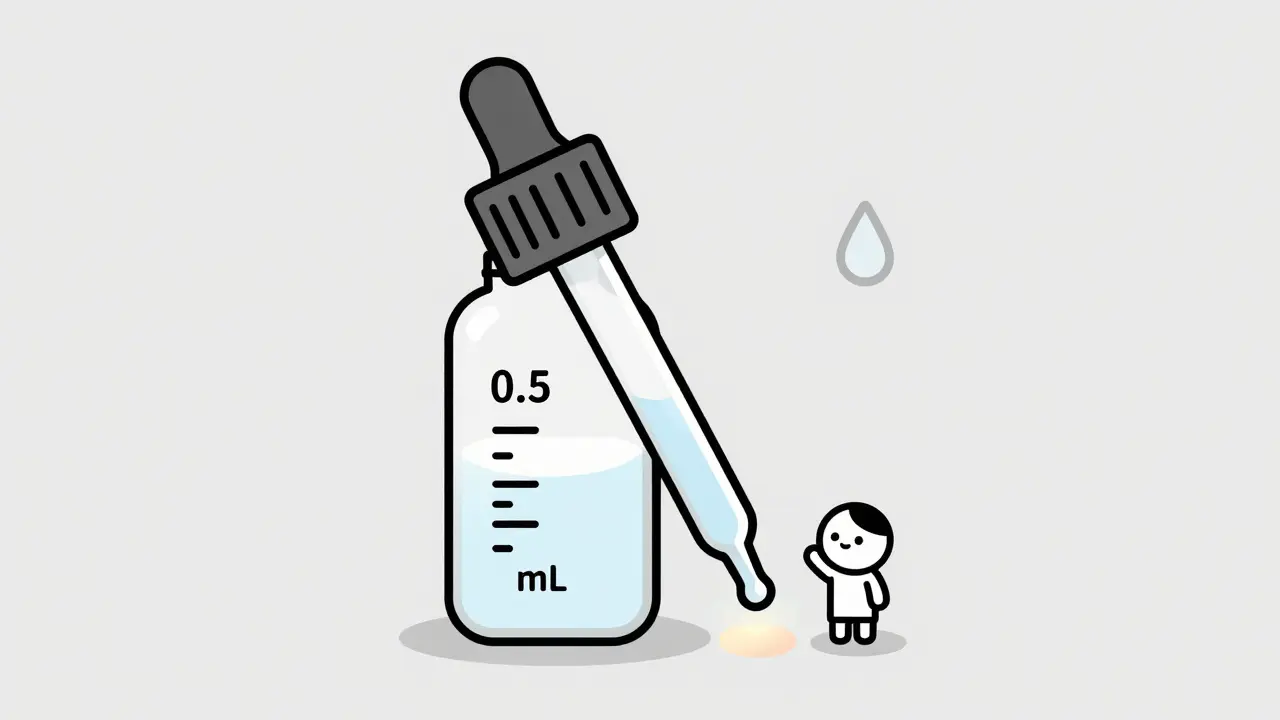
- Measurement windows: Some have a clear side window with marked lines, so you can see the liquid level from the side, not just the tip.
- Color-change indicators: A few advanced droppers have a small chamber that turns color when the correct volume is drawn. Think of it like a traffic light for medicine.
- Fixed-volume designs: Some are made to hold exactly 1 mL or 0.5 mL. You fill it once, and that’s your dose. No measuring needed.
Parents using these droppers report feeling more confident. One mother in Brisbane told a pharmacist, “I used to stress every time I gave my daughter her antibiotics. Now I just fill to the line. I know I’m not giving too much.” That confidence matters.
Measuring Cups and Oral Tools
For older kids and adults taking liquid meds, measuring cups are still common. But many household spoons and cups aren’t calibrated. A teaspoon from your kitchen might hold 4 mL instead of 5. That’s a 20% error right there.
Visual dosing cups fix this with:
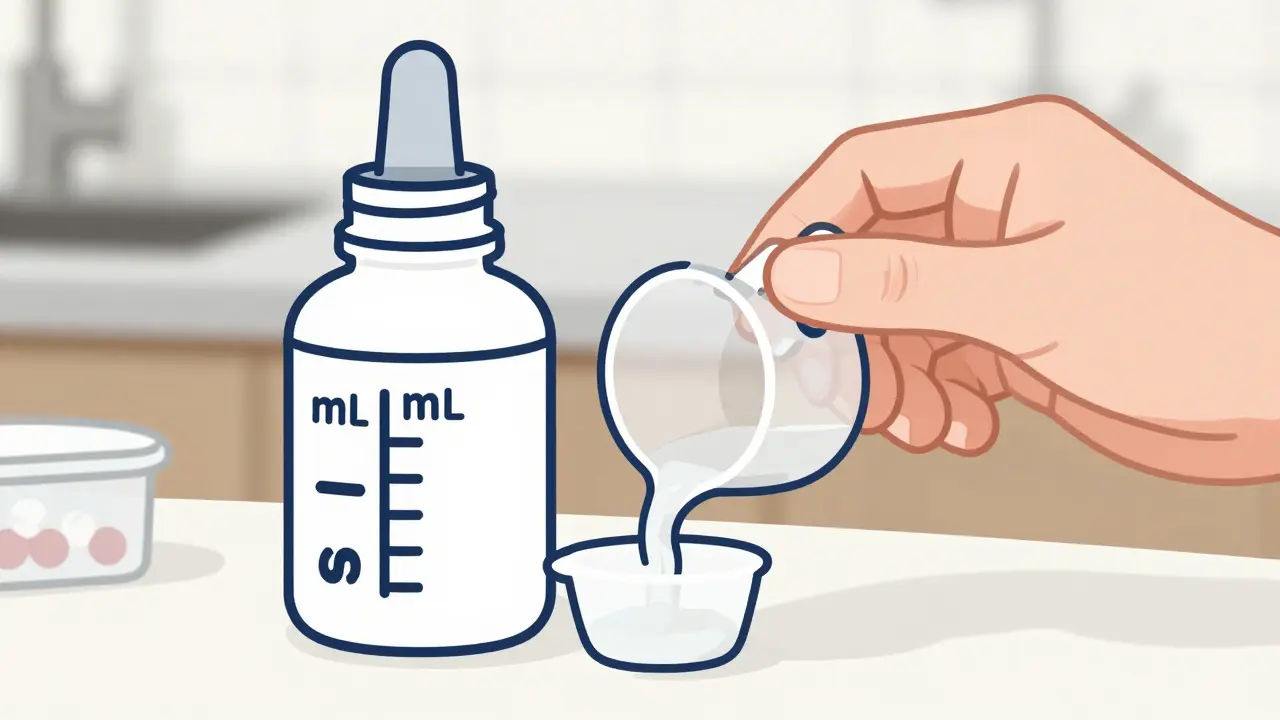
- Clear, bold mL markings (not just teaspoons or tablespoons)
- Spout design that prevents spills
- Non-slip bases so they don’t tip when placed on a counter
- Integrated dosing caps that screw onto medicine bottles, so you can draw the dose directly without pouring
These tools are especially helpful for people with poor eyesight or shaky hands. One study showed that elderly patients using visual measuring cups made 63% fewer dosing mistakes compared to using regular cups or spoons.
What’s Missing? Training and Consistency
Even the best visual aid won’t work if no one knows how to use it. The same 2018 study found that despite the visual tools, 18.2% of teams still made errors-mostly because they misread the color zones or didn’t notice the markings under stress.
That’s not a flaw in the tool. It’s a flaw in how we introduce it. Hospitals and clinics need to:
- Train staff on how to read the visual cues
- Keep visual aids visible and stocked in emergency carts and pediatric units
- Include them in simulation drills-just like CPR training
And for families? Don’t assume your pharmacist explained it. Ask: “Does this medicine come with a visual dosing tool?” If not, request one. Many manufacturers provide them free with the prescription.
What’s Next? The Future of Visual Dosing
There’s no magic bullet yet, but innovation is happening. Some new syringes have QR codes that link to video instructions when scanned. Others use smart ink that changes color if the medicine is expired. In pediatric clinics, digital dosing charts are being printed and laminated for quick reference.
But the core idea stays the same: reduce cognitive load. Make the medicine tell you how much to give, not your brain.
For now, the most powerful tool is still the simple, well-designed syringe or dropper with clear markings. It doesn’t need Wi-Fi. It doesn’t need charging. It just needs to be there-when you need it.
Choosing the Right Tool for Your Needs
Not everyone needs the same thing. Here’s a quick guide:
- For infants: Use a visual dropper with a measurement window or fixed volume.
- For toddlers and kids: Use a calibrated syringe with color zones. Avoid cups-they’re too easy to spill.
- For elderly or shaky hands: Use a dosing cup with a non-slip base and large markings. A syringe with a wide grip works too.
- For emergencies: Make sure your home or clinic has a visual epinephrine syringe clearly labeled and stored with your EpiPen.
Always check the label. If the medicine bottle says “use only with provided dosing device,” don’t substitute it with a spoon or another syringe. That’s how mistakes happen.
Are visual dosing aids only for kids?
No. While they’re especially helpful for children because dosing is based on weight, they’re just as valuable for older adults, people with vision problems, or anyone taking complex medications. Emergency meds like epinephrine also rely on visual aids to ensure fast, accurate delivery.
Can I use a kitchen spoon if I don’t have a measuring tool?
Never. A standard teaspoon holds 4-6 mL, but the correct dose might be exactly 5 mL. That tiny difference can be dangerous. Always use the dosing tool that came with the medicine or ask your pharmacist for one.
Do pharmacies provide visual dosing tools for free?
Yes, most do-especially for liquid medications for children, elderly patients, or emergency use. If they don’t offer one, ask. Many manufacturers send them to pharmacies at no cost. You’re entitled to the safest tool available.
How do I know if a syringe is a visual dosing aid?
Look for: large, bold numbers; color-coded zones (green/yellow/red); fewer, clearer markings; and a high-contrast background. If the syringe looks cluttered or has tiny lines, it’s probably not designed for visual dosing.
Can visual dosing aids eliminate all dosing errors?
No tool eliminates every mistake. Even with visual aids, 18% of users in studies still made errors-often due to stress, distraction, or unfamiliarity. But they cut errors by more than half. That’s why they’re part of a safety system, not the whole system. Combine them with training, clear labels, and double-checking.
Final Thought: See It. Do It. Safely.
Medication safety isn’t about being perfect. It’s about reducing the chances of error. Visual dosing aids do exactly that. They turn uncertainty into clarity. They turn stress into confidence. Whether you’re giving medicine to a child, managing an emergency, or helping an aging parent, the right tool makes all the difference. Don’t wait for a mistake to happen. Ask for the visual aid. Use it. And keep it handy.





Stephen Archbold
February 25, 2026 AT 00:26Also, the color zones? Game changer. Green = go, red = stop. It's like a traffic light for your life.
lela izzani
February 25, 2026 AT 14:12Vanessa Drummond
February 26, 2026 AT 14:37Nick Hamby
February 27, 2026 AT 19:15Is this dependency? Or is it dignity?
Perhaps the real innovation isn’t the syringe-it’s the quiet recognition that human beings, under stress, need scaffolding to be safe.
Nerina Devi
March 1, 2026 AT 00:41Dinesh Dawn
March 2, 2026 AT 00:14kirti juneja
March 2, 2026 AT 10:17Also, the dosing cup with the non-slip base? Genius. My grandma stopped spilling meds all over the counter. She even started taking them on time. Small things. Big impact.
Haley Gumm
March 3, 2026 AT 09:05