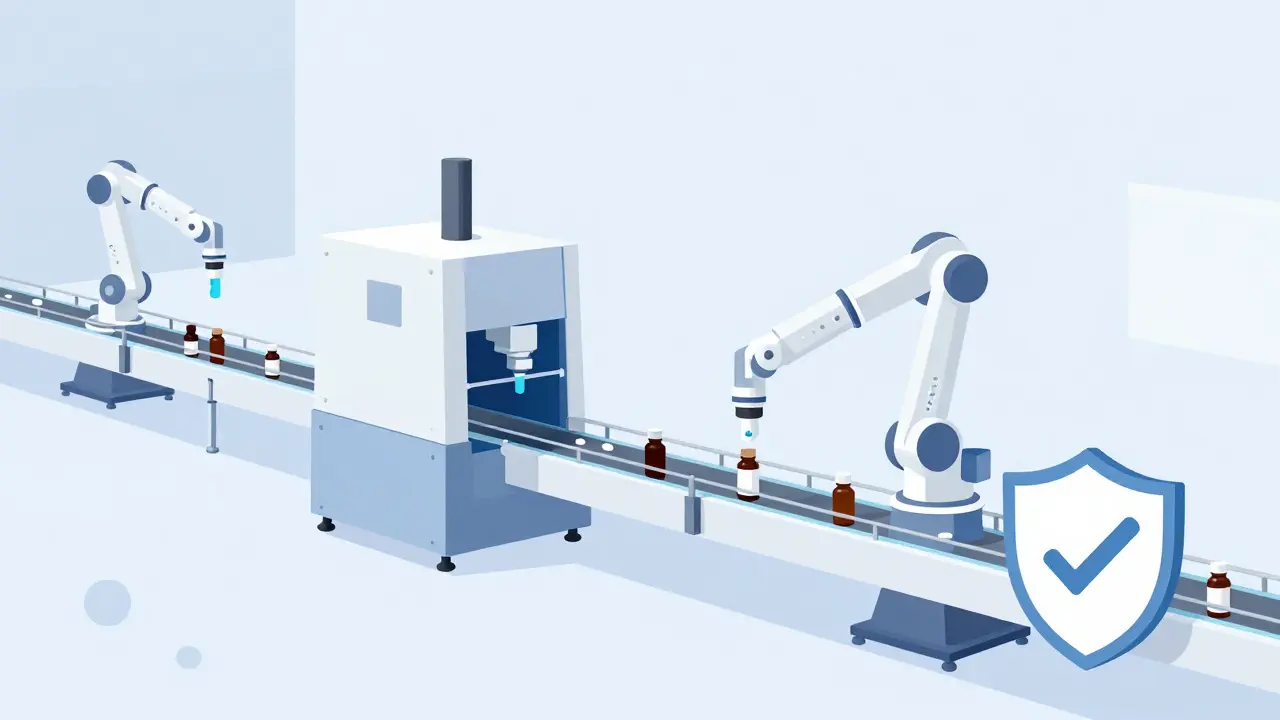
Generic drugs make up about 90% of all prescriptions filled in the United States. That is a massive number. It means that when you pick up your medication at the pharmacy, it is overwhelmingly likely to be a generic version rather than the original brand-name product. You trust that this pill works exactly as well as the expensive brand name. But how do we know it is safe? How do we know it wasn't made in a dirty factory or with contaminated ingredients?
The answer lies in a strict set of rules called Current Good Manufacturing Practices, or CGMP. This is the regulatory framework established by the U.S. Food and Drug Administration (FDA) to ensure that pharmaceutical products are consistently produced and controlled to meet quality standards. For generic manufacturers, these aren't just suggestions; they are the law. If a company wants to sell generic drugs in the U.S., it must follow every single requirement in 21 CFR Parts 210 and 211, which are the specific sections of the Code of Federal Regulations that detail the minimum procedures for manufacturing, processing, packing, or holding drugs. These rules were codified in 1978 and have been updated continuously to keep pace with technology and safety threats.
The Core Purpose of CGMP for Generics
You might wonder if generics get a pass on quality because they are cheaper. They do not. The FDA requires generic drugs to be pharmaceutically equivalent to their brand-name counterparts. This means they must contain the same active ingredient, in the same strength, dosage form, and route of administration.
The "Current" in CGMP is key here. It doesn't mean the rules from 1978 are still the final word. It means manufacturers must use modern equipment, systems, and methods. You cannot rely on outdated practices just because they worked thirty years ago. As FDA Commissioner Robert M. Califf noted in March 2023, CGMP ensures proper design, monitoring, and control of facilities. If your facility isn't in good condition, or your staff isn't fully trained, you are violating the spirit and letter of the law.
This level playing field is crucial. According to Pfizer’s own documentation, generics must be manufactured under the exact same strict standards required for brand products. This protects the $105 billion U.S. generic market and ensures that patients receive consistent identity, strength, purity, and quality in every bottle.
Breaking Down 21 CFR Part 211
The heart of FDA manufacturing requirements is found in 21 CFR Part 211, which is a comprehensive regulation divided into eleven subparts covering every aspect of drug production. Let's look at what these subparts actually demand from manufacturers.
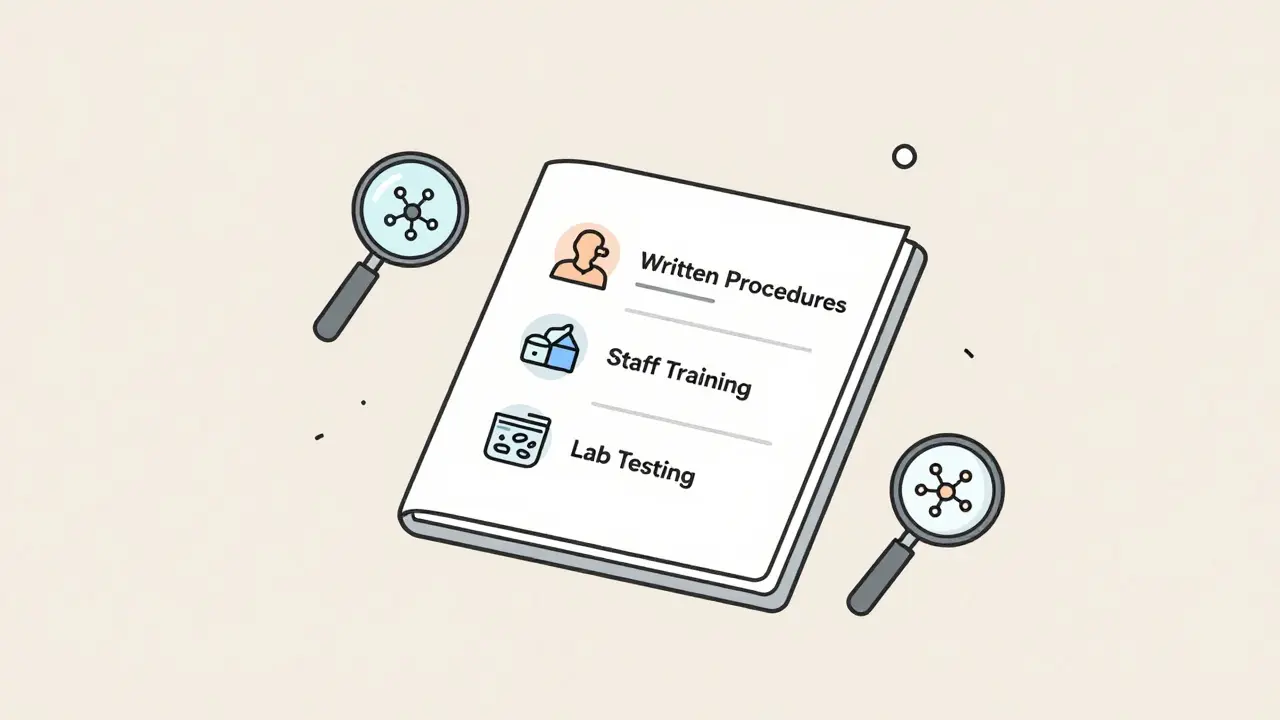
- Subpart A (General Provisions): Everything must be written down. Verbal instructions don't count. You need written procedures for all manufacturing operations.
- Subpart B (Organization and Personnel): Staff matters. You need a Quality Control Unit with the authority to approve or reject materials. Employees must have documented education and training (§ 211.25).
- Subpart C (Buildings and Facilities): Cleanliness is non-negotiable. Facilities must prevent contamination, including specific air quality standards (§ 211.46).
- Subpart D (Equipment): Machines must work correctly. Calibration schedules and maintenance records are mandatory (§ 211.68).
- Subpart E (Control of Components): Every ingredient batch must be tested against established specifications before use (§ 211.84). You can't just assume the supplier sent good stuff.
- Subpart F (Production and Process Controls): In-process testing is required. You need validation protocols to prove your process works consistently (§ 211.100-113).
- Subpart G (Packaging and Labeling): Wrong labels kill people. Verification systems are necessary to ensure the right label goes on the right drug (§ 211.122).
- Subpart H (Holding and Distribution): Storage conditions must be monitored. Temperature excursions can ruin a drug (§ 211.142).
- Subpart I (Laboratory Controls): Stability testing programs are required to ensure the drug stays potent over time (§ 211.166).
- Subpart J (Records and Reports): Keep everything. Manufacturing records must be retained for one year after the product expiration date (§ 211.180).
- Subpart K (Returned Products): Returned drugs must be quarantined. You generally cannot re-sell them unless you can prove they haven't been compromised.
Validation and Testing: The Proof Is in the Data
Writing procedures is step one. Following them is step two. Proving you followed them is step three. This is where Process Validation comes in. The FDA does not specify a minimum number of batches for validation, but industry standard typically uses three consecutive successful batches to demonstrate consistency. However, validation isn't a one-time event. Dr. John Jenkins, former FDA Office of New Drugs Director, emphasized that validation must be maintained through continued verification. If you change a machine or a raw material source, you often have to re-validate.
Testing components is another major hurdle. In May 2023, the FDA issued an immediate-effect guidance requiring testing of high-risk components like glycerin and sorbitol for diethylene glycol and ethylene glycol. This was a direct response to tragic deaths linked to contaminated metformin in Pakistan. Generic manufacturers now face stricter scrutiny on their supply chains. You must test each component batch. If you skip this, you risk adulterating the final product.
For nonsterile products, microbial controls are vital. You need bioburden testing (§ 211.110(a)(6)) and written procedures to prevent objectionable microorganisms. Equipment cleaning validation requires swab and rinse sampling. The acceptance criteria are tight: bio-burden limits usually must not exceed 100 CFU per swab. Missing this mark means your facility is dirty, and your product is unsafe.
FDA vs. International Standards
If you manufacture globally, you know that regulations vary. The European Medicines Agency (EMA) has its own GMP guidelines, known as EudraLex Volume 4, which are the EU's guide to good manufacturing practice for medicinal products. A 2021 assessment by the International Council for Harmonisation (ICH) showed about 85% alignment between FDA and EMA requirements. However, those missing 15% matter.
| Feature | FDA CGMP (USA) | EMA GMP (EU) |
|---|---|---|
| Documentation Style | Strict, detailed, frequent updates | Principles-based, slightly more flexible formats |
| Inspection Frequency | High (~1.3 inspections/year for domestic) | Variable, often less frequent for compliant firms |
| Quality Unit Authority | Mandatory independent authority (§ 211.22) | Required, but structure can vary |
| Compliance Cost Impact | ~18% higher due to documentation rigor | Lower administrative burden in some areas |
| Enforcement Focus | Data integrity, process validation | GMP principles, risk management |
FDA inspections are notoriously rigorous. Domestic facilities average 1.3 inspections annually. Foreign facilities face increasing scrutiny, with the FDA allocating 25% more resources to foreign inspections in its 2023-2027 strategic plan. Historically, foreign facilities received fewer warning letters, but this gap is closing. The FDA is cracking down on data integrity issues, which accounted for 63% of Warning Letters related to CGMP violations in 2022.
The Reality of Compliance Costs and Challenges
Let's be honest: CGMP compliance is expensive. A 2022 survey by the International Society for Pharmaceutical Engineering (ISPE) found that 68% of generic manufacturers struggle with documentation requirements. For a mid-sized firm, annual compliance costs can hit $2.3 million. Small firms feel this pinch even harder. On Reddit, a user described spending $1.2 million and 14 months just to implement electronic batch records to meet 21 CFR Part 11, which governs electronic records and electronic signatures.
Data integrity is the biggest headache. The ALCOA+ principles (Attributable, Legible, Contemporaneous, Original, Accurate, plus Complete, Consistent, Enduring, and Available) are now the gold standard. Yet, 78% of firms report difficulties implementing audit trails. Why? Because old systems weren't built for this level of transparency. Upgrading to Electronic Quality Management Systems (eQMS) helps, and 65% of large manufacturers had adopted them by 2023.
Supply chain risks are also real. In 2022, 43% of generic manufacturers experienced component testing failures. When a supplier sends bad active pharmaceutical ingredients (APIs), you can't just mix it in. You have to reject it, document it, and find a new source. This delays production and burns cash. The 2022 recall of 12 generic metformin products due to NDMA contamination was a stark reminder that inadequate process controls and poor cleaning validation can lead to massive recalls and reputational damage.
Future Trends: Continuous Manufacturing and AI
The world of generic manufacturing is changing. Traditional batch processing is slow and prone to human error. Continuous Manufacturing is a production method where materials move continuously through the system without stopping, allowing for real-time quality control. Teva Pharmaceutical successfully implemented this for a generic cardiovascular drug in 2021, reducing batch failures from 4.2% to 0.7%. The FDA supports this shift through its Emerging Technology Program, with draft guidance expected in 2024.
Artificial Intelligence is also entering the room. McKinsey projects that by 2028, 65% of manufacturers will use predictive quality systems. Instead of waiting for a batch to fail, AI analyzes data in real-time to predict deviations. This aligns with the future of CGMP: moving from reactive inspection to proactive assurance. However, until the regulations fully catch up, companies must validate these new technologies carefully. You can't just plug in an AI model and hope it passes inspection. You must prove it works.
Do generic drugs have the same FDA GMP requirements as brand-name drugs?
Yes. The FDA requires generic drugs to be manufactured under the exact same strict Current Good Manufacturing Practice (CGMP) regulations as brand-name drugs. There is no lower standard for generics. They must meet identical requirements for facility cleanliness, equipment calibration, personnel training, and quality control to ensure they are pharmaceutically equivalent to the brand-name reference product.
What happens if a generic manufacturer fails an FDA inspection?
Consequences can be severe. Minor issues may result in observations that need correction within a set timeframe. Serious violations lead to Warning Letters, which are public notices of non-compliance. In extreme cases, the FDA can issue import alerts (blocking foreign shipments), seize products, or obtain injunctions to stop production. Persistent non-compliance can lead to criminal prosecution or permanent debarment of responsible individuals.
How much does it cost to maintain CGMP compliance for a generic drug facility?
Costs vary significantly by size and complexity. For mid-sized generic manufacturers, annual compliance costs can reach approximately $2.3 million. These costs cover quality assurance staff, laboratory testing, facility maintenance, documentation systems, and training. Smaller firms may spend less in absolute terms but often face a higher percentage of overhead relative to revenue. Large enterprises benefit from economies of scale but still invest heavily in advanced systems like eQMS.
What is the difference between GMP and CGMP?
The "C" stands for "Current." While GMP refers to the basic principles, CGMP emphasizes that manufacturers must use modern technology and systems. It implies that standards evolve. A facility cannot rely on outdated methods if better, safer, or more efficient technologies are available. The FDA expects companies to update their processes to reflect current scientific understanding and technological advancements.
Why is data integrity so important in FDA GMP inspections?
Data integrity proves that your results are real and unaltered. Without it, you cannot trust that the drug is safe or effective. The FDA has cracked down hard on data falsification, such as deleting failed test results or backdating records. Compliance with 21 CFR Part 11 requires robust audit trails that show who accessed data, when, and what changes were made. Violations here are considered critical and often lead to immediate enforcement action.