
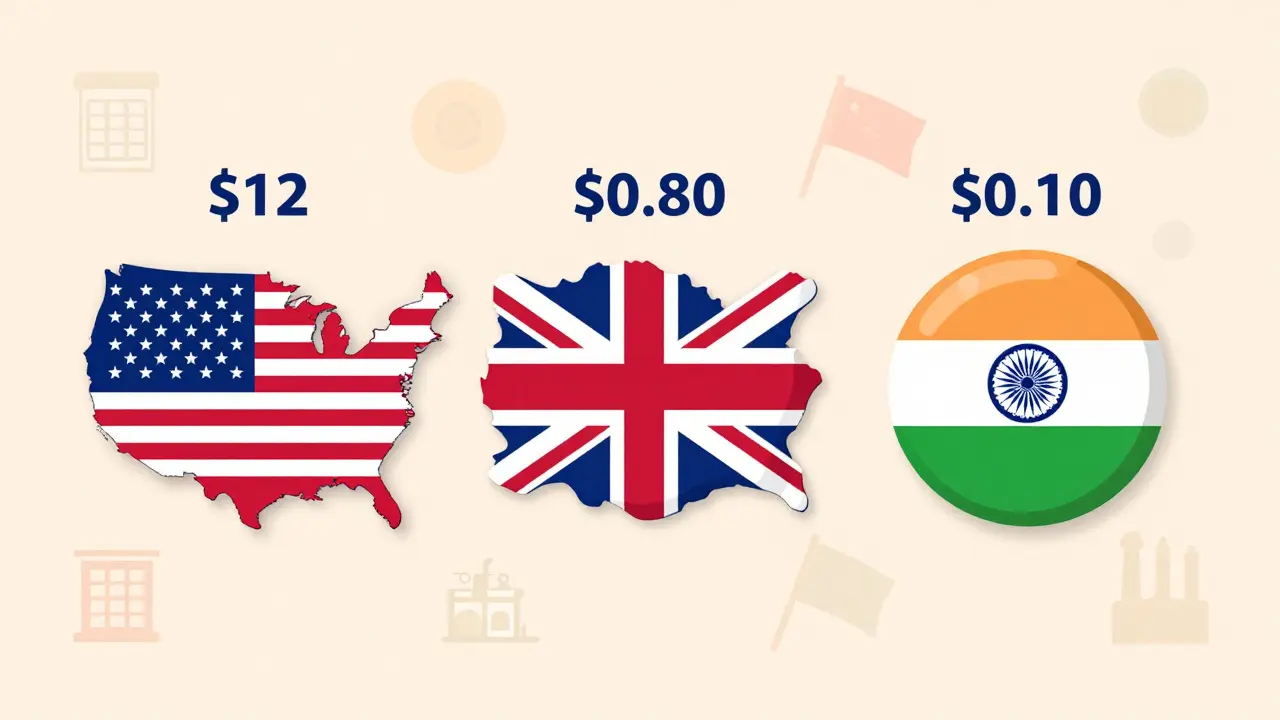
Think about this: you take the same generic pill as someone in Germany, India, or Canada-but you pay six times more. It’s not a mistake. It’s the reality of how generic drugs work across the world. The active ingredient is identical. The pill looks the same. But the price? The availability? The trust in it? That’s where everything falls apart.
Same Drug, Different Worlds
In the United States, over 90% of prescriptions are filled with generic drugs. That’s higher than any other country. But here’s the twist: the U.S. still pays the most for those generics. In 2022, drug prices in the U.S. were nearly three times higher than in other rich countries, even for drugs that have been off-patent for decades. Meanwhile, in the U.K., 83% of prescriptions are generic-and the price per pill is often less than a dollar. In Switzerland, only 17% of prescriptions are generic, and the same pill costs more than $10. Why? It’s not about quality control. It’s about policy. The U.S. has a system that pushes pharmacies to substitute generics automatically. But it doesn’t force manufacturers to compete on price. So even when five companies make the same generic metformin, one of them might suddenly jack up the price because no one’s watching. In Europe, governments set price caps. In the U.K., the NHS negotiates bulk deals. In Germany, pharmacists get paid more to hand out generics. In Switzerland, doctors and patients still trust the brand name-even if it’s been off-patent for 20 years.Who Makes Your Generic Pills?
Chances are, the generic drug you’re taking was made in India or China. India alone produces about 20% of the world’s generic drugs and supplies 40% of the generics used in the U.S. There are over 750 Indian manufacturing sites approved by the FDA. But here’s what most people don’t know: not all Indian-made generics are the same. A 2023 study from Ohio State University found that generic drugs made in India were linked to 54% more severe side effects-like hospitalizations and even deaths-compared to identical drugs made in the U.S. That doesn’t mean all Indian generics are dangerous. But when production costs are squeezed to the bone, corners get cut. Excipients change. Manufacturing conditions shift. And for older drugs like levothyroxine or metformin, where profit margins are razor-thin, quality control becomes a gamble. China is catching up fast. Its FDA-approved facilities jumped from 12 in 2010 to 187 in 2023. But inspections are still a problem. The FDA mostly gives companies advance notice before inspections. In the U.S., inspections are unannounced. Overseas? Not so much. That’s why a plant in India might pass inspection one month and fail the next-because they clean up for the visit and go back to old habits.Why Some Countries Have More Generics Than Others
It’s not just about money. It’s about culture, law, and history. In the U.K. and the Netherlands, pharmacists are legally allowed-and even encouraged-to swap a brand-name drug for a generic without asking the doctor. Patients are told, “This is just as good, and it saves the system money.” Over time, that builds trust. In Germany, doctors are paid bonuses for prescribing generics. In Italy and Greece, patients still ask for the brand. Why? Because they remember when generics were unreliable. Or because their doctor never pushed them. South Korea is a weird case. Prices for generics there are often lower than in the U.S. or Europe. But doctors still prescribe the brand name 80% of the time. Why? Because patients believe the brand is better. Even when the science says otherwise. In the U.S., state laws govern substitution. Some states let pharmacists switch without asking. Others require the doctor’s permission. That creates a patchwork. A patient in New York gets a generic. A patient in California gets the brand because the pharmacist didn’t know the rules. It’s chaotic.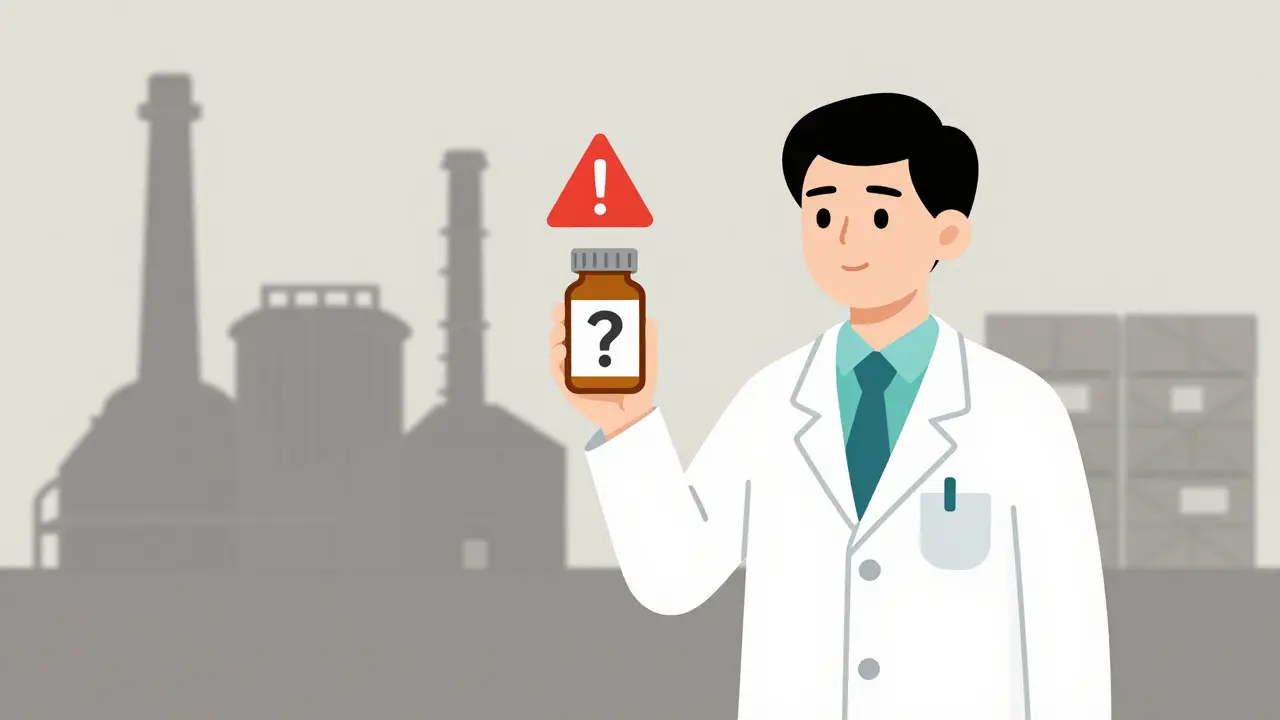
The Hidden Cost of Low Prices
Low prices sound great. But when a generic drug sells for 50 cents a pill, who makes it? And how? In 2023, the U.S. had 147 generic drug shortages. Two-thirds of them came from quality issues at single manufacturing sites-mostly in India and China. One factory fails an inspection, and suddenly, no one can get the blood pressure medicine they’ve been taking for 10 years. The FDA can’t inspect every facility every month. So when one plant shuts down, the whole supply chain breaks. Dr. Rena Conti from the University of Chicago says this isn’t accidental. “We’ve driven generic prices so low that manufacturers can’t afford to run safe, reliable plants,” she told Health Affairs in 2023. “We’re sacrificing reliability for savings.” In Europe, where prices are higher and margins are better, shortages are rarer. In Canada, where the government sets price floors, manufacturers still make money-and keep making the drug. But in the U.S., if a generic drug drops below 20 cents a pill, companies walk away. That’s why you’ll see sudden spikes: a drug is cheap for years, then one manufacturer quits, demand stays high, and the price jumps 500% overnight.Parallel Trade and the Gray Market
Ever bought a generic drug from Canada? Or Germany? Or the U.K.? You’re not alone. People in the U.S. are increasingly turning to online pharmacies abroad because the same pill costs 60-80% less. Reddit threads are full of stories: “I paid $12 for my generic lisinopril in Canada. Back home, it was $98.” But here’s the catch: these aren’t always the same drug. A generic made in India for the U.K. market might use a different filler than the one made for the U.S. That’s legal. But if you’re sensitive to certain dyes or binders, you could get sick. One doctor on the American Medical Association forum reported patients arriving from Canada with rashes and dizziness-because their “same” generic had a different inactive ingredient. The U.S. government doesn’t stop this. It’s a loophole. But it’s also a sign of failure. If your own system can’t deliver affordable, reliable medicine, people will find another way.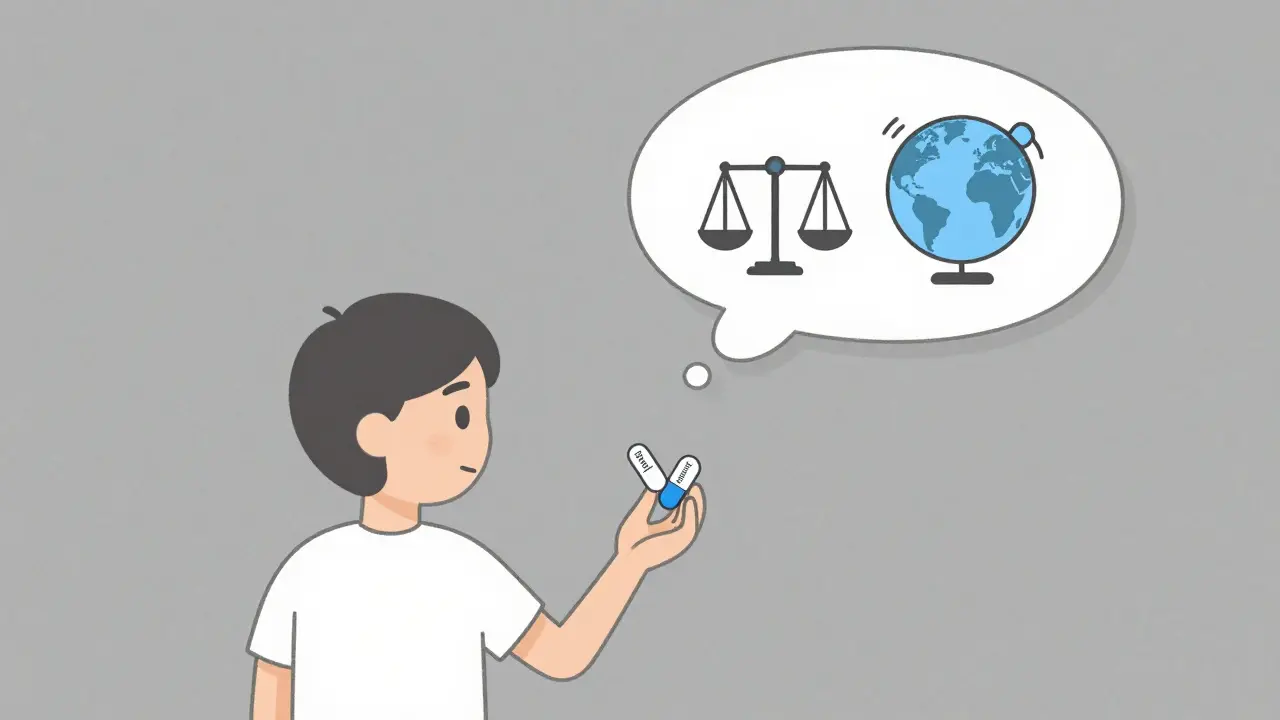
What’s Changing? And What’s Not
There’s movement. The U.S. Inflation Reduction Act of 2022 gave the FDA more money to inspect foreign plants. It also promised to speed up generic approvals by 30%. The European Union wants 80% generic use across all member states by 2030. The WHO is pushing for global quality standards. But the big barriers remain. Patent evergreening: Drug companies file dozens of tiny patents on minor changes-new coating, new shape, new dosage form-to delay generics. Between 2015 and 2022, 1,247 such patents were filed on just 12 top-selling drugs. Regulatory chaos: The EMA approves a generic for Europe. But each country still has to approve it separately. That adds 18-24 months to market entry. In the U.S., the FDA approves a drug, but then inspects each factory-no matter how many times it’s been checked before. And then there’s the human factor: doctors still trust brands. Patients still believe the expensive one is better. Until that changes, even the best policies won’t fix everything.What You Can Do
You can’t fix the system. But you can protect yourself.- Ask your pharmacist: Is this the same generic you’ve had before? If the pill looks different, ask why.
- Check the manufacturer: Look up the name on the bottle. If it’s made by a company you’ve never heard of, research it. Some are reliable. Others aren’t.
- Don’t assume cheaper is better: A $0.10 pill might be a risk. A $1.50 pill from a known manufacturer might be worth it.
- Track your reactions: If you feel different after switching generics-dizziness, nausea, fatigue-tell your doctor. It might not be in your head.
What’s Next?
The next wave of savings isn’t in small-molecule generics anymore. It’s in biosimilars-generic versions of complex biologic drugs like insulin, rheumatoid arthritis meds, and cancer treatments. They’re cheaper than the brand, but harder to make. And even harder to get approved. By 2028, biosimilars could save the U.S. healthcare system $60 billion. But only if regulators can keep up. And only if patients and doctors trust them. Right now, the global generic drug market is a paradox. It saves billions. It reaches millions. But it’s built on shaky foundations. And until we fix the incentives, the quality gaps, and the mistrust, the same pill will keep costing different things-depending on where you live.Why are generic drugs cheaper than brand-name drugs?
Generic drugs are cheaper because they don’t need to repeat expensive clinical trials. The original brand paid millions to prove the drug works and is safe. Generic makers only need to prove their version is bioequivalent-meaning it delivers the same amount of active ingredient into the bloodstream at the same rate. That cuts development costs by 80-90%. They also don’t spend money on advertising, so the savings get passed on.
Are generic drugs as effective as brand-name drugs?
Yes-by law, they must be. The FDA and EMA require generics to deliver the same active ingredient in the same strength and be absorbed at the same rate as the brand. But “same” doesn’t always mean “identical.” Fillers, dyes, and coatings can vary. For most people, that doesn’t matter. But for those with allergies, sensitivities, or conditions like epilepsy or thyroid disease, even small changes can cause side effects. Always monitor how you feel after switching.
Why do some countries have more generic drugs than others?
It’s a mix of policy, culture, and economics. Countries like the U.K. and Germany pay pharmacists to substitute generics and set price caps to keep costs low. In the U.S., substitution is allowed but not enforced, and prices aren’t controlled, so manufacturers can charge more. In Switzerland and Italy, patients and doctors still prefer brand names, even if they’re 10x more expensive. Cultural trust matters as much as regulation.
Is it safe to buy generic drugs from other countries online?
It’s risky. While many online pharmacies abroad sell legitimate generics, others sell counterfeit or substandard versions. Even if the drug is real, the formulation might differ from what you’re used to-different fillers, different manufacturing standards. The FDA doesn’t regulate foreign online sellers. If you do it, stick to verified pharmacies (like those certified by PharmacyChecker) and always check the manufacturer. Never buy from unknown sites.
Why do generic drug prices suddenly spike?
It usually happens when one manufacturer stops making the drug-often because the price is too low to make a profit. If only one or two companies make a generic, and one quits, demand stays the same but supply drops. The remaining company raises prices. This is common with older, low-margin drugs like antibiotics or blood pressure meds. The FDA tracks these shortages, but there’s no law forcing companies to keep making unprofitable drugs.
Can I ask my doctor to prescribe a specific generic manufacturer?
Yes, you can. In the U.S., you can ask your doctor to write “Dispense as Written” or “Do Not Substitute” on the prescription. This stops the pharmacist from switching brands. It’s not always easy-some pharmacies push back-but it’s your right. If you’ve had bad reactions to a certain generic before, this is the best way to avoid it.

Geri Rogers
February 5, 2026 AT 04:59OMG I just switched my metformin brand and my blood sugar went nuts for a week 😫 Turns out the new one had a different filler-turns out I’m allergic to that dye. Always check the manufacturer name now. My pharmacist didn’t even tell me it changed. 🤦♀️
Katherine Urbahn
February 5, 2026 AT 20:57It is, however, a matter of public record that the United States Food and Drug Administration (FDA) maintains stringent regulatory oversight over pharmaceutical manufacturing-both domestic and foreign. The assertion that Indian-manufactured generics are inherently inferior is not only misleading but dangerously reductive. Quality control is not determined by geography, but by compliance with Current Good Manufacturing Practices (cGMP). The FDA conducts over 3,000 inspections annually, and the vast majority of facilities-regardless of location-are compliant.
Moreover, the statistical correlation cited in the Ohio State study does not establish causation; confounding variables such as patient adherence, co-morbidities, and concurrent medication use were not adequately controlled. To blame manufacturing location is to ignore systemic failures in post-market surveillance and physician education.
Additionally, the notion that price suppression equates to quality degradation is economically naive. Competitive markets drive efficiency-not negligence. The real issue lies in the lack of price transparency and the absence of federal price negotiation authority, not in the pills themselves.
caroline hernandez
February 6, 2026 AT 18:23Let’s talk about the supply chain architecture here. The U.S. has outsourced manufacturing to a low-margin, high-volume model-essentially commoditizing life-saving molecules. But when you compress margins below the cost of compliance (QA/QC, environmental controls, personnel training), you create systemic fragility. It’s not just about inspections-it’s about economic sustainability. If a pill sells for $0.12, you can’t afford to run a Class 10,000 clean room, maintain redundant systems, or train technicians properly.
Europe and Canada don’t have higher prices because they’re inefficient-they have higher prices because they’ve built a value-based ecosystem where reliability is monetized. That’s not ‘overpaying.’ That’s risk mitigation. We’re paying for it anyway-in hospitalizations, shortages, and lost productivity. The real ROI isn’t in the sticker price-it’s in the continuity of care.
And biosimilars? They’re the next frontier. But we’re going to need a whole new regulatory playbook. You can’t apply small-molecule logic to complex biologics. We’re talking about protein folding, glycosylation patterns, immunogenicity risks. If we don’t invest in the infrastructure now, we’re setting ourselves up for another insulin crisis in 2030.
Jhoantan Moreira
February 7, 2026 AT 23:51Just wanted to say I’ve been buying my lisinopril from a Canadian pharmacy for 3 years now-$8 vs $110 back home. Same batch code, same pill, same results. I’m British but live in the US now, and honestly? I don’t feel guilty. The system’s broken, not me. 🤷♂️
Janice Williams
February 8, 2026 AT 04:52It is utterly irresponsible to suggest that patients should accept substandard pharmaceuticals simply because they are cheaper. The fact that Americans are willing to gamble with their health for a few dollars is not a testament to ingenuity-it is a moral failure of epic proportions. You are not saving money; you are sacrificing your life on the altar of corporate greed and regulatory apathy. Shame on you.
Roshan Gudhe
February 9, 2026 AT 16:21It’s funny how we treat medicine like a commodity. We buy pills like we buy socks-price first, quality later. But medicine isn’t a product. It’s a covenant between your body and science. When you cut corners on excipients, you’re not just changing a filler-you’re altering the dialogue between your cells and the drug. India makes 20% of the world’s generics? Sure. But who’s paying for the silence of the workers in those factories? Who’s paying for the rivers poisoned by pharmaceutical waste? We’re not just buying pills-we’re buying complicity.
And then we wonder why trust is broken. We don’t need more inspections. We need a new moral framework. One where a pill isn’t measured in cents, but in dignity.
Rachel Kipps
February 10, 2026 AT 18:36i read this and thought about my mom shes on levothyroxine and switched generics last year and she swears shes more tired now and her heart races sometimes. she never told the doctor bc she thought it was just aging. maybe we should all pay more attention to these little changes. sorry for the typos, typing on phone
Prajwal Manjunath Shanthappa
February 11, 2026 AT 20:39Let’s be clear: the U.S. healthcare system is a grotesque parody of capitalism. You have a nation that boasts the most advanced medical research on earth, yet its citizens are forced to become pharmaceutical arbitrageurs, scouring Reddit for Canadian pharmacies like it’s some kind of black-market espionage operation. Meanwhile, Indian manufacturers-many of whom operate under conditions that would be criminalized in the West-are quietly subsidizing American consumerism with exploitative labor and environmental degradation. And we call this ‘affordability’? Please. This isn’t capitalism. It’s colonialism with a pill bottle.
And don’t even get me started on the FDA’s ‘advance notice’ inspections. That’s not oversight-it’s a charade. A corporate theater where compliance is performative, not substantive. You don’t fix a broken system by throwing more money at inspections-you fix it by dismantling the entire incentive structure.
Joy Johnston
February 12, 2026 AT 21:43My pharmacist actually told me to look up the manufacturer on Drugs.com when I asked why my pill looked different. I did-and found out the new one was made by a company that had been cited for 12 violations in 2022. I asked for my old one back. They gave it to me. No hassle. You can ask. Seriously. Just say ‘I want the same manufacturer.’ It’s your right.
Shelby Price
February 13, 2026 AT 16:25So… if I buy a generic from Canada, and it’s made in India, but labeled for the UK market… is it the same as the one I’d get in the US? Or am I just playing Russian roulette with my thyroid?
Jesse Naidoo
February 15, 2026 AT 04:43Wait so you’re saying I can’t trust my blood pressure med? I’ve been taking this same generic for 7 years. Are you telling me I’ve been poisoned this whole time? I need answers. I need names. I need to know who made this pill.