
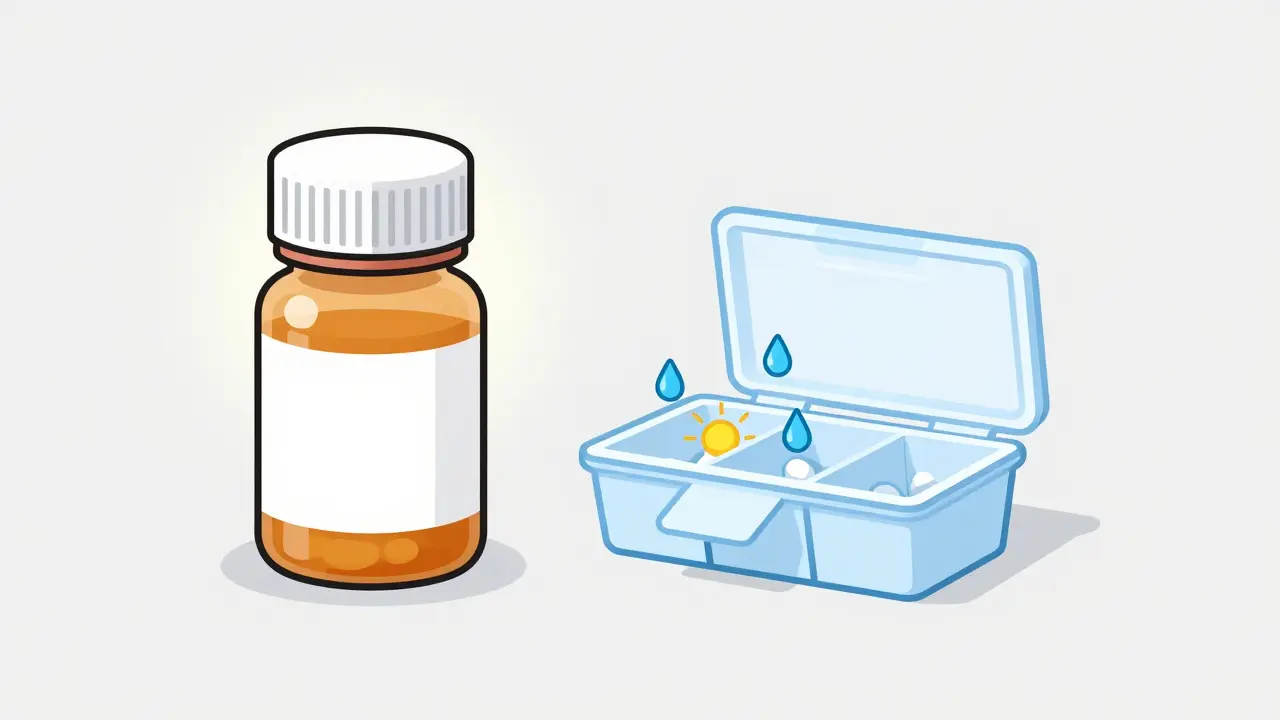
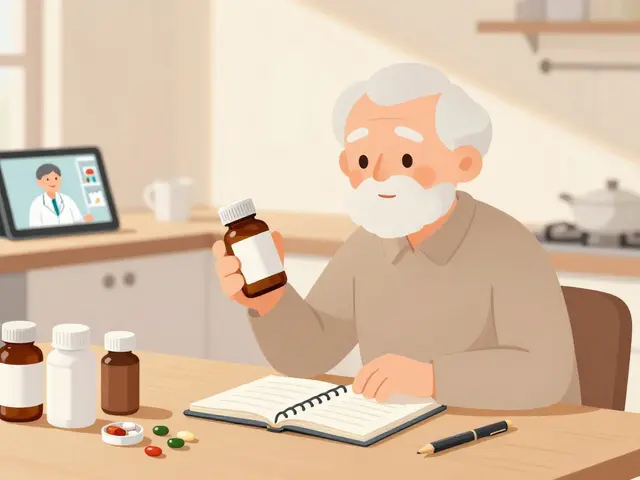
Most of us have a plastic pill organizer on the counter or a pharmacy bottle filled with a mix of tablets. It seems convenient, but there is a hidden risk: once a drug leaves its original manufacturer's packaging, the clock starts ticking much faster. Many people assume the expiration date on the original box still applies, but that is a dangerous mistake. When you move a drug into a pillbox or a different vial, you strip away the specialized barriers-like desiccants and light-shielding plastics-that keep the medicine active and safe.
Why Original Packaging Matters
Manufacturers don't pick bottles and blisters at random. They design a "container-closure system" specifically for each drug. For instance, Repackaged medications is the process of transferring a drug product from its original container into a different container for dispensing or administration. This shift exposes the drug to environmental stressors that the original packaging was designed to block.
The biggest enemies are moisture, oxygen, and light. Standard pharmacy vials often have much higher moisture vapor transmission rates than manufacturer bottles. In a real-world example, albuterol sulfate tablets stored in a standard pharmacy vial showed nearly 16% degradation after just 90 days, while those in the original HDPE bottle with a desiccant only dropped by 3.2%. When you move a pill into a plastic organizer, you're essentially inviting the air in, which can lead to hydrolysis (breakdown due to water) or oxidation.
The Pillbox Problem: Interaction and Decay
Pillboxes introduce a unique complication: drug-drug interactions. In the original packaging, medications are isolated. In a weekly organizer, multiple drugs from different manufacturers sit side-by-side for days. Research shows that nearly 19% of medications in these organizers exhibit physical interactions, such as caking or color changes, within just two weeks.
If you notice your pills are sticking together, changing color, or developing a strange smell, the chemical structure is likely breaking down. This isn't just a cosmetic issue; it means the medication may no longer be potent enough to treat your condition, or worse, it could create degradation products that are harmful.
| Drug Type | Example | Recommended Max Period (Amber Vial) | Primary Risk |
|---|---|---|---|
| Hygroscopic | Amoxicillin | 30 Days | Moisture absorption |
| Light-Sensitive | Nifedipine | 60 Days | UV degradation |
| Stable | Atenolol | 90 Days | General oxidation |
How to Formally Evaluate Stability
For pharmacy professionals and high-risk patients, a casual "look and smell" test isn't enough. A formal stability evaluation follows a specific scientific path to determine exactly when a drug becomes ineffective.
- Stress Testing: The process starts by exposing a sample to extreme conditions-typically 40°C and 75% relative humidity for 14 days. This helps identify which drugs are most susceptible to breakdown before a longer study begins.
- Long-Term Testing: The drug is stored at a controlled temperature (25°C ± 2°C) and humidity (60% RH ± 5% RH). Testing intervals are usually every three months for a year, though for repackaged drugs, checks happen weekly in the first month and biweekly in the second.
- Analytical Verification: Experts use HPLC-UV is High-Performance Liquid Chromatography with Ultraviolet detection, used to detect degradation products at concentrations as low as 0.05%. This is the gold standard for seeing if the active ingredient is actually still there. For proteins, Size-Exclusion Chromatography (SEC-HPLC) is used to find aggregates that signal instability.
- Statistical Analysis: Using a one-sided 95 percent confidence limit, researchers determine the exact date the drug's potency falls below the acceptable threshold.
Practical Rules for Safe Storage
Since most people don't have an HPLC machine in their kitchen, you need practical heuristics to keep your medications safe. The general rule from the International Pharmaceutical Federation is that repackaged solid oral drugs should not exceed a 6-month stability window under standard pharmacy conditions, but for many, 30 to 90 days is the safer bet.
To extend the life of your meds, consider these steps:
- Use Desiccants: Adding small silica gel packs to your pharmacy vials can extend stability by nearly 50% for moisture-sensitive drugs.
- Limit Pillbox Filling: Don't fill your organizer for the whole month. Fill it weekly to minimize the time drugs are exposed to air.
- Avoid the Bathroom: The humidity from your shower is a catalyst for degradation. Store your pillboxes in a cool, dry place like a bedroom dresser.
- Check for "Caking": If tablets feel sticky or have fused together, discard them immediately. This is a clear sign of moisture ingress.
Regulatory Realities and Risks
The FDA takes this seriously. In recent years, they have issued warning letters to pharmacies that failed to establish written procedures for assigning expiration dates to repackaged drugs. This is because the "manufacturer's date" is legally and scientifically void once the seal is broken and the drug is moved to a new container.
Data from the FDA's Office of Testing and Research shows a startling gap: 22% of repackaged medications tested beyond 90 days showed degradation exceeding safety limits, compared to only 3% of those left in original packaging. This proves that the risk isn't theoretical-it's a measurable loss of efficacy.
Can I still use the expiration date on the original bottle after moving pills to a pillbox?
No. The manufacturer's expiration date is only valid if the drug remains in the original container with the original seal and desiccant. Once repackaged, the drug is exposed to different environmental factors, and its stability profile changes. You should consult a pharmacist for a repackaged expiration date.
How can I tell if my medication has degraded in a pillbox?
Look for physical changes: discoloration (yellowing or spotting), caking (pills sticking together), or a change in smell. However, some chemical degradation is invisible. If a medication has been in an open pillbox for more than 30-90 days, its potency may have dropped even if it looks normal.
Are all medications equally unstable when repackaged?
No. Some drugs, like atenolol, are relatively stable. Others, like amoxicillin (hygroscopic) or nifedipine (light-sensitive), degrade very quickly. High-risk medications, including biologics and narrow therapeutic index drugs, should never be repackaged without professional stability testing.
Does using an amber-colored vial help with stability?
Yes, amber vials protect light-sensitive medications from UV degradation. However, they do not stop moisture. For hygroscopic drugs, the color of the plastic is less important than whether the container has a moisture-proof seal or a desiccant pack.
What is the safest way to use a weekly pill organizer?
The safest method is to only fill the organizer for 7 days at a time. Keep the bulk of your medication in the original manufacturer's bottles and only move a week's worth into the organizer. Store the organizer away from heat and humidity.
Next Steps for Patients and Caregivers
If you are managing multiple medications, start by auditing your storage. If you have a pillbox filled for a month, consider switching to a weekly rotation. For those taking high-risk biologics or chemotherapy agents, avoid pillboxes entirely and keep them in their original, often refrigerated, packaging.
If you suspect your medication has been compromised, don't just toss it-talk to your pharmacist. They can help you determine if the drug is still viable or if you need a replacement. When picking up new prescriptions, ask your pharmacist specifically: "Is this medication stable in a pillbox, or should I keep it in this bottle?"
Tama Weinman
April 18, 2026 AT 01:12Just typical pharma-backed nonsense to keep us buying more bottles while they manipulate the shelf-life data behind the scenes. Think about why they want you to avoid those organizers-maybe because it makes it too easy to track exactly how much they're overcharging for a chemical that's stable enough for a plastic box.
Kim Hyunsoo
April 18, 2026 AT 03:15Wait, so my cute little rainbow organizer is basically a tiny chemistry lab of decay? 🌈 That's wild. I always wondered why some of my meds looked a bit dusty after a month. Totally trippy stuff! 😵💫
Nathan Berlin
April 18, 2026 AT 05:31honestly just typical western obsession with overcomplicating simple things 🙄 we have better chemists in india anyway and our systems are way more efficient than this messy us pharmacy drama 🇮🇳💊 pls just stop worrying and trust the experts who actually know what they are doing
Anmol Garg
April 18, 2026 AT 08:09It's really just about finding a balance that works for your own life and health. We all want convenience, but taking a moment to realize how these things interact is part of a deeper mindfulness regarding our bodies. Maybe the weekly shift is a good way to stay present with our wellness journey.
Nell O'Leary
April 18, 2026 AT 23:57Totally agree on the hydrolysis point! 🧪 The moisture vapor transmission rate (MVTR) in those cheap plastics is absolutely abysmal compared to HDPE. It's basically a free-for-all for atmospheric water to compromise the API stability. 📉
Randall Barker
April 19, 2026 AT 04:50The sheer negligence of people who ignore these warnings is astounding. If you can't take five minutes a week to fill a pillbox correctly, you're essentially gambling with your own biological integrity. It's a moral failure to disregard the basic science of stability just for the sake of a little laziness.
Dana Chichirita Nicoleta
April 20, 2026 AT 15:49Oh my goodness, I am absolutely thrilled that this information is being shared so openly because it is simply marvelous how much we can improve our longevity just by making a tiny, infinitesimal change to our morning routines! I shall immediately begin the practice of filling my organizer only once every seven days, and I feel an overwhelming sense of joy knowing that my medications will remain in their most potent and effective state, ensuring that every single dose I take is working exactly as the brilliant scientists intended it to do for my overall well-being! ✨
Autumn Bridwell
April 22, 2026 AT 03:58I literally just checked my husband's pillbox and the tablets look weird! Now I'm going to go through every single one of his bottles to see if he's been doing this wrong for years! This is honestly a tragedy that no one tells us this!
Richard Moore
April 22, 2026 AT 19:58Exactly! Just keep it simple and follow the guidelines. 💯 No need to overthink it, just move to a weekly fill and you're good to go. 👏
ira fitriani
April 23, 2026 AT 18:51This is such a great reminder to stay proactive about our health! 🌟 I'm definitely moving my organizers out of the bathroom and into the bedroom today. Let's all motivate ourselves to take these small steps for a healthier future! 💪✨
Cheryl C
April 25, 2026 AT 13:29USA pharmacys be trippin 🇺🇸 lol just put them in a baggie and call it a day 🤷♀️ who got time for hplc machines lmao
Heer Malhotra
April 27, 2026 AT 05:10It is a matter of civic duty to adhere to pharmaceutical standards. Those who ignore these stability limits are displaying a reckless disregard for the rigorous scientific processes established by our global health authorities. One must maintain the highest level of discipline when administering medication.