
Customized medications aren’t just convenient-they’re lifesaving. For a child who can’t swallow pills, a patient allergic to dyes in commercial drugs, or someone needing a precise dose that doesn’t exist on store shelves, compounded medications make treatment possible. But with great personalization comes great risk. One wrong calculation, one mislabeled bottle, one contaminated batch-and the result isn’t just a wasted prescription. It’s an ICU stay. A death. A family shattered.
The 2012 NECC outbreak didn’t come out of nowhere. It was the result of years of skipped steps: poor sanitation, no verification, no accountability. Since then, the system has tightened. But not everywhere. And not consistently. If you’re compounding medications, you’re not just mixing ingredients. You’re holding someone’s life in your hands. Here’s how to stop errors before they happen.
Start with the Standards-USP <795>, <797>, and <800> Aren’t Suggestions
USP chapters <795> (non-sterile), <797> (sterile), and <800> (hazardous drugs) aren’t optional guidelines. They’re the bare minimum for safety. If your facility doesn’t meet these, you’re not just cutting corners-you’re gambling with lives.
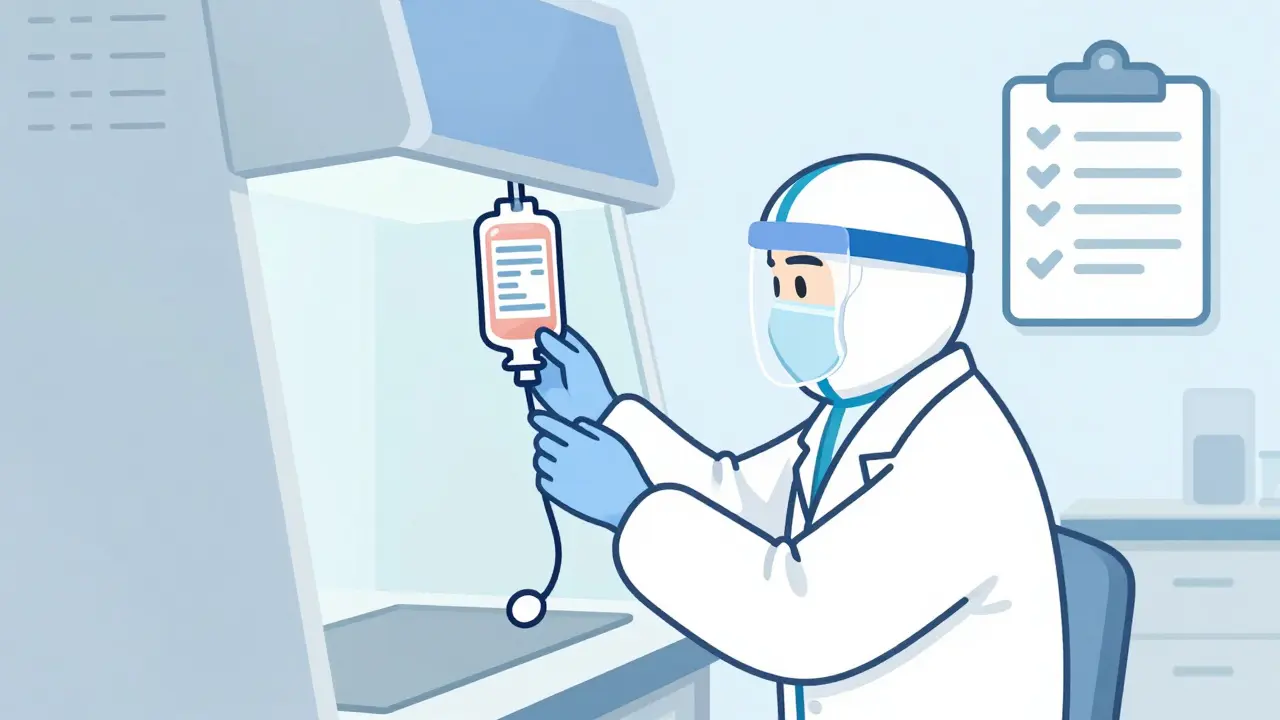
For sterile compounding, like IV bags or injectables, you need an ISO Class 5 cleanroom. That means HEPA-filtered air, laminar flow hoods, and staff wearing full gowns, masks, and gloves. No exceptions. A single speck of dust in a spinal injection can cause meningitis. You don’t need to be a microbiologist to understand that.
Non-sterile compounding-think topical creams, oral liquids, or capsules-requires at least an ISO Class 8 environment. That’s not a clean counter in the back room. That’s a dedicated space with controlled airflow, no food or drinks, and regular surface swabs to check for contamination.
And if you’re handling chemo drugs, hormones, or other hazardous materials? USP <800> kicks in. That means dedicated ventilation, spill kits, and double-gloving. Skipping this isn’t laziness-it’s negligence.
Double-Check Everything-No Exceptions
One pharmacist calculates the dose. Another verifies it. That’s not bureaucracy. That’s survival.
The American Society of Health-System Pharmacists says dual verification is non-negotiable. Why? Because humans make mistakes. A decimal point in the wrong place turns 5 mg into 50 mg. A child dies. A parent loses their child. And you? You live with it.
Verification isn’t just looking at the math. It’s checking:
- Each ingredient’s name and lot number against the prescription
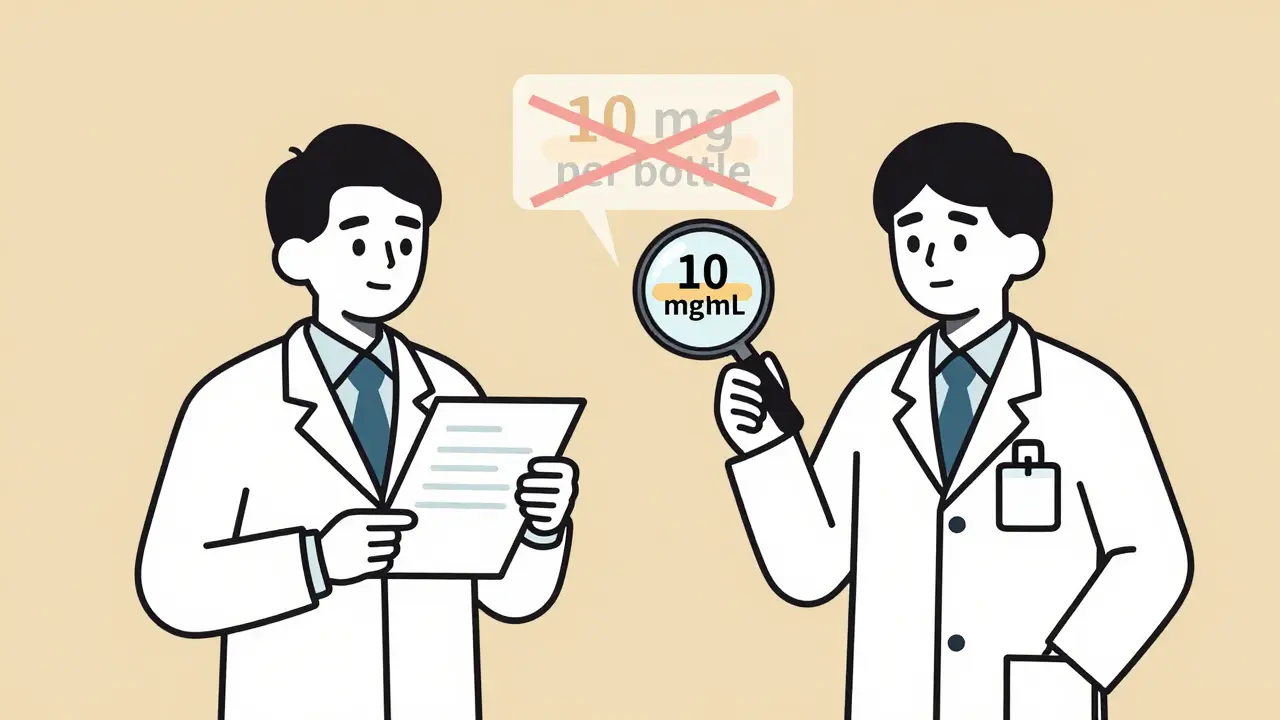
- The concentration-mg/mL, not mg per bottle
- The beyond-use date (BUD) based on stability data
- The final product’s appearance-no cloudiness, no separation, no strange odor
Use checklists. Don’t rely on memory. Even the most experienced pharmacist has had a bad day. A missed call. A sick kid at home. A rushed shift. That’s when errors happen.
Labeling Isn’t an Afterthought-It’s a Lifeline
Between 2018 and 2022, the FDA recorded 27 fentanyl overdose cases linked to compounded medications. Why? Labels said ‘10 mg per container’ when they meant ‘10 mg per mL.’
That’s not a typo. That’s a fatal misunderstanding.
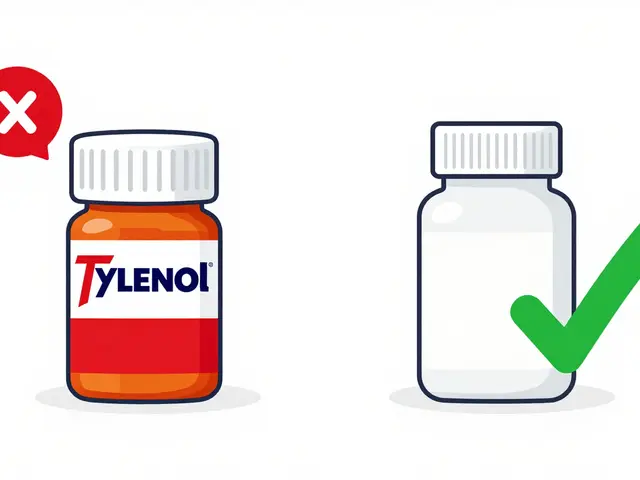
The FDA’s 2023 draft guidance demands standardized labeling: always use concentration units like mg/mL, mg/g, or units/mL. Never say ‘per bottle’ or ‘per vial’ unless you also state the total volume. If the label doesn’t say exactly how much active ingredient is in each milliliter, it’s dangerous.
And don’t forget the patient’s name, prescriber, date, and BUD. If a nurse grabs a bottle off the shelf and can’t tell who it’s for or when it expires, they won’t stop. They’ll give it anyway. And then you’ll be the one answering questions from a coroner.
Use Technology-But Don’t Trust It Blindly
Software like Compounding.io and PharmScript isn’t magic. But it’s your best defense against calculation errors. A 2022 study in the Journal of the American Pharmacists Association found these tools cut human error by 40%.
They catch:
- Wrong dose calculations based on weight or body surface area
- Drug interactions you might miss
- Expired ingredients in your inventory
- Inconsistent units (like mixing grams and milligrams)
But here’s the catch: software doesn’t verify the ingredient. It doesn’t smell the cream. It doesn’t see if the vial is cracked. So use it as a tool-not a replacement for human judgment.
Some pharmacies now use AI systems like CompoundingGuard AI. In a 2022 pilot, it reduced calculation errors by 87%. That’s not a trend. That’s a game-changer. If your pharmacy still uses paper calculators and handwritten logs, you’re operating in the 1990s.
Training Isn’t a One-Time Event
Dr. Henry Cohen, former president of the International Academy of Compounding Pharmacists, says this plainly: ‘Quarterly competency assessments are the single most effective error prevention strategy.’
That means:
- 40+ hours of initial training before anyone touches a compound
- 8-12 hours of continuing education every year
- Hands-on testing: calculate a dose from scratch, prepare a sterile IV, clean a hood, interpret a BUD chart
- Simulated errors: give staff a prescription with a red flag and see if they catch it
And it’s not just pharmacists. Technicians handle ingredients, clean equipment, and label bottles. They need the same training. A 2021 study found that 67% of labeling errors came from support staff-not pharmacists.
Don’t train once and forget. Retrain when standards change. Retrain after an incident. Retrain after vacation time. Retrain because complacency kills.
Accreditation Isn’t Optional-It’s Your Reputation
PCAB accreditation costs $15,000-$25,000 and takes over a year. It’s a grind. But here’s the truth: accredited pharmacies have error rates below 2%. Non-accredited ones? Up to 25%.
Why? Because PCAB doesn’t just check your paperwork. They send inspectors to watch you work. They test your air quality. They review your batch records. They interview your staff. They check if you actually do dual verification-or just pretend to.
As of 2023, only 18% of compounding pharmacies in the U.S. are PCAB-accredited. That means 82% are flying blind. If you’re not accredited, you’re not just risking fines-you’re risking your license, your reputation, and your patients’ lives.
Document Everything-Or Be Ready to Explain Why You Didn’t
Every batch needs a complete record:
- Ingredients used (name, lot number, supplier)
- Equipment used (hood number, balance ID)
- Environmental conditions (temperature, humidity, air pressure)
- Who prepared it
- Who verified it
- Beyond-use date and how it was determined
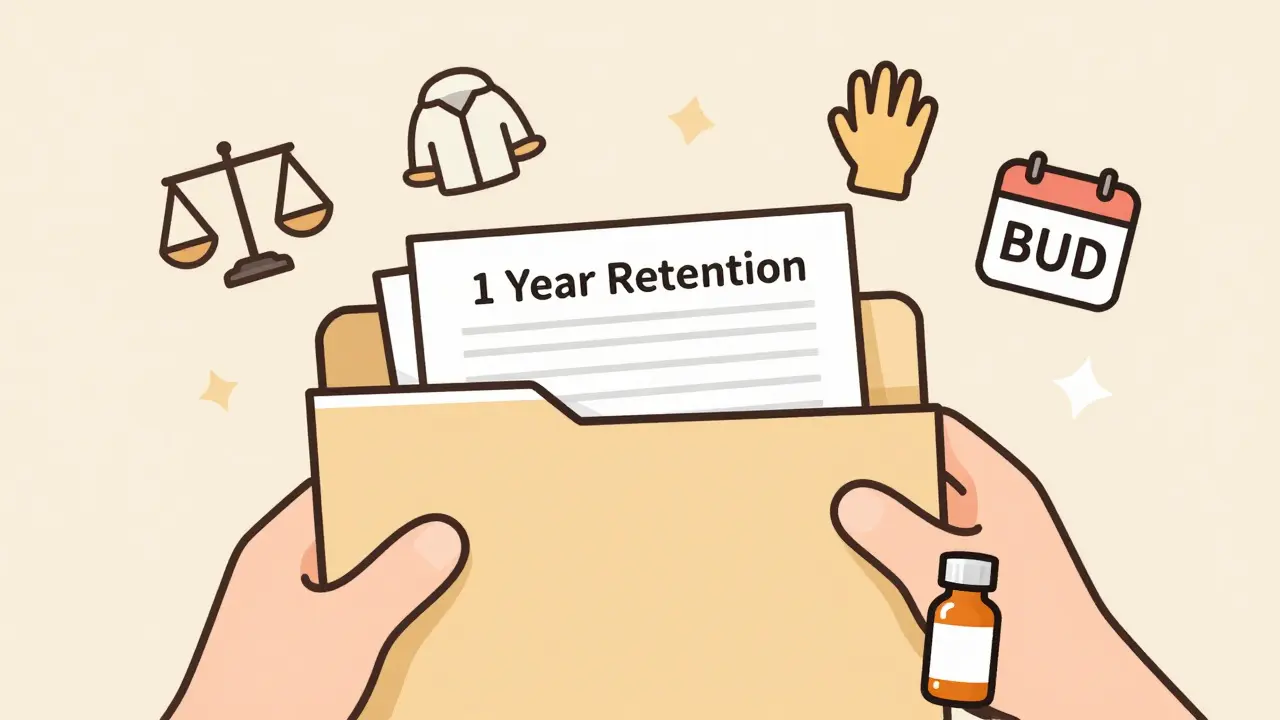
Retention? Minimum one year past the BUD. In some states, it’s five years. If you get audited and can’t produce a batch record, you’re done. No second chances.
And don’t forget stability testing. You can’t just guess how long a cream lasts. You need data. If you don’t have the lab to test it, partner with one. If you can’t afford it, don’t compound it. That’s the hard truth.
The Bigger Picture: Why This Matters
Compounded medications serve 6 million Americans a year. That’s not a niche. That’s critical care. For 91% of patients needing allergen-free formulas, there’s no alternative. For kids who need 1.2 mg of a drug instead of 10 mg, compounding is the only option.
But the system is fractured. 503A pharmacies-most of them-operate under patchwork state rules. 503B outsourcing facilities? They’re held to FDA manufacturing standards. Their error rates are 22% lower.
The future? More regulation. More consolidation. More pressure to meet national standards. The proposed Compounding Quality Act of 2024 could force every pharmacy to follow the same rules. If you’re not ready, you won’t survive.
So ask yourself: Are you doing this because you care-or because you’re just trying to make a profit? If it’s the latter, you shouldn’t be compounding at all. Because when a child dies because of a label mistake, no one remembers your sales numbers. They remember your name.
What Happens When You Skip Steps
Reddit user NurseAmy2022 posted about a geriatric patient who went into serotonin syndrome. Why? A compounded tramadol solution was labeled ‘50 mg per container’-but the patient’s caregiver thought it was 50 mg per mL. They gave 10 mL. That’s 500 mg. The patient ended up in ICU for three days.
That wasn’t a freak accident. It was preventable. A clear label. A dual check. A pharmacist who asked, ‘Does this make sense?’
Don’t wait for a tragedy to change your process. Change it now.
evelyn wellding
January 17, 2026 AT 07:23This post hit me right in the feels. I’ve seen what happens when shortcuts are taken-my cousin’s baby almost didn’t make it because of a compounded med mix-up. Please, pharmacists, don’t treat this like a to-do list. Lives are in your hands. 💕
Chelsea Harton
January 18, 2026 AT 08:10usps? more like usp’s. if you dont follow them you’re just a glorified kitchen chemist. 🤷♀️
Corey Chrisinger
January 18, 2026 AT 08:35There’s something deeply human about this whole thing. We’re not just mixing powders-we’re holding space for people who have nowhere else to turn. The math is cold, but the consequence? Warm with fear, love, grief. That’s the weight we carry.
And yeah, AI helps. But it doesn’t cry when a kid dies because of a typo. We do.
So maybe the real question isn’t how to prevent errors…
But how we keep caring enough to try.
Bianca Leonhardt
January 20, 2026 AT 02:05Wow. So you’re telling me that pharmacists who don’t follow USP standards are basically murderers with a pharmacy degree? Good. Let’s shut down every non-PCAB shop tomorrow. No more excuses. No more ‘we’re too busy.’ If you can’t do it right, get out of the game.
And yes-I’m talking to YOU, the one reading this while eating a burrito in your cleanroom.
Travis Craw
January 20, 2026 AT 08:17I get the fear. I really do. But not everyone has access to fancy software or a $20k accreditation budget. Some of us are in rural towns with one tech and a broken hood. We do our best. Maybe the system needs to change-not just the people.
Just saying.
Christina Bilotti
January 21, 2026 AT 03:25Oh look, another ‘compounding is sacred’ sermon. Let me guess-you also think handwritten prescriptions are ‘art’ and that ‘I’m too tired to double-check’ is a valid excuse?
Newsflash: If you’re still using paper logs in 2025, you’re not a pharmacist. You’re a relic. And your patients deserve better than your nostalgia.
brooke wright
January 22, 2026 AT 07:56Wait-so if I’m a tech and I label a bottle wrong, I’m responsible? But if the pharmacist doesn’t catch it, they’re not? That’s messed up. Why aren’t we all held to the same standard? Why do pharmacists get to be the ‘experts’ while we’re just the ‘helpers’? I’ve seen more errors come from pharmacists ignoring checklists than from us.
And don’t even get me started on how we’re blamed when the label says ‘per bottle’ and someone gives 10 mL. We didn’t write it. We just copied it.
It’s not our fault. It’s the system.
Henry Ip
January 23, 2026 AT 11:42Great breakdown. I’ve used Compounding.io for two years now. Cut my math errors in half. But the real win? My team actually talks to each other now. We pause. We check. We say ‘wait, does this make sense?’
That’s the culture shift. Not the software.
Keep going. You’re doing good work.
Kasey Summerer
January 25, 2026 AT 04:23Y’all in the US act like this is the first time someone messed up a compound. In India, we’ve been doing this for decades with no cleanrooms and half the supplies. We use ice baths for sterility. We label with Sharpies. And guess what? We’ve saved more kids than your fancy ISO Class 5 hood ever will.
Maybe the real problem isn’t the pharmacy…
It’s the arrogance that thinks only your way works.
kanchan tiwari
January 26, 2026 AT 00:29THEY’RE HIDING SOMETHING. WHY IS THE FDA PUSHING THIS NOW? WHO BENEFITS? COMPUNDING.IO IS OWNED BY BIG PHARMA. THEY WANT TO KILL SMALL PHARMACIES. THIS IS A COVER-UP FOR MONOPOLY. I SAW A VIDEO OF A MAN IN A WHITE COAT BURNING PAPER RECORDS. THEY’RE ERASING THE TRUTH.
THEY WANT YOU TO THINK YOU NEED $20K TO SAVE A LIFE. THEY’RE LYING.
THEY’RE AFRAID OF THE PEOPLE.
Bobbi-Marie Nova
January 26, 2026 AT 03:12Okay but can we talk about how the real MVPs are the techs who clean the hoods at 3am after a 12-hour shift? No one writes posts about them. But they’re the ones making sure no dust gets in. So yeah-double-checking matters. But so does giving your team a break, a coffee, and a ‘thank you.’
We’re all in this together. Even the ones who still use calculators. 😊