
Imagine buying a bottle of medication that looks perfect on the outside but has quietly lost its potency inside. You take it for an infection, only to find it doesn't work because the active ingredients have degraded during storage. This isn't just a hypothetical nightmare; it is a real risk that stability testing is designed to prevent.
Stability testing is the systematic process where manufacturers monitor how drugs change over time under specific environmental conditions. It answers critical questions: How long does this drug last? Does heat or humidity destroy its effectiveness? Is it safe to use until the expiration date? Without this rigorous post-manufacture monitoring, we would have no scientific basis for shelf-life dates or storage instructions.
Why Stability Testing Matters More Than Ever
You might think stability testing is just another regulatory box to check before launching a new drug. In reality, it is one of the most vital safety nets in modern medicine. The International Council for Harmonisation (ICH) established these standards in 1990, creating a unified global approach so that a drug approved in Europe meets the same quality benchmarks as one approved in the United States or Japan.
The stakes are incredibly high. According to an FDA report from 2022, nearly 17.3% of all drug recalls in 2021 were linked directly to stability issues. These weren't minor packaging errors; they involved potency loss and dangerous degradation products exceeding acceptable limits. When a drug degrades, it can become ineffective or even toxic. For example, certain antibiotics break down into compounds that can cause kidney damage if ingested. Stability testing catches these changes before the product ever reaches your pharmacy shelf.
Dr. John B. House, former FDA Division Director of Product Quality Research, highlighted a stark statistic in a 2022 webinar: stability failures accounted for 22% of all drug shortages in 2021. Why? Because when a manufacturer realizes their stock is unstable, they must pull it from the market immediately. Robust stability programs don't just protect patients; they ensure consistent supply chains.
How Stability Testing Works: The Science Behind the Shelf Life
So, what actually happens in a stability lab? It’s not just leaving bottles on a shelf and checking them once a year. It involves precise, controlled environments and rigorous analytical chemistry.
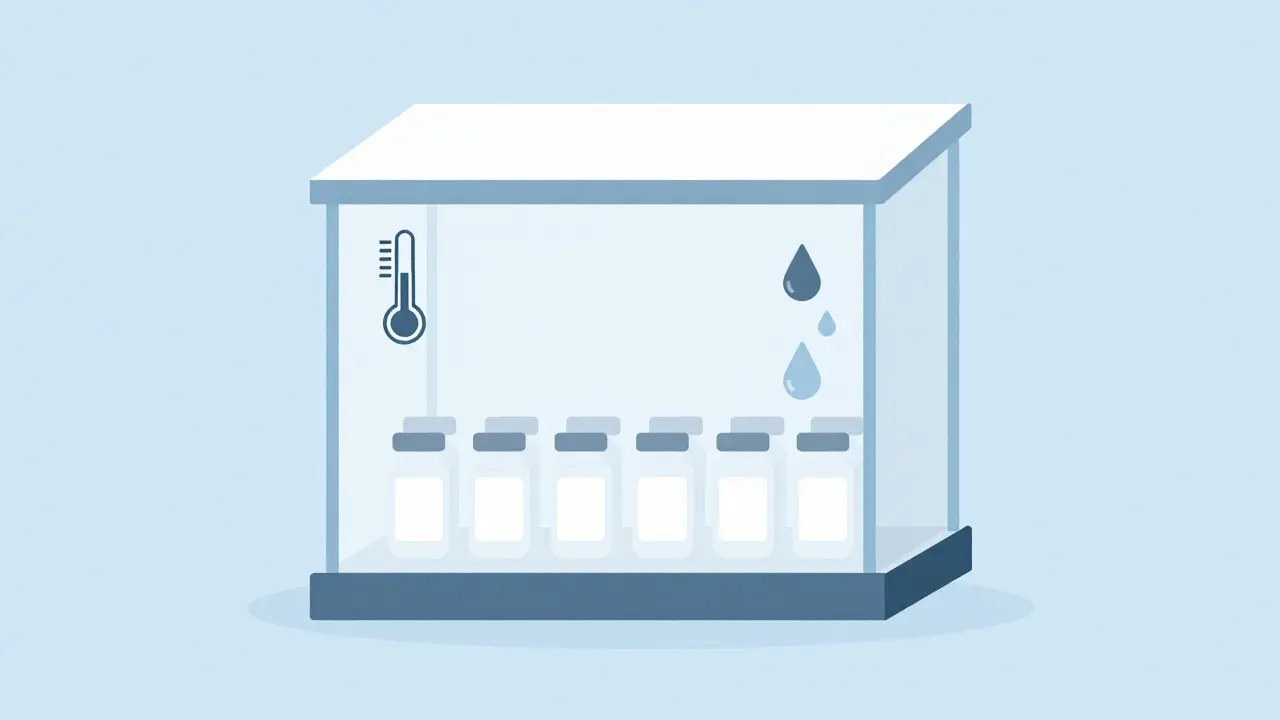
Manufacturers place packaged drug products into specialized stability chambers. These chambers maintain exact temperature and humidity levels defined by ICH Q1A(R2) guidelines. For temperate climates, the standard condition is 25°C ± 2°C with 60% relative humidity (RH) ± 5%. For hot and humid climates, it shifts to 30°C ± 2°C with 65% RH ± 5%. These samples are tested at regular intervals-typically 0, 3, 6, 9, 12, 18, 24, and 36 months-to track any physical, chemical, or microbiological changes.
| Test Type | Temperature | Humidity (RH) | Duration | Purpose |
|---|---|---|---|---|
| Long-Term (Temperate) | 25°C ± 2°C | 60% ± 5% | Up to 36 months | Determine actual shelf life |
| Long-Term (Hot/Humid) | 30°C ± 2°C | 65% ± 5% | Up to 36 months | Shelf life for tropical regions |
| Accelerated | 40°C ± 2°C | 75% ± 5% | 6 months | Predict potential instability |
| Photostability | N/A | N/A | Light exposure | Check light sensitivity |
In addition to long-term studies, companies run accelerated testing at harsher conditions (40°C and 75% RH) for six months. This helps identify potential stability issues early in development. If a drug survives accelerated testing well, it gives developers confidence that it will likely hold up in real-world storage. However, accelerated data alone cannot replace real-time data for setting final expiration dates.
What exactly are scientists looking for? They analyze:
- Physical attributes: Does the tablet crack? Does the color change? Does the pH shift?
- Chemical properties: Is the assay (potency) still within range? Are there new degradation impurities?
- Microbiological characteristics: For non-sterile products, is bacterial growth controlled?
- Dissolution profiles: Does the drug dissolve in the body at the expected rate?
All analytical methods used must be "stability-indicating," meaning they can clearly separate the active ingredient from its breakdown products. This validation follows ICH Q2(R1) guidelines to ensure accuracy.
The Cost of Quality: Investment vs. Risk
Stability testing is expensive. Major pharmaceutical companies typically invest between $500,000 and $2 million annually in stability infrastructure alone. A single comprehensive stability study for one product formulation can cost anywhere from $50,000 to $150,000, according to a 2023 survey by the QbD Group. When you add in the labor of chemists, statisticians, and quality assurance teams, the price tag grows quickly.
But consider the alternative. In 2022, SGS published a case study where stability testing identified a critical interaction between a new biologic drug and its container closure system. The plastic vials were leaching chemicals into the liquid drug, rendering it unsafe. Catching this during testing prevented a potential $500 million product launch failure and, more importantly, protected thousands of patients from harm.
Conversely, cutting corners leads to disaster. A Reddit user working as a stability technician shared a harrowing experience in May 2023: recurring humidity excursions in their stability chambers caused three-month data gaps. This delayed their Abbreviated New Drug Application (ANDA) submission by eight months, costing an estimated $2.3 million in lost market entry time. The lesson? Proper chamber qualification and maintenance are not optional extras; they are foundational.
Challenges in Modern Stability Monitoring
Even with best practices, stability testing faces significant hurdles. One major challenge is equipment reliability. Temperature mapping studies, required quarterly per USP Chapter 1079, cost approximately $8,500 per chamber. If a chamber fails calibration, all data collected during that period may be invalid, forcing companies to restart studies.
Data management is another bottleneck. ICH Q1D requires storing stability data for one year beyond the product's expiration date. For a company with hundreds of products, this creates massive archives. Paper-based systems are slow and error-prone. Companies implementing electronic stability data management systems report reducing data review time by 55%, though validating these digital systems takes 6-9 months of effort.
Complex formulations like biologics present unique difficulties. Unlike small molecule drugs, biologics are large, fragile proteins that degrade through multiple pathways simultaneously. Dr. James Huang, Director of Pharmaceutical Development at Vici Health Sciences, noted in a 2022 review that highly unstable compounds sometimes degrade too rapidly for meaningful data collection, requiring innovative protective formulations.

Future Trends: AI and Continuous Manufacturing
The field is evolving rapidly. The traditional model of waiting 24-36 months for real-time data is being challenged by new technologies. Artificial intelligence and machine learning are beginning to predict degradation pathways with greater accuracy. PhRMA predicts that AI could reduce stability testing timelines by 30-40% by 2027. Imagine uploading historical stability data and having an algorithm forecast shelf life based on molecular structure and packaging materials.
Another major shift is continuous manufacturing. Instead of making drugs in discrete batches, some facilities now produce them continuously. The ICH Q13 guideline, finalized in February 2023, introduces new requirements for evaluating stability in these environments. Rather than testing random batches, manufacturers will need real-time stability monitoring throughout the production line. This approach promises faster feedback loops and higher consistency.
Risk-based approaches are also gaining traction. ICH Q12 principles allow companies to manage post-approval changes more efficiently. A senior quality manager reported on the American Pharmaceutical Review forum that implementing ICH Q12 reduced their stability sample sizes by 40% while maintaining data integrity, saving roughly $120,000 annually per product. This doesn't mean less safety; it means smarter, targeted testing based on known risks.
Best Practices for Effective Stability Programs
If you are involved in pharmaceutical quality assurance, here are actionable steps to strengthen your stability program:
- Invest in Chamber Qualification: Perform initial installation, operational, and performance qualifications (IQ/OQ/PQ). Conduct quarterly temperature mapping to detect cold spots or humidity fluctuations.
- Validate Analytical Methods Early: Ensure your HPLC or GC methods are truly stability-indicating. If you can't separate degradants from the API, your data is useless.
- Adopt Electronic Data Systems: Move away from paper logs. Use validated software that tracks chain-of-custody and prevents unauthorized edits.
- Train Staff on OOS Investigations: Out-of-specification results happen. Have a clear, documented procedure for investigating deviations without bias.
- Review Container Closure Systems: Don't assume the package is inert. Test interactions between the drug and its primary packaging material.
Remember, stability testing is not a one-time event. It is a lifecycle commitment. As Dr. Jennifer Orme, VP of Quality at Pfizer, stated, robust stability programs have reduced post-market recalls by 31% since 2015. That statistic speaks volumes about the value of diligent, long-term monitoring.
How long does stability testing take for a new drug?
For new molecular entities, real-time stability testing typically runs for 24 to 36 months to establish a definitive shelf life. Accelerated testing provides preliminary data in 6 months, but regulators require long-term data for final approval.
What is the difference between accelerated and long-term stability testing?
Long-term testing simulates normal storage conditions (e.g., 25°C/60% RH) over years to determine actual shelf life. Accelerated testing uses harsher conditions (40°C/75% RH) for 6 months to quickly identify potential instability issues early in development.
Why do some drugs fail stability testing?
Common reasons include moisture absorption causing hydrolysis, oxidation due to poor packaging, light sensitivity leading to photodegradation, or chemical interactions between the active ingredient and excipients.
Can stability testing be outsourced?
Yes, 72% of pharmaceutical companies outsource part or all of their stability testing to Contract Research Organizations (CROs) like SGS or Eurofins. This allows smaller firms to access specialized infrastructure without huge capital investments.
What happens if a stability test shows an out-of-specification result?
An immediate investigation is triggered under cGMP rules. The lab must verify the result, check for procedural errors, and if confirmed, assess the impact on product safety and efficacy. This may lead to batch rejection or revised expiration dates.